
We read your photo as:
Given f(x) = (7)/(x² + 3).
Mathematics
ScanSolve AI Answer
Answer
Use the left and right arrow keys to trace the curve, up and down to jump between key points, and plus and minus to zoom.
| Point | x | y |
|---|---|---|
| Maximum | 0 | 2.33 |
Step-by-step solution
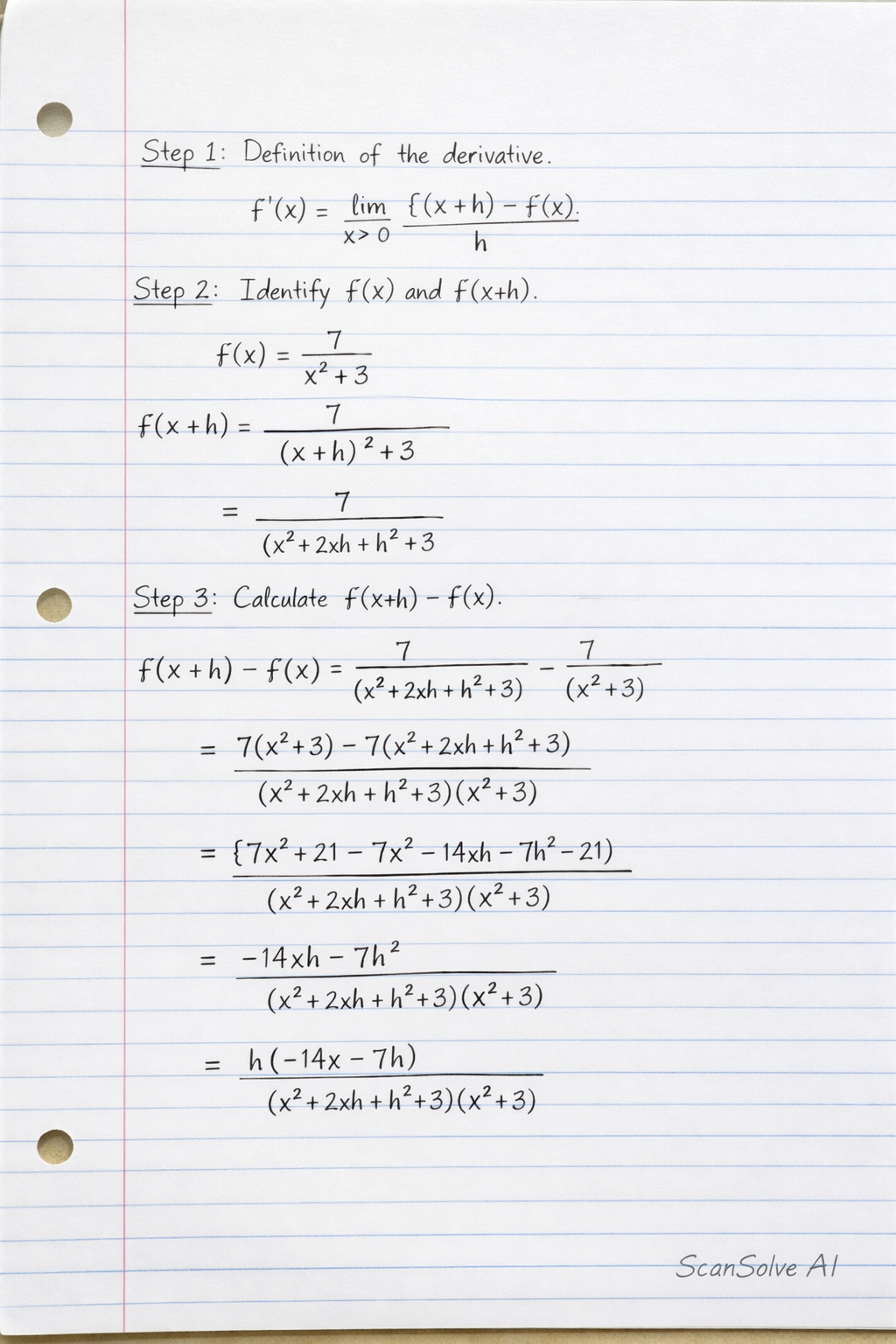
5 stepsWrite down the definition of the derivative from first principles.
The derivative of a function is given by:
Identify and .
Given .
Substitute into to find :Calculate .
To subtract the fractions, find a common denominator:
Expand the numerator:
Simplify the numerator:
Factor out from the numerator:
Divide by .
Cancel out :
Take the limit as .
Substitute into the expression:
The derivative of from first principles is:
Was this helpful?
Try one yourself
A new problem that tests the same skill.
Still stuck on this one?
Ask a follow-up, and the answer starts from this question.
Got a different question?Ask your own question
More Mathematics Questions
Handwritten Step-by-Step Solution
Get this as a handwritten image on WhatsApp — like a tutor wrote it for you.
Try on WhatsApp