
We read your photo as:
Given masses: m1 = 1 kg, m2 = 2 kg.
Mathematics
ScanSolve AI Answer
Step-by-step solution
6 stepslet's tackle these physics problems.
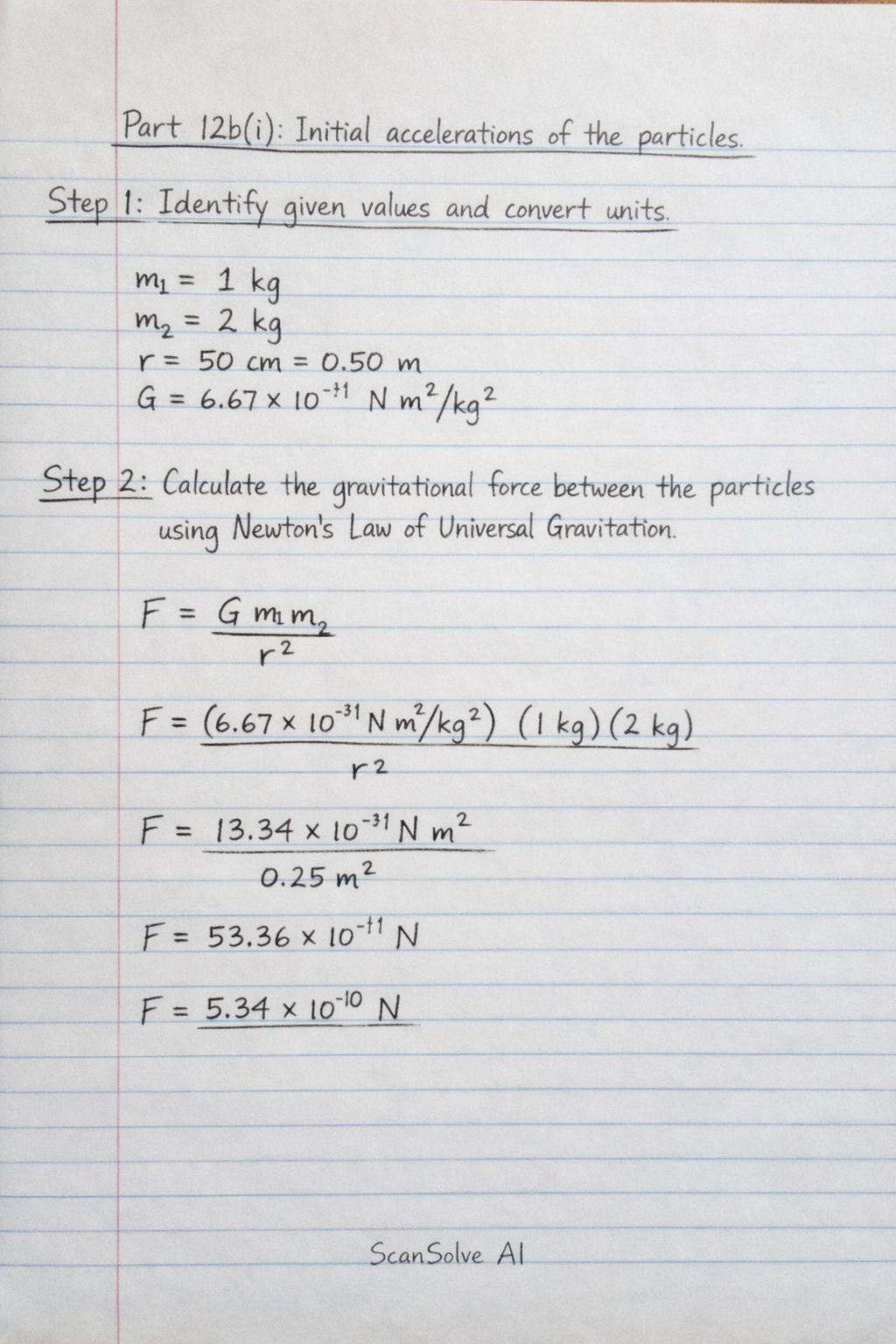
Part 12b(i): Initial accelerations of the particles
Identify given values and convert units.
Given masses: , .
Separation distance: .
Gravitational constant: .Calculate the gravitational force between the particles using Newton's Law of Universal Gravitation.
The formula is .
Calculate the initial acceleration of each particle using Newton's Second Law ().
For the first particle ():
For the second particle ():
The initial accelerations are:
Part 12b(ii): Escape velocity from the moon
Identify given values and convert units.
Mass of the moon: .
Radius of the moon: .
Gravitational constant: .Calculate the escape velocity using the formula .
Round the result to an appropriate number of significant figures.
The escape velocity from the moon is:
Was this helpful?
Still stuck on this one?
Ask a follow-up, and the answer starts from this question.
Got a different question?Ask your own question
More Mathematics Questions
QMass of object 1, m₁ = 8 kgQTwo bodies of masses m1 and m2 are acted upon by equal forces F for equal time t. If the ratio of…QTwo bodies of masses M1 and M2 are connected to a ceiling as illustrated in the diagram below. The…QA horizontal force is applied to a system of two blocks (m1 = 300g, m2 = 500g) resting on a…QTwo masses 2kg and 1.5kg are tied to the ends of a light inextensible string which passes over a…
Handwritten Step-by-Step Solution
Get this as a handwritten image on WhatsApp — like a tutor wrote it for you.
Try on WhatsApp