We read your photo as:

Given p = 5 −7 , q = -1 3 , and r = 2 1 .

Mathematics

ScanSolve AI Answer

Answers

3 parts
1

(13−16)\begin{pmatrix} 13 \\ -16 \end{pmatrix}

2

3i + 2j

3

−35i+45j-\frac{3}{5}i + \frac{4}{5}j

Step-by-step solution

7 steps

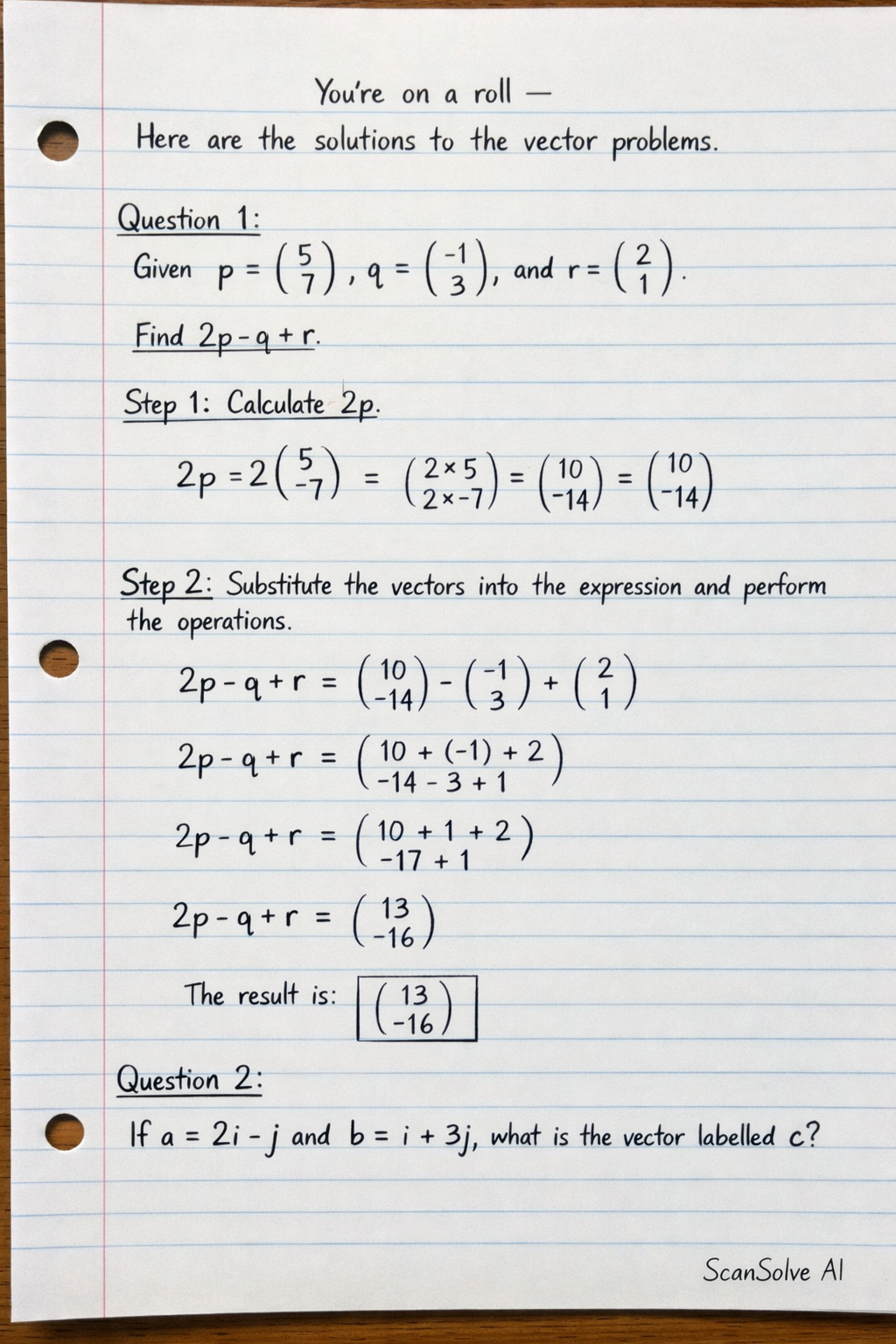
Here are the solutions to the vector problems.

Part 1· 2 steps

Given p=(5−7)p = \begin{pmatrix} 5 \\ -7 \end{pmatrix}, q=(−13)q = \begin{pmatrix} -1 \\ 3 \end{pmatrix}, and r=(21)r = \begin{pmatrix} 2 \\ 1 \end{pmatrix}.
Find 2p−q+r2p - q + r.

  1. Calculate $2p$.

    2p=2(5−7)=(2×52×−7)=(10−14)2p = 2 \begin{pmatrix} 5 \\ -7 \end{pmatrix} = \begin{pmatrix} 2 \times 5 \\ 2 \times -7 \end{pmatrix} = \begin{pmatrix} 10 \\ -14 \end{pmatrix}
  2. Substitute the vectors into the expression and perform the operations.

    2p−q+r=(10−14)−(−13)+(21)2p - q + r = \begin{pmatrix} 10 \\ -14 \end{pmatrix} - \begin{pmatrix} -1 \\ 3 \end{pmatrix} + \begin{pmatrix} 2 \\ 1 \end{pmatrix} 2p−q+r=(10−(−1)+2−14−3+1)2p - q + r = \begin{pmatrix} 10 - (-1) + 2 \\ -14 - 3 + 1 \end{pmatrix} 2p−q+r=(10+1+2−17+1)2p - q + r = \begin{pmatrix} 10 + 1 + 2 \\ -17 + 1 \end{pmatrix} 2p−q+r=(13−16)2p - q + r = \begin{pmatrix} 13 \\ -16 \end{pmatrix}

    The result is:

    (13−16)\boxed{\begin{pmatrix} 13 \\ -16 \end{pmatrix}}

Part 23i + 2j

If a=2i−ja = 2i - j and b=i+3jb = i + 3j, what is the vector labelled cc?

  1. Identify the relationship between vectors aa, bb, and cc from the diagram.

    The diagram shows a parallelogram where aa and bb are adjacent sides originating from the same point. Vector cc is the diagonal originating from that same point. According to the parallelogram law of vector addition, cc is the sum of aa and bb.

    c=a+bc = a + b
  2. Substitute the given vector components and add them.

    c=(2i−j)+(i+3j)c = (2i - j) + (i + 3j) c=(2+1)i+(−1+3)jc = (2+1)i + (-1+3)j c=3i+2jc = 3i + 2j

    The vector cc is:

    3i+2j\boxed{3i + 2j}

Part 3

−35i+45j-\frac{3}{5}i + \frac{4}{5}j

Find a unit vector in the opposite direction of vv, given vector v=6i−8jv = 6i - 8j.

  1. Calculate the magnitude of vector vv.

    ∣v∣=62+(−8)2|v| = \sqrt{6^2 + (-8)^2} ∣v∣=36+64|v| = \sqrt{36 + 64} ∣v∣=100|v| = \sqrt{100} ∣v∣=10|v| = 10
  2. Find the unit vector in the direction of vv.

    v^=v∣v∣=6i−8j10\hat{v} = \frac{v}{|v|} = \frac{6i - 8j}{10} v^=610i−810j\hat{v} = \frac{6}{10}i - \frac{8}{10}j v^=35i−45j\hat{v} = \frac{3}{5}i - \frac{4}{5}j
  3. Find the unit vector in the opposite direction of vv.

    This is −v^-\hat{v}.

    −v^=−(35i−45j)-\hat{v} = - \left( \frac{3}{5}i - \frac{4}{5}j \right) −v^=−35i+45j-\hat{v} = -\frac{3}{5}i + \frac{4}{5}j

    The unit vector in the opposite direction of vv is:

    −35i+45j\boxed{-\frac{3}{5}i + \frac{4}{5}j}

Part 4

The image provided cuts off the rest of Question 4. Please send the complete question for me to solve it.

Was this helpful?

Try one yourself

A new problem that tests the same skill.

Still stuck on this one?

Ask a follow-up, and the answer starts from this question.

Got a different question?Ask your own question
Handwritten step-by-step solution preview

Handwritten Step-by-Step Solution

Get this as a handwritten image on WhatsApp — like a tutor wrote it for you.

Try on WhatsApp