
We read your photo as:
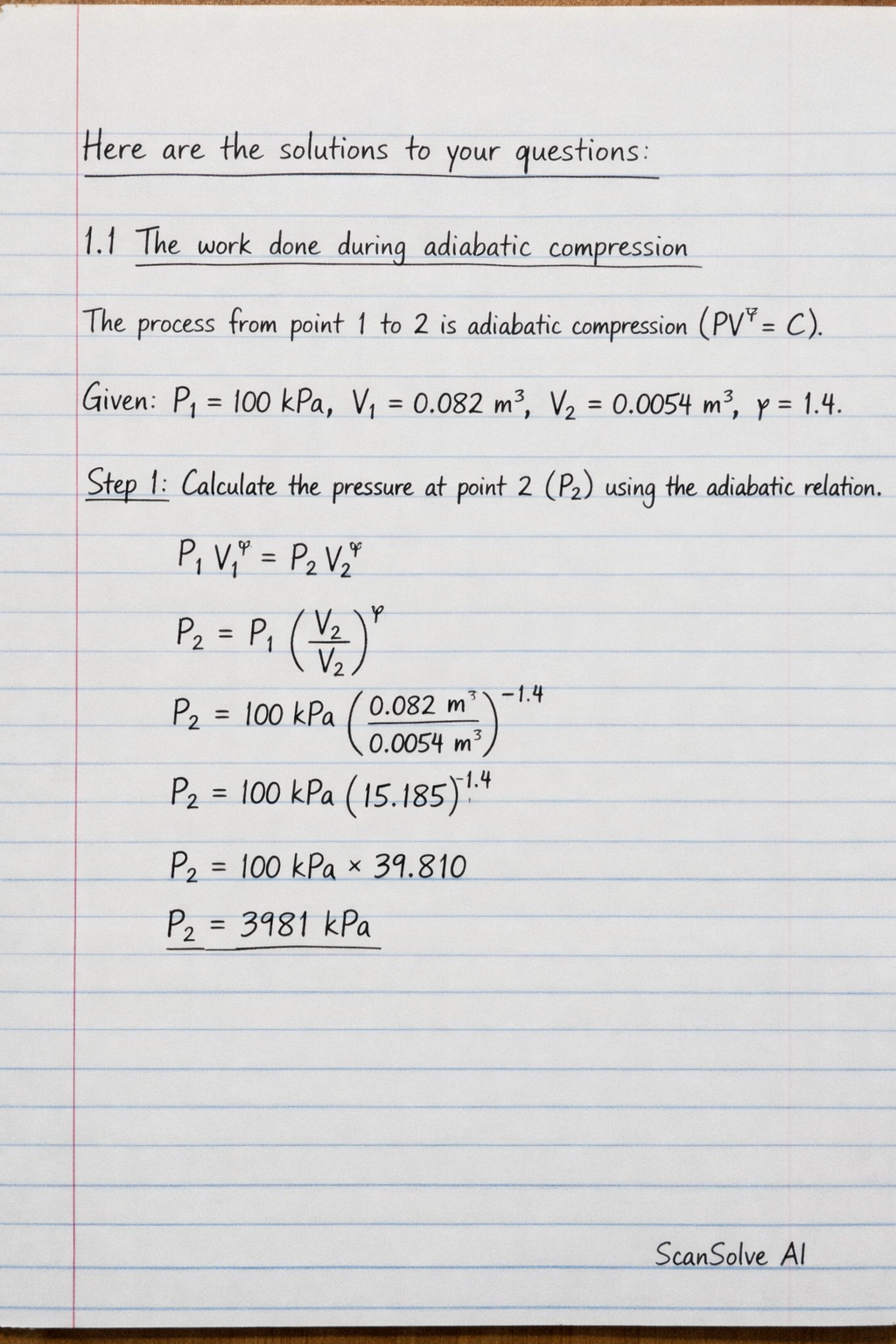
Given: P1 = 100 kPa, V1 = 0.082 m³, V₂ = 0.0054 m³, gamma = 1.4.
ScanSolve AI Answer
Answers
2 partsStep-by-step solution
5 stepsHere are the solutions to your questions:
Part 1.1· 2 steps
The work done during adiabatic compression
The process from point 1 to 2 is adiabatic compression ().
Given: , , , .
Calculate the pressure at point 2 () using the adiabatic relation.
Calculate the work done during the adiabatic compression.
The work done for a reversible adiabatic process is given by:
The negative sign indicates work is done on the gas.
Part 1.2
The work done during the constant pressure process
The process from point 3 to 4 is a constant pressure process.
Given: , , .
Calculate the work done for the constant pressure process.
Part 1.3· 2 steps
The volume at point 3 and point 5 in litres
From the diagram: and .
To convert from cubic meters to litres, multiply by 1000 ().
Convert to litres.
Convert to litres.
Try one yourself
A new problem that tests the same skill.
Still stuck on this one?
Ask a follow-up, and the answer starts from this question.
More Mathematics Questions
Handwritten Step-by-Step Solution
Get this as a handwritten image on WhatsApp — like a tutor wrote it for you.
Try on WhatsApp