
We read your photo as:
Given R1 = 6 and R2 = 12 .
Mathematics
ScanSolve AI Answer
Answer
Step-by-step solution
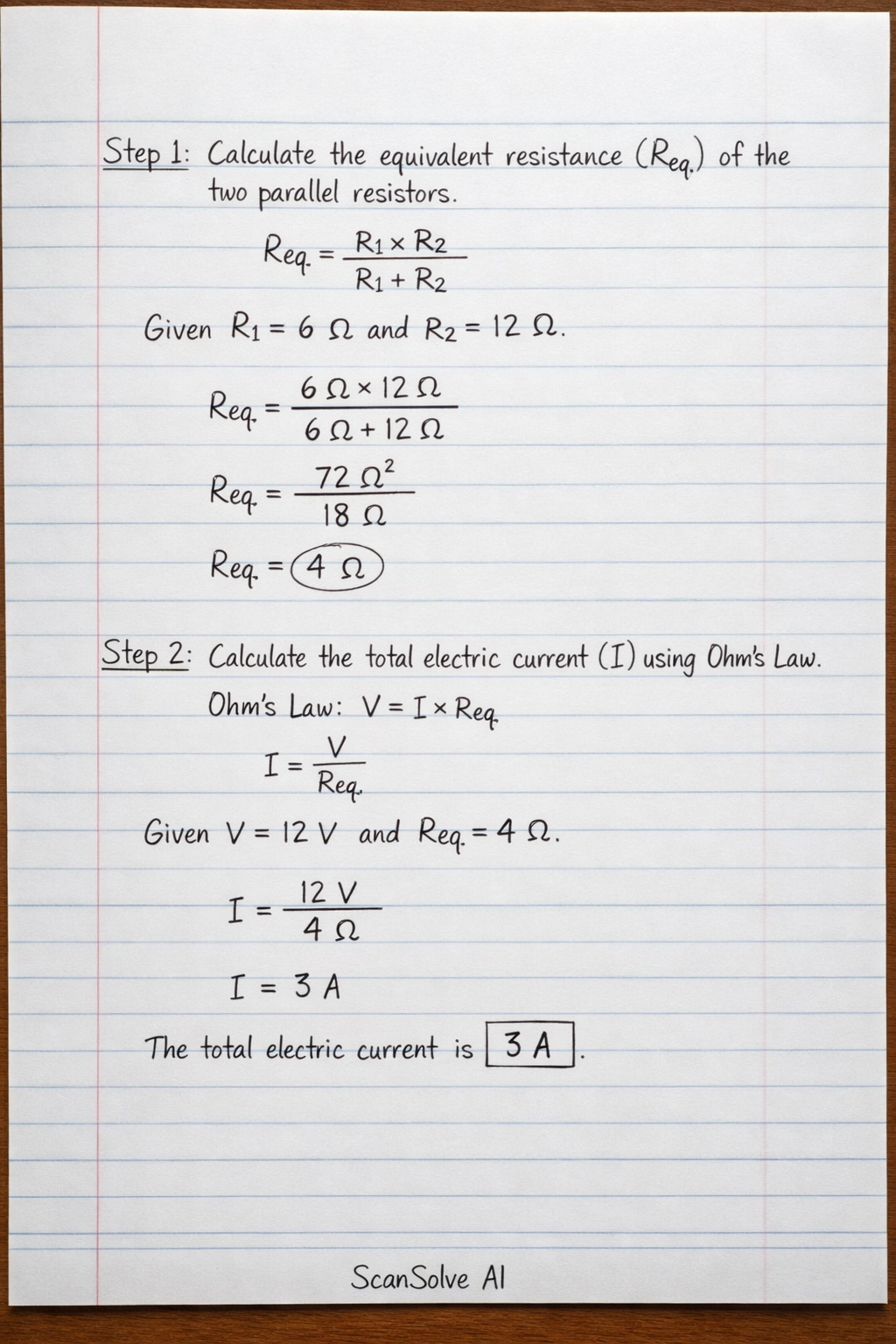
2 stepsCalculate the equivalent resistance () of the two parallel resistors.
The formula for two resistors in parallel is:
Given and .
Calculate the total electric current () using Ohm's Law.
Ohm's Law states , so .
Given the voltage and the equivalent resistance .The total electric current is .
Was this helpful?
Try one yourself
A new problem that tests the same skill.
Still stuck on this one?
Ask a follow-up, and the answer starts from this question.
Got a different question?Ask your own question
More Mathematics Questions
QCalculate the equivalent resistance of two resistors, R1 = 300 Ω and R2 = 200 Ω, connected in…QTwo resistors R1 and R2 are connected in parallel. The equivalent resistance is given by:QCalculate the equivalent resistance between points A and B in the provided circuit diagram. Given…QSet E1=24V, R1=12 oHMS, E2=12V, R2=8 ohms, R3=4 ohms. Solve for the currents using NODAL ANALYSIS.QCalculate R, V, R1=202, R2=502 Series and Parallel Calculation
Handwritten Step-by-Step Solution
Get this as a handwritten image on WhatsApp — like a tutor wrote it for you.
Try on WhatsApp