
We read your photo as:
Given radius r = 4 m.
ScanSolve AI Answer
Answer
Step-by-step solution
5 stepsTo show that m, we need to equate the perimeter of the parallelogram to the circumference of the circle.
Calculate the circumference of the circle.
The formula for the circumference of a circle is .
Given radius m.Set up the expression for the perimeter of the parallelogram.
The formula for the perimeter of a parallelogram is , where and are the lengths of the adjacent sides.
Given sides are 6.51 m and m.Equate the perimeter of the parallelogram to the circumference of the circle.
Solve for .
Divide both sides by 2:
Subtract 6.51 from both sides:
Calculate the numerical value of and round to 2 decimal places.
Using the value of :
Rounding to 2 decimal places, we look at the third decimal place. Since it is 6 (which is 5 or greater), we round up the second decimal place.
Thus, we have shown that .
Try one yourself
A new problem that tests the same skill.
Still stuck on this one?
Ask a follow-up, and the answer starts from this question.
More Mathematics Questions
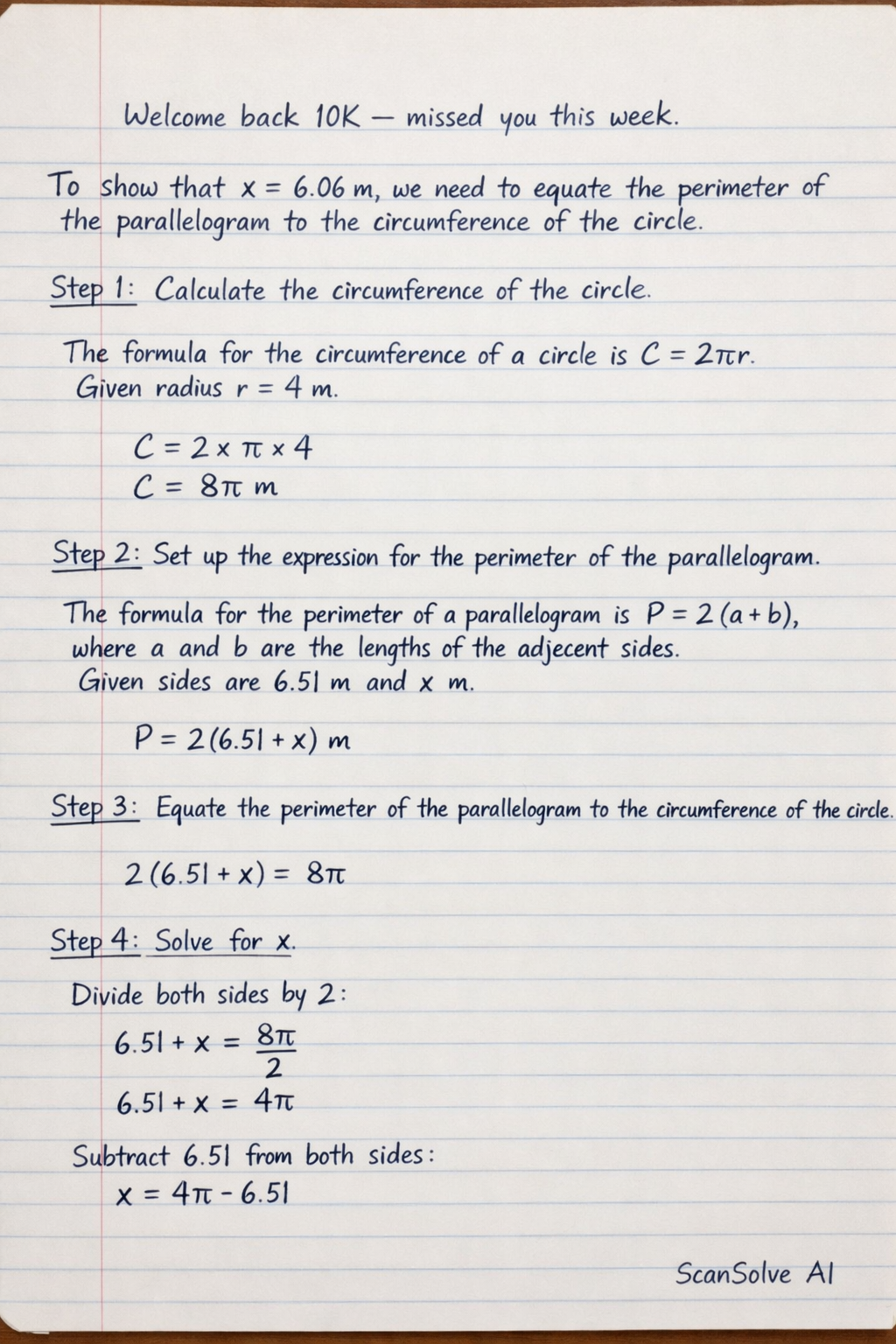
Handwritten Step-by-Step Solution
Get this as a handwritten image on WhatsApp — like a tutor wrote it for you.
Try on WhatsApp