
We read your photo as:
Given that (1)/(a), (1)/(b), (1)/(c) are in A.P., we can write:
ScanSolve AI Answer
Answer
Step-by-step solution
4 stepsUnderstand the property of an Arithmetic Progression (A.P.).
If three terms are in A.P., then the middle term is the average of the other two, or equivalently, the common difference between consecutive terms is constant. This means , which simplifies to .
Apply the A.P.
property to the given terms.
Given that are in A.P., we can write:Simplify the right side by finding a common denominator:
Express the common difference.
The common difference, , can be found by subtracting any term from its succeeding term. Let's use the first two terms:
Substitute the relationship from Step 2 into the common difference expression and simplify.
From Step 2, we have . This means .
Substitute this expression for into the equation for :To subtract these fractions, find a common denominator, which is :
Combine the numerators:
Thus, the common difference is .
Try one yourself
A new problem that tests the same skill.
Still stuck on this one?
Ask a follow-up, and the answer starts from this question.
More Mathematics Questions
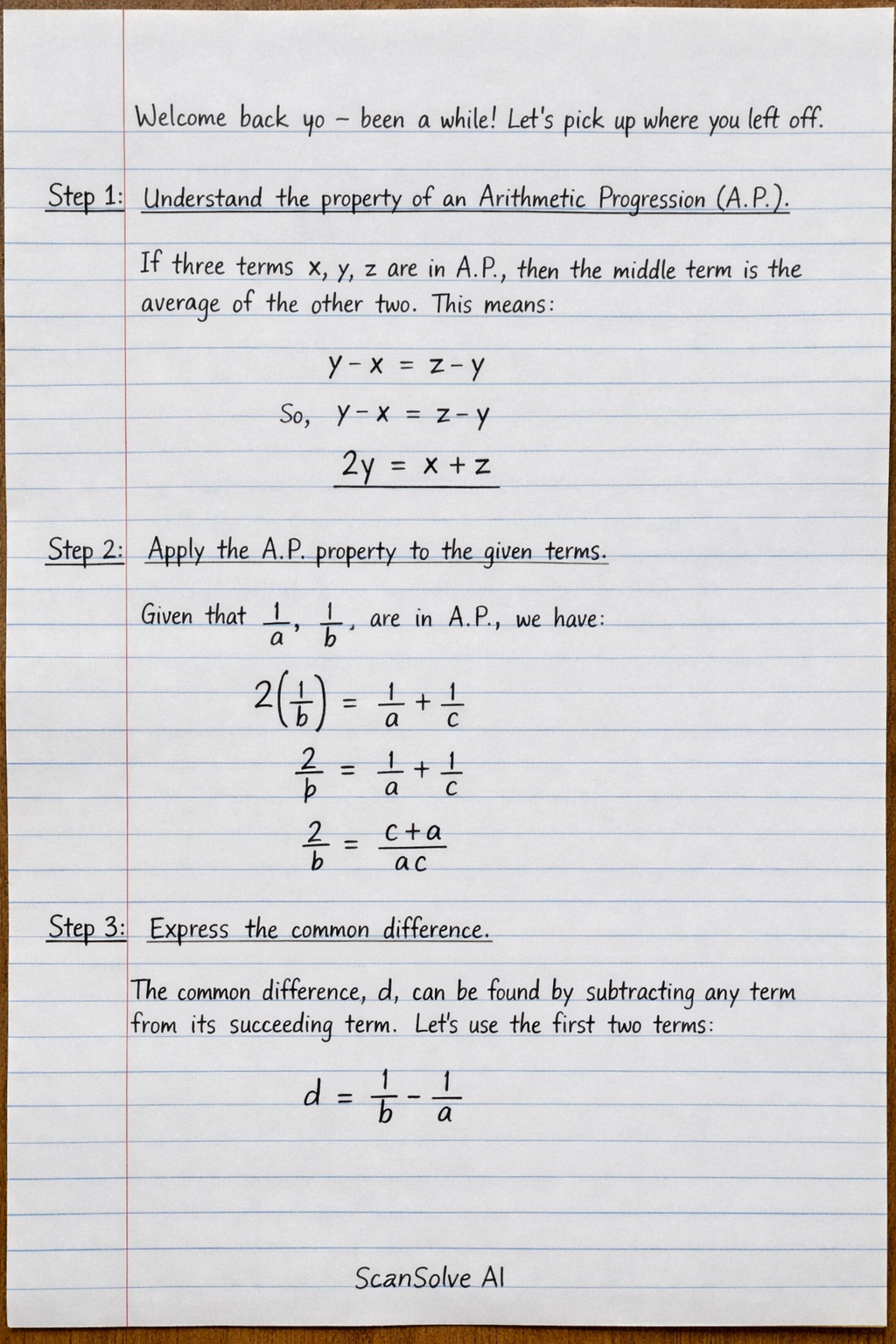
Handwritten Step-by-Step Solution
Get this as a handwritten image on WhatsApp — like a tutor wrote it for you.
Try on WhatsApp