
We read your photo as:
Given that (4x - 1), (2x + 5) and (5x + 11) are consecutive terms of an Arithmetic Progression (A. P.). Find the values of x.
Mathematics
ScanSolve AI Answer
Step-by-step solution
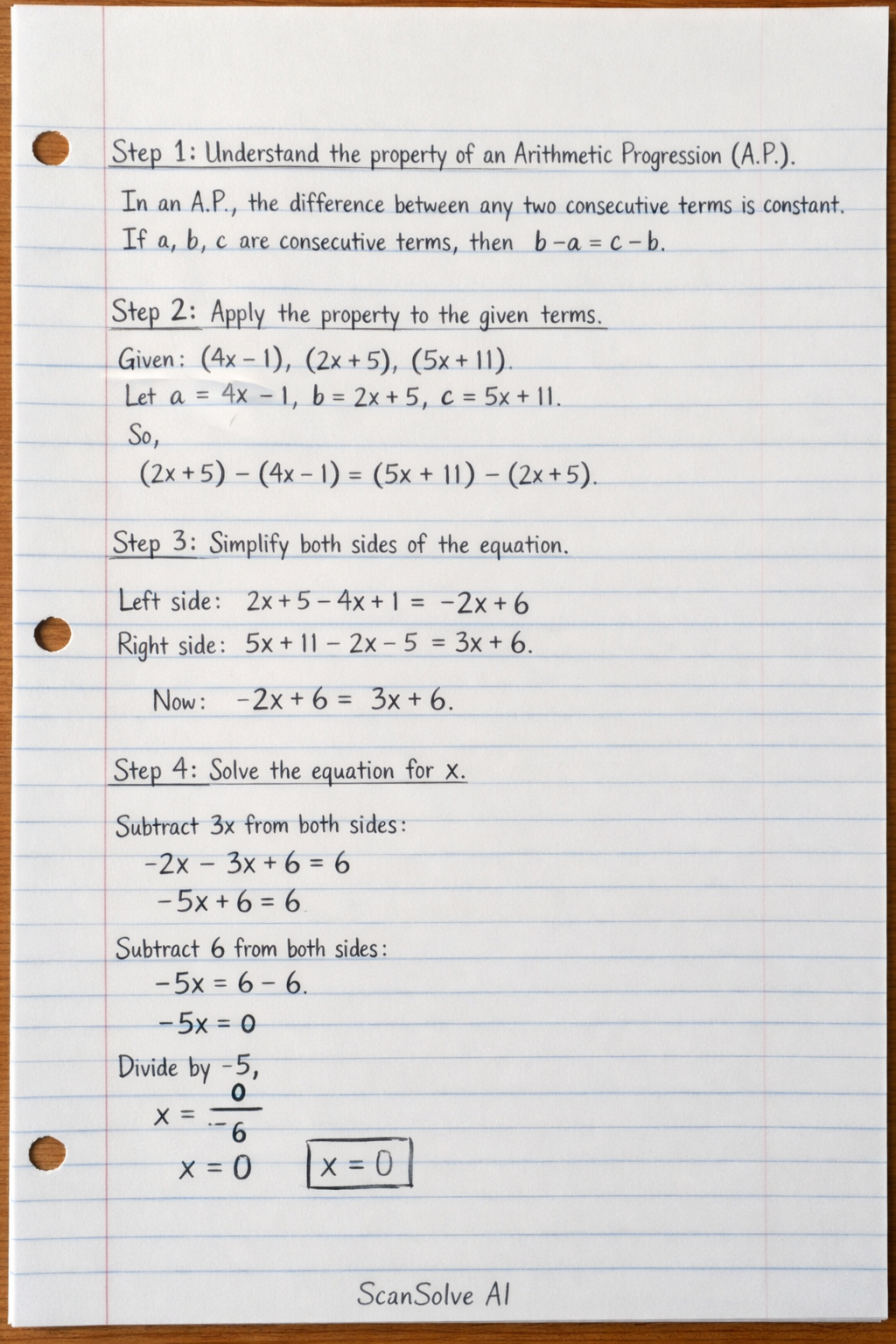
4 stepsUnderstand the property of an Arithmetic Progression (A.P.).
In an Arithmetic Progression, the difference between any two consecutive terms is constant. If , , and are consecutive terms of an A.P., then .
Apply the property to the given terms.
Given the consecutive terms are , , and .
Let , , and .
So, we can write the equation:Simplify both sides of the equation.
For the left side:
For the right side:
Now the equation is:
Solve the equation for .
Subtract from both sides:
Subtract 6 from both sides:
Divide by -5:
Was this helpful?
Still stuck on this one?
Ask a follow-up, and the answer starts from this question.
Got a different question?Ask your own question
More Mathematics Questions
QGiven that (2x+1), (7x+1) and (10x+1) are the first three consecutive terms of an AP. Find the value…QGiven that (x + 2), (4x + 3) and (7x + 24) are consecutive terms of a Geometric Progression (G.P)…QA) To find the value of x, we use the property of an arithmetic progression (A.P.) that the common…QA geometric progression has consecutive terms 3^(2x+1), 9^x, and 81. Find x, the common ratio, and…QSolve the following algebraic equations and number patterns: 1) (2 + x) × 4 = 48, 2) (x − 12) / 3…
Browse by topic:Pre-Calculus
Handwritten Step-by-Step Solution
Get this as a handwritten image on WhatsApp — like a tutor wrote it for you.
Try on WhatsApp