
We read your photo as:
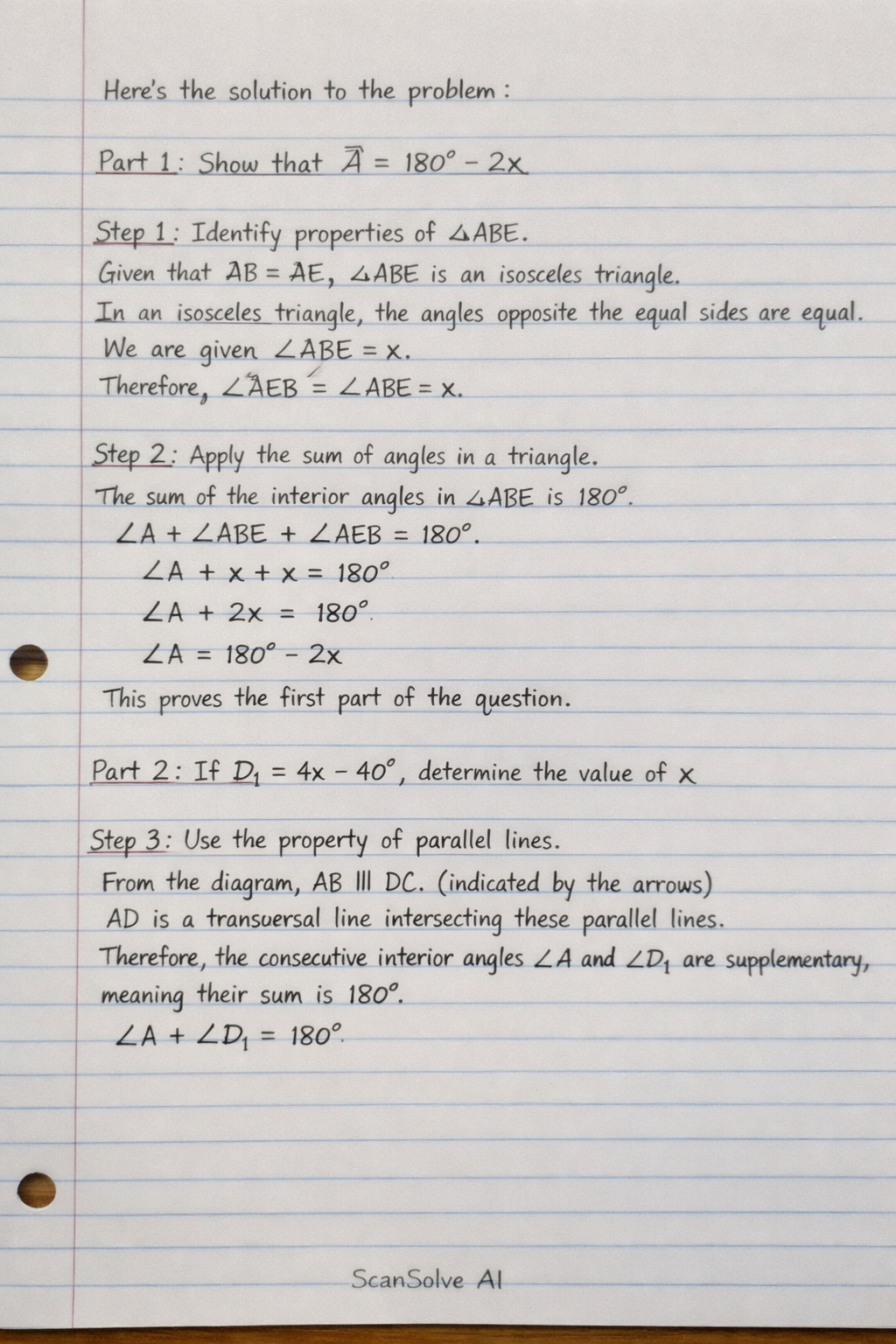
Given that AB = AE, ABE is an isosceles triangle. In an isosceles triangle, the angles opposite the equal sides are equal.
ScanSolve AI Answer
Answers
2 partsStep-by-step solution
4 stepsHere's the solution to the problem:
Part 1· 2 steps
Show that
Identify properties of .
Given that , is an isosceles triangle. In an isosceles triangle, the angles opposite the equal sides are equal.
We are given .
Therefore, .Apply the sum of angles in a triangle.
The sum of the interior angles in is .
Substitute the known angle values:
This proves the first part of the question.
Part 2
If , determine the value of
Use the property of parallel lines.
From the diagram, (indicated by the arrows on the lines). AD is a transversal line intersecting these parallel lines.
Therefore, the consecutive interior angles and are supplementary, meaning their sum is .Substitute the expressions for and and solve for .
Substitute (from Part 1) and (given):
Combine like terms:
Subtract from both sides:
Divide by 2:
Try one yourself
A new problem that tests the same skill.
Still stuck on this one?
Ask a follow-up, and the answer starts from this question.
More Mathematics Questions
Handwritten Step-by-Step Solution
Get this as a handwritten image on WhatsApp — like a tutor wrote it for you.
Try on WhatsApp