
We read your photo as:
Given that (x-3) is a factor of F(x) = ax3 + bx2 − 9x − 9, we must have F(3) = 0.
Mathematics
ScanSolve AI Answer
Step-by-step solution
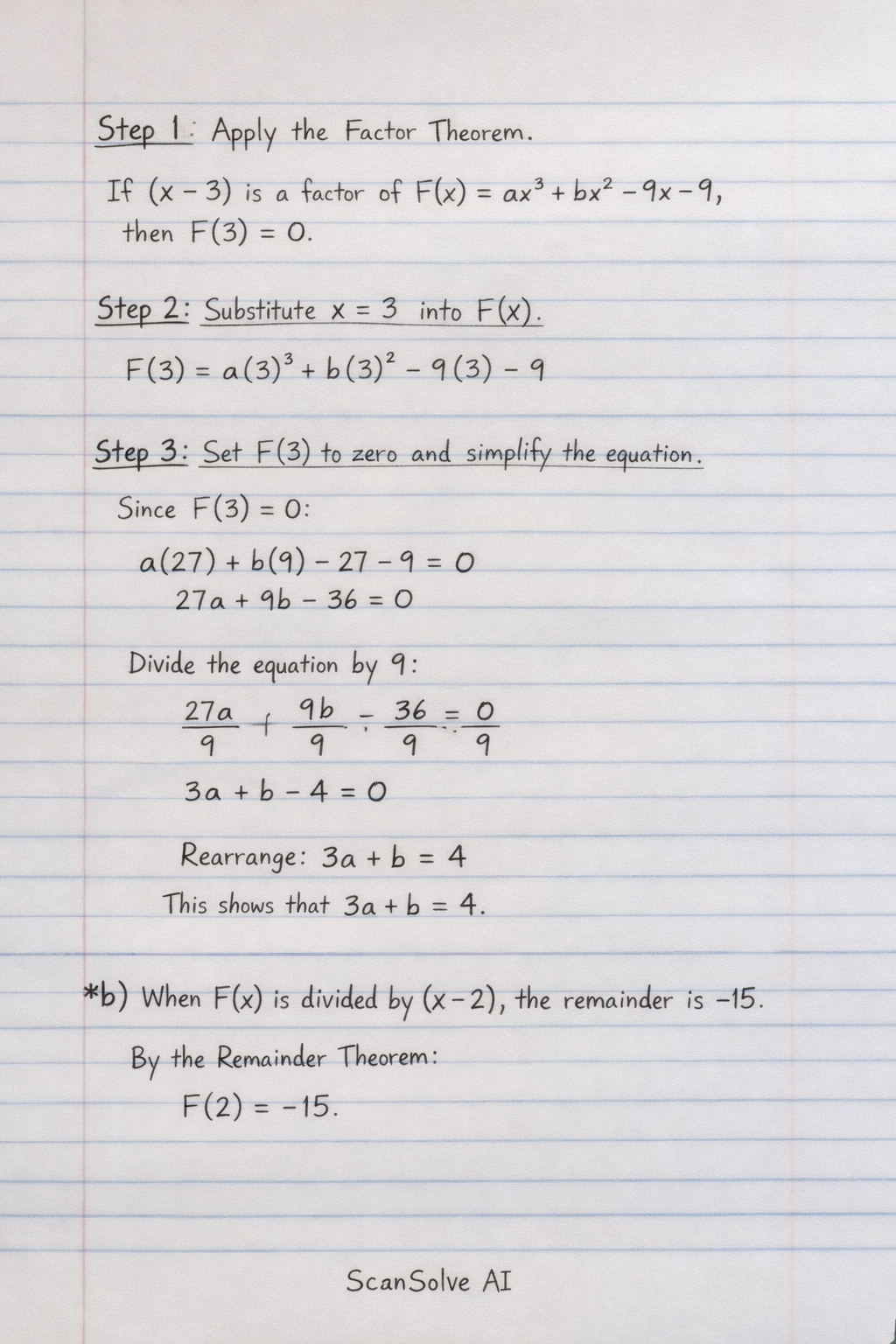
3 stepsApply the Factor Theorem.
The Factor Theorem states that if is a factor of a polynomial , then .
Given that is a factor of , we must have .Substitute into .
Substitute into the polynomial :
Set to zero and simplify the equation.
Since :
Divide the entire equation by 9:
Rearrange the equation to match the required form:
This shows that .
b) When is divided by , the remainder is . This is a given condition. By the Remainder Theorem, this means .
Was this helpful?
Still stuck on this one?
Ask a follow-up, and the answer starts from this question.
Got a different question?Ask your own question
More Mathematics Questions
QGiven that (x−1) is a factor of f(x) = ax⁴ + x³ − 12x² − x + 2, by the Factor Theorem, f(1) = 0.QLet f(x) = ax3 - x2 + bx + 6. If (x+2) is a factor of f(x) and the remainder when f(x) is divided by…QGiven that (x+1) is a factor of f(x) = x3 + 4x2 + 5x + c.QGiven that (3x+2) is a factor of P(x) = 18x³ + bx² - x − 2, we set 3x+2=0 to find the root.QFind the equation of the function f(x) = −x3 + ax2 + bx + c given that it has a point of inflection…
Handwritten Step-by-Step Solution
Get this as a handwritten image on WhatsApp — like a tutor wrote it for you.
Try on WhatsApp