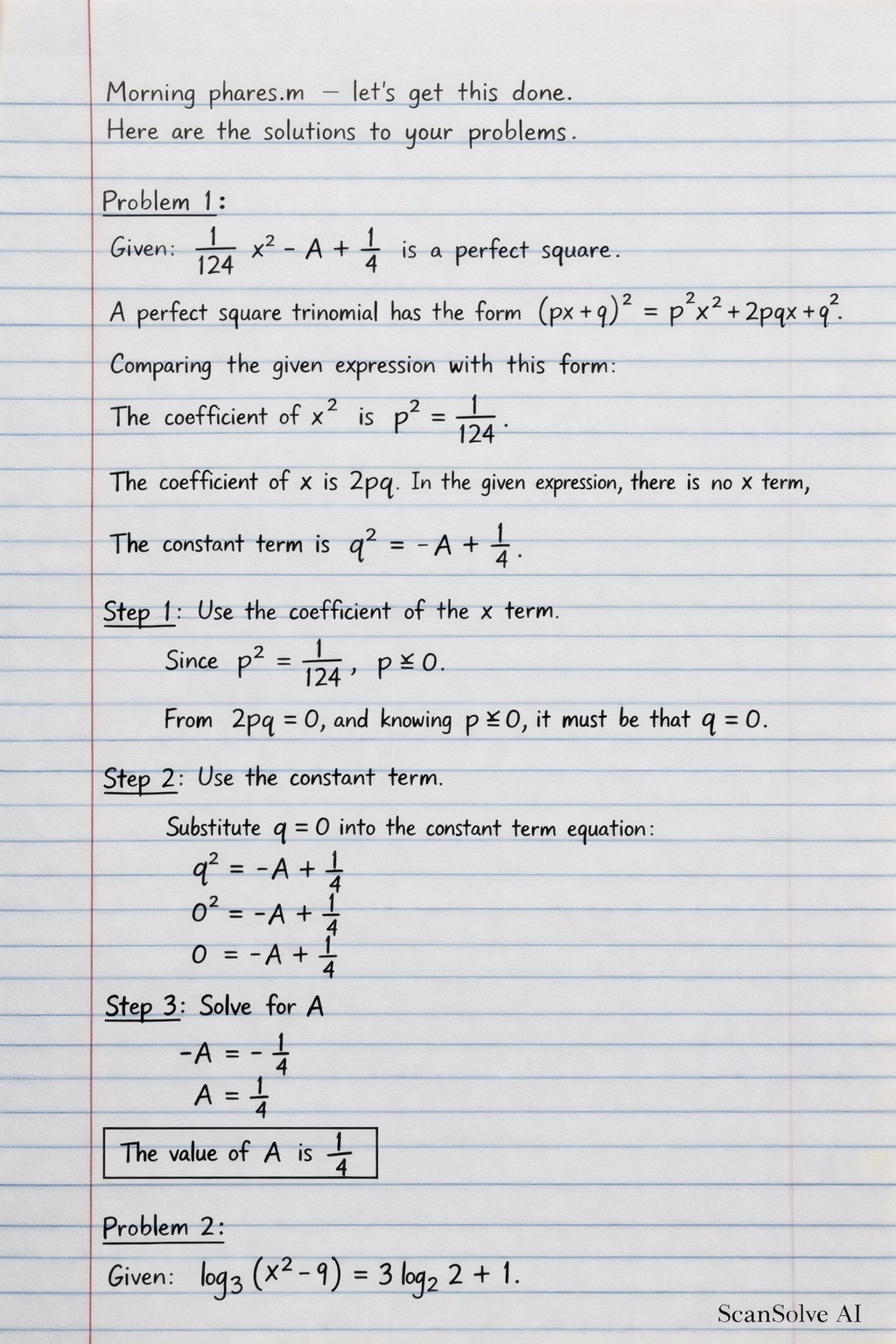
Morning phares.m — let's get this done.
Here are the solutions to your problems.
Problem 1:
Given the expression $\frac{1}{124} x^2 - A + \frac{1}{4}$ is a perfect square.
A perfect square trinomial has the form $(px+q)^2 = p^2x^2 + 2pqx + q^2$.
Com…
Given the expression (1)/(124) x^2 - A + (1)/(4) is a perfect square.
This mathematics problem involves applying core mathematical principles and formulas. Below you will find a complete step-by-step solution with detailed explanations for each step, helping you understand not just the answer but the method behind it.
ScanSolve AI Answer
Morning phares.m — let's get this done.
Here are the solutions to your problems.
Problem 1:
Given the expression $\frac{1}{124} x^2 - A + \frac{1}{4}$ is a perfect square.
A perfect square trinomial has the form $(px+q)^2 = p^2x^2 + 2pqx + q^2$.
Comparing the given expression with this form:
The coefficient of $x^2$ is $p^2 = \frac{1}{124}$.
The coefficient of $x$ is $2pq$. In the given expression, there is no $x$ term, so its coefficient is $0$. Thus, $2pq = 0$.
The constant term is $q^2 = -A + \frac{1}{4}$.
Step 1: Use the coefficient of the $x$ term.
Since $p^2 = \frac{1}{124}$, $p$ cannot be $0$.
From $2pq = 0$, and knowing $p \neq 0$, it must be that $q = 0$.
Step 2: Use the constant term.
Substitute $q=0$ into the constant term equation:
$q^2 = -A + \frac{1}{4}$
$0^2 = -A + \frac{1}{4}$
$0 = -A + \frac{1}{4}$
Step 3: Solve for $A$.
$A = \frac{1}{4}$
The value of $A$ is $\boxed{\frac{1}{4}}$.
---
Problem 2:
Given the equation $\log_3 (x^2-9) = 3\log_2 2 + 1$.
Step 1: Simplify the right-hand side (RHS) of the equation.
Recall that $\log_b b = 1$. Therefore, $\log_2 2 = 1$.
RHS $= 3(1) + 1 = 3 + 1 = 4$.
Step 2: Rewrite the equation with the simplified RHS.
$\log_3 (x^2-9) = 4$.
Step 3: Convert the logarithmic equation to an exponential equation.
If $\log_b y = z$, then $y = b^z$.
So, $x^2-9 = 3^4$.
Step 4: Calculate $3^4$.
$3^4 = 3 \times 3 \times 3 \times 3 = 81$.
Step 5: Solve for $x$.
$x^2 - 9 = 81$
$x^2 = 81 + 9$
$x^2 = 90$
$x = \pm\sqrt{90}$
Step 6: Simplify the square root.
$\sqrt{90} = \sqrt{9 \times 10} = \sqrt{9} \times \sqrt{10} = 3\sqrt{10}$.
So, $x = \pm 3\sqrt{10}$.
Step 7: Check the domain of the logarithm.
For $\log_3 (x^2-9)$ to be defined, the argument must be positive: $x^2-9 > 0$.
This means $x^2 > 9$.
If $x = 3\sqrt{10}$, then $x^2 = (3\sqrt{10})^2 = 9 \times 10 = 90$. Since $90 > 9$, this solution is valid.
If $x = -3\sqrt{10}$, then $x^2 = (-3\sqrt{10})^2 = 9 \times 10 = 90$. Since $90 > 9$, this solution is also valid.
The values of $x$ are $\boxed{\pm 3\sqrt{10}}$.
Send me the next one 📸
Given the expression (1)/(124) x^2 - A + (1)/(4) is a perfect square.
|Mathematics
Given the expression (1)/(124) x^2 - A + (1)/(4) is a perfect square.
ScanSolve AI Answer
Verified
Morning phares.m — let's get this done.
Here are the solutions to your problems.
Problem 1:
Given the expression 1241x2−A+41 is a perfect square.
A perfect square trinomial has the form (px+q)2=p2x2+2pqx+q2.
Comparing the given expression with this form:
The coefficient of x2 is p2=1241.
The coefficient of x is 2pq. In the given expression, there is no x term, so its coefficient is 0. Thus, 2pq=0.
The constant term is q2=−A+41.
Step 1: Use the coefficient of the x term.
Since p2=1241, p cannot be 0.
From 2pq=0, and knowing p=0, it must be that q=0.
Step 2: Use the constant term.
Substitute q=0 into the constant term equation:
q2=−A+4102=−A+410=−A+41
Step 3: Solve for A.
A=41
The value of A is 41.
Problem 2:
Given the equation log3(x2−9)=3log22+1.
Step 1: Simplify the right-hand side (RHS) of the equation.
Recall that logbb=1. Therefore, log22=1.
RHS =3(1)+1=3+1=4.
Step 2: Rewrite the equation with the simplified RHS.
log3(x2−9)=4.
Step 3: Convert the logarithmic equation to an exponential equation.
If logby=z, then y=bz.
So, x2−9=34.
Step 4: Calculate 34.
34=3×3×3×3=81.
Step 5: Solve for x.
x2−9=81x2=81+9x2=90x=±90
Step 6: Simplify the square root.
90=9×10=9×10=310.
So, x=±310.
Step 7: Check the domain of the logarithm.
For log3(x2−9) to be defined, the argument must be positive: x2−9>0.
This means x2>9.
If x=310, then x2=(310)2=9×10=90. Since 90>9, this solution is valid.
If x=−310, then x2=(−310)2=9×10=90. Since 90>9, this solution is also valid.
The values of x are ±310.
Send me the next one 📸
Need help with your own homework?
Get instant step-by-step solutions to any question. Free to start.