
We read your photo as:
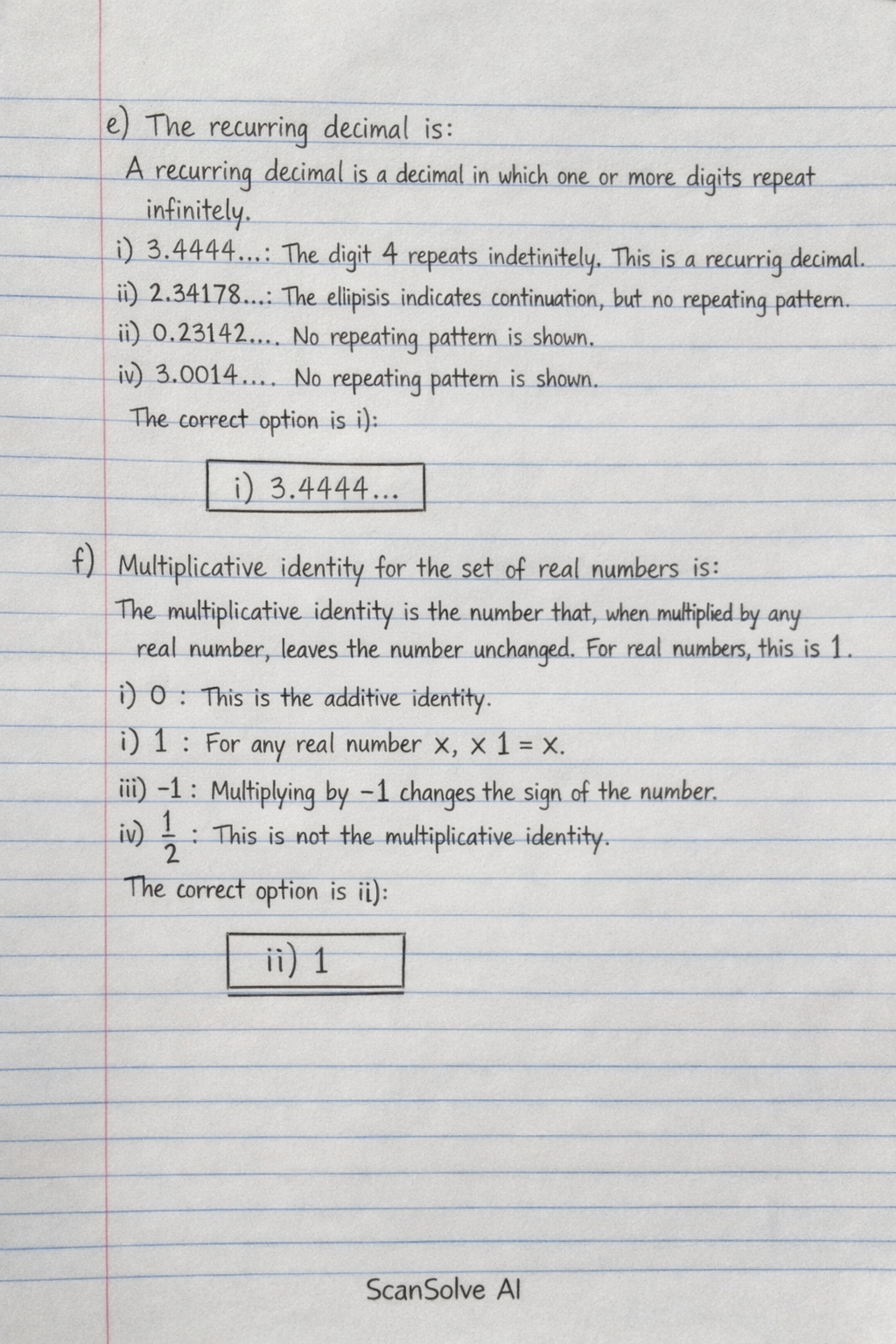
e) The recurring decimal is:
ScanSolve AI Answer
Answers
4 partse) The recurring decimal is:
A recurring decimal is a decimal in which one or more digits repeat infinitely.
- i) 3.4444...: The digit 4 repeats indefinitely. This is a recurring decimal.
- ii) 2.34178...: The ellipsis indicates continuation, but no repeating pattern is shown.
- iii) 0.23142...: No repeating pattern is shown.
- iv) 3.0014...: No repeating pattern is shown. The correct option is i).
f) Multiplicative identity for the set of real numbers is:
The multiplicative identity is the number that, when multiplied by any real number, leaves the number unchanged. For real numbers, this is 1.
- i) 0: This is the additive identity.
- ii) 1: For any real number , .
- iii) : Multiplying by changes the sign of the number.
- iv) : This is not the multiplicative identity. The correct option is ii).
g) The additive inverse of is:
The additive inverse of a number is the number such that .
For , the additive inverse is .
- i) : This is the negative reciprocal.
- ii) : This is the additive inverse.
- iii) : This is the original number.
- iv) 0: This is the additive identity. The correct option is ii).
h) Which of these is an irrational number?
An irrational number is a number that cannot be expressed as a simple fraction where and are integers and . Square roots of non-perfect squares are irrational.
- i) : Since 5 is not a perfect square, is an irrational number.
- ii) : This is a rational number ().
- iii) : This is a rational number ().
- iv) : This is a rational number (). The correct option is i).
Try one yourself
A new problem that tests the same skill.
Still stuck on this one?
Ask a follow-up, and the answer starts from this question.
More Mathematics Questions
Handwritten Step-by-Step Solution
Get this as a handwritten image on WhatsApp — like a tutor wrote it for you.
Try on WhatsApp