
We read your photo as:
Given the sides of the triangle are a = 13 cm, b = 14 cm, and c = 15 cm.
Mathematics
ScanSolve AI Answer
Answers
4 partsStep-by-step solution
11 stepshere's the solution for Question 4:
Given the sides of the triangle are , , and .
Part a· 2 steps
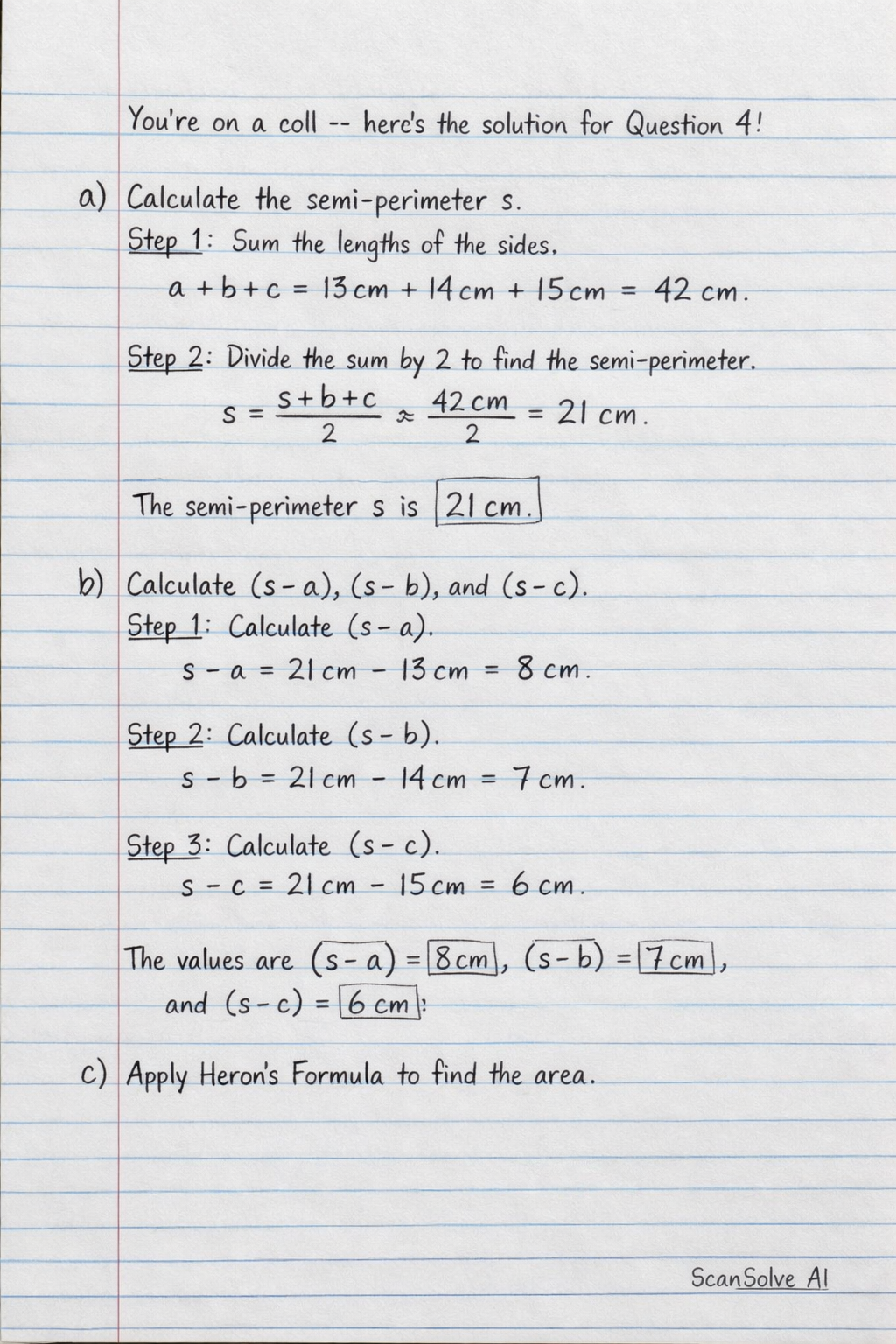
Calculate the semi-perimeter .
Sum the lengths of the sides.
Divide the sum by 2 to find the semi-perimeter.
The semi-perimeter is .
Part b
Calculate , , and .
Calculate .
Calculate .
Calculate .
The values are , , and .
Part c
Apply Heron's Formula to find the area.
Substitute the values into Heron's Formula.
Multiply the terms under the square root.
Calculate the square root.
The area of the triangle is (correct to 2 decimal places).
Part d
Find the new area if all three sides are doubled.
Determine the linear scale factor.
The sides are doubled, so the linear scale factor .
Determine the area scale factor.
The area scale factor is .
Multiply the original area by the area scale factor to find the new area.
The new area is .
Was this helpful?
Still stuck on this one?
Ask a follow-up, and the answer starts from this question.
Got a different question?Ask your own question
More Mathematics Questions
QGiven the triangle below, calculate the length of AB. 2. Solve triangle ABC, if a = 13, b = 11 and c…QA triangle ABC has sides AB = 9 cm, BC = 12 cm, and AC = 15 cm. (a) Calculate the area of triangle…QIn a triangle ABC, side a = 6.7 cm, side c = 2.3 cm and angle B = 46.6 degrees. Find side b and…QTwo sides of a right angle triangle are 17cm and 8cm. Find the 3rd side.QConstruct a triangle with sides 3cm 6cm 7cm
Browse by topic:Geometry
Handwritten Step-by-Step Solution
Get this as a handwritten image on WhatsApp — like a tutor wrote it for you.
Try on WhatsApp