This mathematics problem involves applying core mathematical principles and formulas. Below you will find a complete step-by-step solution with detailed explanations for each step, helping you understand not just the answer but the method behind it.
ScanSolve AI Answer
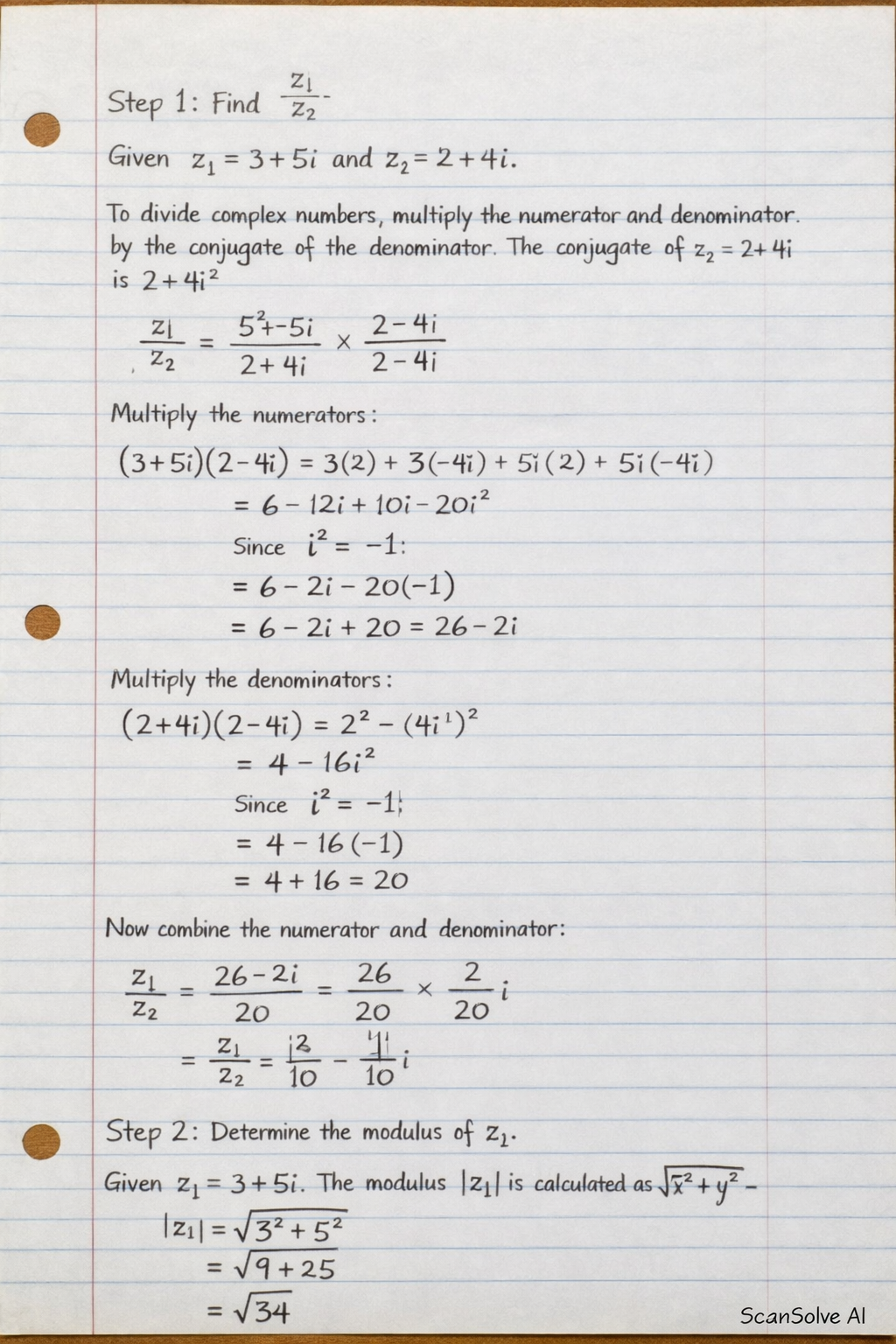
Step 1: Find $\frac{z_1}{z_2}$.
Given $z_1 = 3 + 5i$ and $z_2 = 2 + 4i$.
To divide complex numbers, multiply the numerator and denominator by the conjugate of the denominator. The conjugate of $z_2 = 2 + 4i$ is $2 - 4i$.
$$ \frac{z_1}{z_2} = \frac{3 + 5i}{2 + 4i} \times \frac{2 - 4i}{2 - 4i} $$
Multiply the numerators:
$$ (3 + 5i)(2 - 4i) = 3(2) + 3(-4i) + 5i(2) + 5i(-4i) $$
$$ = 6 - 12i + 10i - 20i^2 $$
Since $i^2 = -1$:
$$ = 6 - 2i - 20(-1) $$
$$ = 6 - 2i + 20 = 26 - 2i $$
Multiply the denominators:
$$ (2 + 4i)(2 - 4i) = 2^2 - (4i)^2 $$
$$ = 4 - 16i^2 $$
Since $i^2 = -1$:
$$ = 4 - 16(-1) = 4 + 16 = 20 $$
Now combine the numerator and denominator:
$$ \frac{z_1}{z_2} = \frac{26 - 2i}{20} = \frac{26}{20} - \frac{2}{20}i $$
$$ \frac{z_1}{z_2} = \frac{13}{10} - \frac{1}{10}i $$
Step 2: Determine the modulus of $z_1$.
Given $z_1 = 3 + 5i$. The modulus $|z_1|$ is calculated as $\sqrt{x^2 + y^2}$.
$$ |z_1| = \sqrt{3^2 + 5^2} $$
$$ = \sqrt{9 + 25} $$
$$ = \sqrt{34} $$
Step 3: Determine the argument of $z_1$.
Given $z_1 = 3 + 5i$. The argument $\arg(z_1)$ is $\theta$ such that $\tan \theta = \frac{y}{x}$. Since $x=3$ and $y=5$ are both positive, $z_1$ is in the first quadrant.
$$ \tan \theta = \frac{5}{3} $$
$$ \theta = \arctan\left(\frac{5}{3}\right) $$
In degrees:
$$ \theta \approx 59.04^\circ $$
In radians:
$$ \theta \approx 1.03 \text{ radians} $$
The results for the complex numbers are:
$$ \boxed{\frac{z_1}{z_2} = \frac{13}{10} - \frac{1}{10}i} $$
$$ \boxed{|z_1| = \sqrt{34}} $$
$$ \boxed{\arg(z_1) = \arctan\left(\frac{5}{3}\right) \approx 59.04^\circ \text{ or } 1.03 \text{ radians}} $$
Step 4: Solve the logarithm equation $\log_4 3^x - 4 \log_4 3 = 0$.
Use the logarithm property $\log_b M^p = p \log_b M$:
$$ x \log_4 3 - 4 \log_4 3 = 0 $$
Factor out $\log_4 3$:
$$ (x - 4) \log_4 3 = 0 $$
Since $\log_4 3 \neq 0$ (because $3 \neq 4^0 = 1$), we must have:
$$ x - 4 = 0 $$
$$ x = 4 $$
The solution to the logarithm equation is:
$$ \boxed{x = 4} $$
Step 5: Find $\sin(A+B)$ and $\cos(A-B)$.
Given $\sin A = \frac{4}{5}$ and $\cos B = \frac{12}{13}$. Angles $A$ and $B$ are both acute, meaning they are in the first quadrant.
First, find $\cos A$ and $\sin B$.
For angle $A$:
Since $A$ is acute, $\cos A > 0$.
$$ \cos A = \sqrt{1 - \sin^2 A} = \sqrt{1 - \left(\frac{4}{5}\right)^2} $$
$$ = \sqrt{1 - \frac{16}{25}} = \sqrt{\frac{25 - 16}{25}} = \sqrt{\frac{9}{25}} = \frac{3}{5} $$
For angle $B$:
Since $B$ is acute, $\sin B > 0$.
$$ \sin B = \sqrt{1 - \cos^2 B} = \sqrt{1 - \left(\frac{12}{13}\right)^2} $$
$$ = \sqrt{1 - \frac{144}{169}} = \sqrt{\frac{169 - 144}{169}} = \sqrt{\frac{25}{169}} = \frac{5}{13} $$
Now, calculate $\sin(A+B)$ using the formula $\sin(A+B) = \sin A \cos B + \cos A \sin B$:
$$ \sin(A+B) = \left(\frac{4}{5}\right)\left(\frac{12}{13}\right) + \left(\frac{3}{5}\right)\left(\frac{5}{13}\right) $$
$$ = \frac{48}{65} + \frac{15}{65} $$
$$ = \frac{48 + 15}{65} = \frac{63}{65} $$
Finally, calculate $\cos(A-B)$ using the formula $\cos(A-B) = \cos A \cos B + \sin A \sin B$:
$$ \cos(A-B) = \left(\frac{3}{5}\right)\left(\frac{12}{13}\right) + \left(\frac{4}{5}\right)\left(\frac{5}{13}\right) $$
$$ = \frac{36}{65} + \frac{20}{65} $$
$$ = \frac{36 + 20}{65} = \frac{56}{65} $$
The results for the trigonometric expressions are:
$$ \boxed{\sin(A+B) = \frac{63}{65}} $$
$$ \boxed{\cos(A-B) = \frac{56}{65}} $$
Q
Given z1 = 3 + 5i and z2 = 2 + 4i.
|Mathematics
Given z1 = 3 + 5i and z2 = 2 + 4i.
ScanSolve AI Answer
Step 1: Find z2z1.
Given z1=3+5i and z2=2+4i.
To divide complex numbers, multiply the numerator and denominator by the conjugate of the denominator. The conjugate of z2=2+4i is 2−4i.
z2z1=2+4i3+5i×2−4i2−4i
Multiply the numerators:
(3+5i)(2−4i)=3(2)+3(−4i)+5i(2)+5i(−4i)=6−12i+10i−20i2
Since i2=−1:
=6−2i−20(−1)=6−2i+20=26−2i
Multiply the denominators:
(2+4i)(2−4i)=22−(4i)2=4−16i2
Since i2=−1:
=4−16(−1)=4+16=20
Now combine the numerator and denominator:
z2z1=2026−2i=2026−202iz2z1=1013−101i
Step 2: Determine the modulus of z1.
Given z1=3+5i. The modulus ∣z1∣ is calculated as x2+y2.
∣z1∣=32+52=9+25=34
Step 3: Determine the argument of z1.
Given z1=3+5i. The argument arg(z1) is θ such that tanθ=xy. Since x=3 and y=5 are both positive, z1 is in the first quadrant.
tanθ=35θ=arctan(35)
In degrees:
θ≈59.04∘
In radians:
θ≈1.03radians
The results for the complex numbers are:
\frac{z_1{z_2} = \frac{13}{10} - \frac{1}{10}i}∣z1∣=34\arg(z_1) = \arctan\left(\frac{5{3}\right) \approx 59.04^\circ or 1.03 radians}
Step 4: Solve the logarithm equation log43x−4log43=0.
Use the logarithm property logbMp=plogbM:
xlog43−4log43=0
Factor out log43:
(x−4)log43=0
Since log43=0 (because 3=40=1), we must have:
x−4=0x=4
The solution to the logarithm equation is:
x=4
Step 5: Find sin(A+B) and cos(A−B).
Given sinA=54 and cosB=1312. Angles A and B are both acute, meaning they are in the first quadrant.
First, find cosA and sinB.
For angle A:
Since A is acute, cosA>0.
cosA=1−sin2A=1−(54)2=1−2516=2525−16=259=53
For angle B:
Since B is acute, sinB>0.
sinB=1−cos2B=1−(1312)2=1−169144=169169−144=16925=135
Now, calculate sin(A+B) using the formula sin(A+B)=sinAcosB+cosAsinB:
sin(A+B)=(54)(1312)+(53)(135)=6548+6515=6548+15=6563
Finally, calculate cos(A−B) using the formula cos(A−B)=cosAcosB+sinAsinB:
cos(A−B)=(53)(1312)+(54)(135)=6536+6520=6536+20=6556
The results for the trigonometric expressions are:
\sin(A+B) = \frac{63{65}}\cos(A-B) = \frac{56{65}}
Need help with your own homework?
Get instant step-by-step solutions to any question. Free to start.