Outline four functions of a management accountant in an organization. Formulate the linear programming problem and prepare the initial simplex tableau.

Computer Science
Outline four functions of a management accountant in an organization. Formulate the linear programming problem and prepare the initial simplex tableau.

ScanSolve AI Answer

Answer

Ksh. 320

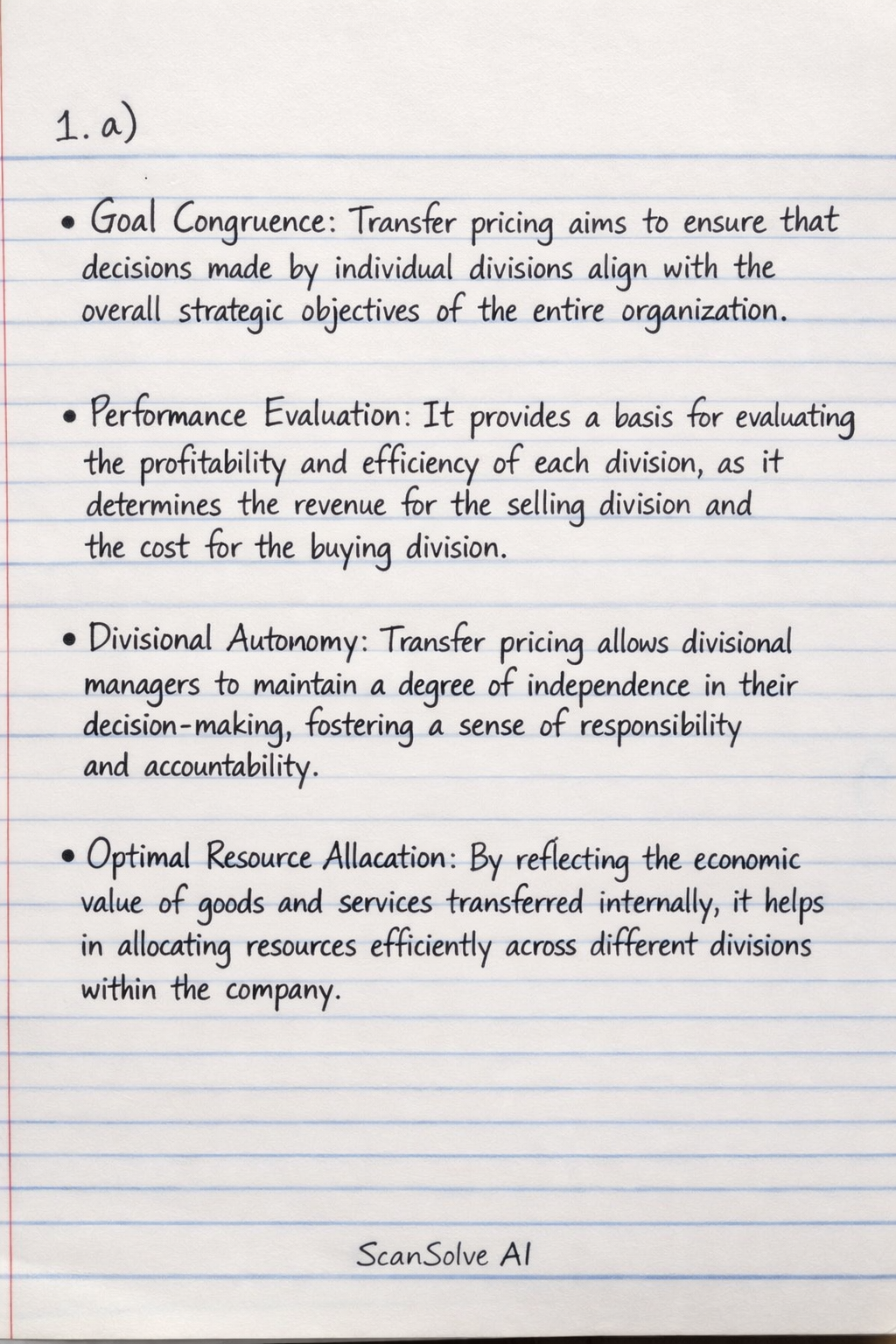
  1. a)Goal Congruence: Transfer pricing aims to ensure that decisions made by individual divisions align with the overall strategic objectives of the entire organization. • Performance Evaluation: It provides a basis for evaluating the profitability and efficiency of each division, as it determines the revenue for the selling division and the cost for the buying division. • Divisional Autonomy: Transfer pricing allows divisional managers to maintain a degree of independence in their decision-making, fostering a sense of responsibility and accountability. • Optimal Resource Allocation: By reflecting the economic value of goods and services transferred internally, it helps in allocating resources efficiently across different divisions within the company.

b) Step 1: Calculate Variable Cost per unit and Total Fixed Costs. Selling Price (SP) per unit = Ksh. 320 Variable Costs (VC) per unit: Raw material = Ksh. 80 Direct labour = Ksh. 40 VCperunit=Ksh.80+Ksh.40=Ksh.120VC per unit = Ksh. 80 + Ksh. 40 = Ksh. 120 Fixed Costs (FC) per month: Rent = Ksh. 50,000 Supervisor salary = Ksh. 100,000 TotalFC=Ksh.50,000+Ksh.100,000=Ksh.150,000Total FC = Ksh. 50,000 + Ksh. 100,000 = Ksh. 150,000 Target Profit = Ksh. 450,000

Step 2: Calculate Contribution Margin (CM) per unit. CMperunit=SPperunitVCperunitCM per unit = SP per unit - VC per unit CMperunit=Ksh.320Ksh.120=Ksh.200CM per unit = Ksh. 320 - Ksh. 120 = Ksh. 200

i) Determine break-even point in units and shillings. Break-even point in units (BEP units): BEP(units)=FixedCostsCMperunitBEP (units) = \frac{Fixed Costs}{CM per unit} BEP(units)=Ksh.150,000Ksh.200/unit=750unitsBEP (units) = \frac{Ksh. 150,000}{Ksh. 200/unit} = 750 units Break-even point in shillings (BEP shillings): BEP(shillings)=BEP(units)×SPperunitBEP (shillings) = BEP (units) \times SP per unit BEP(shillings)=750units×Ksh.320/unit=Ksh.240,000BEP (shillings) = 750 units \times Ksh. 320/unit = Ksh. 240,000 The break-even point is 750 units and Ksh. 240,000.

iv) Determine number of units to be sold per month to attain the targeted profit. UnitsforTargetProfit=FixedCosts+TargetProfitCMperunitUnits for Target Profit = \frac{Fixed Costs + Target Profit}{CM per unit} UnitsforTargetProfit=Ksh.150,000+Ksh.450,000Ksh.200/unitUnits for Target Profit = \frac{Ksh. 150,000 + Ksh. 450,000}{Ksh. 200/unit} UnitsforTargetProfit=Ksh.600,000Ksh.200/unit=3,000unitsUnits for Target Profit = \frac{Ksh. 600,000}{Ksh. 200/unit} = 3,000 units The number of units to be sold to attain the targeted profit is 3,000 units.

ii) Determine margin of safety in units. MarginofSafety(units)=UnitsforTargetProfitBEP(units)Margin of Safety (units) = Units for Target Profit - BEP (units) MarginofSafety(units)=3,000units750units=2,250unitsMargin of Safety (units) = 3,000 units - 750 units = 2,250 units The margin of safety in units is 2,250 units.

iii) Determine margin of safety in percentage. First, calculate Target Sales Revenue: TargetSalesRevenue=UnitsforTargetProfit×SPperunitTarget Sales Revenue = Units for Target Profit \times SP per unit TargetSalesRevenue=3,000units×Ksh.320/unit=Ksh.960,000Target Sales Revenue = 3,000 units \times Ksh. 320/unit = Ksh. 960,000 Margin of Safety in shillings: MarginofSafety(shillings)=TargetSalesRevenueBEP(shillings)Margin of Safety (shillings) = Target Sales Revenue - BEP (shillings) MarginofSafety(shillings)=Ksh.960,000Ksh.240,000=Ksh.720,000Margin of Safety (shillings) = Ksh. 960,000 - Ksh. 240,000 = Ksh. 720,000 Margin of Safety in percentage: MarginofSafety(%)=MarginofSafety(shillings)TargetSalesRevenue×100%Margin of Safety (\%) = \frac{Margin of Safety (shillings)}{Target Sales Revenue} \times 100\% MarginofSafety(%)=Ksh.720,000Ksh.960,000×100%=75%Margin of Safety (\%) = \frac{Ksh. 720,000}{Ksh. 960,000} \times 100\% = 75\% The margin of safety in percentage is 75%.

Was this helpful?

Need help with your own homework?

Get instant step-by-step solutions to any question. Free to start.

Ask Your Question
Handwritten step-by-step solution preview

Handwritten Step-by-Step Solution

Get this as a handwritten image on WhatsApp — like a tutor wrote it for you.

Try on WhatsApp

Still have questions?

Quick Answer

1. a) • Goal Congruence: Transfer pricing aims to ensure that decisions made by individual divisions align with the overall strategic objectives of the entire organization.

Outline four functions of a management accountant in an organization. Formulate the linear programming problem and prepare the initial simplex tableau.
Computer Science

This computer science problem involves algorithmic thinking and programming concepts. The solution below explains the approach, logic, and implementation step by step.

ScanSolve AI Answer
1. a) • Goal Congruence: Transfer pricing aims to ensure that decisions made by individual divisions align with the overall strategic objectives of the entire organization. • Performance Evaluation: It provides a basis for evaluating the profitability and efficiency of each division, as it determines the revenue for the selling division and the cost for the buying division. • Divisional Autonomy: Transfer pricing allows divisional managers to maintain a degree of independence in their decision-making, fostering a sense of responsibility and accountability. • Optimal Resource Allocation: By reflecting the economic value of goods and services transferred internally, it helps in allocating resources efficiently across different divisions within the company. b) Step 1: Calculate Variable Cost per unit and Total Fixed Costs. Selling Price (SP) per unit = Ksh. 320 Variable Costs (VC) per unit: Raw material = Ksh. 80 Direct labour = Ksh. 40 VC per unit = Ksh. 80 + Ksh. 40 = Ksh. 120 Fixed Costs (FC) per month: Rent = Ksh. 50,000 Supervisor salary = Ksh. 100,000 Total FC = Ksh. 50,000 + Ksh. 100,000 = Ksh. 150,000 Target Profit = Ksh. 450,000 Step 2: Calculate Contribution Margin (CM) per unit. CM per unit = SP per unit - VC per unit CM per unit = Ksh. 320 - Ksh. 120 = Ksh. 200 i) Determine break-even point in units and shillings. Break-even point in units (BEP units): BEP (units) = Fixed CostsCM per unit BEP (units) = Ksh. 150,000Ksh. 200/unit = 750 units Break-even point in shillings (BEP shillings): BEP (shillings) = BEP (units) × SP per unit BEP (shillings) = 750 units × Ksh. 320/unit = Ksh. 240,000 The break-even point is 750 units and Ksh. 240,000. iv) Determine number of units to be sold per month to attain the targeted profit. Units for Target Profit = Fixed Costs + Target ProfitCM per unit Units for Target Profit = Ksh. 150,000 + Ksh. 450,000Ksh. 200/unit Units for Target Profit = Ksh. 600,000Ksh. 200/unit = 3,000 units The number of units to be sold to attain the targeted profit is 3,000 units. ii) Determine margin of safety in units. Margin of Safety (units) = Units for Target Profit - BEP (units) Margin of Safety (units) = 3,000 units - 750 units = 2,250 units The margin of safety in units is 2,250 units. iii) Determine margin of safety in percentage. First, calculate Target Sales Revenue: Target Sales Revenue = Units for Target Profit × SP per unit Target Sales Revenue = 3,000 units × Ksh. 320/unit = Ksh. 960,000 Margin of Safety in shillings: Margin of Safety (shillings) = Target Sales Revenue - BEP (shillings) Margin of Safety (shillings) = Ksh. 960,000 - Ksh. 240,000 = Ksh. 720,000 Margin of Safety in percentage: Margin of Safety (\%) = Margin of Safety (shillings)Target Sales Revenue × 100\% Margin of Safety (\%) = Ksh. 720,000Ksh. 960,000 × 100\% = 75\% The margin of safety in percentage is 75%.