
We read your photo as:
Determine the gradient and y-intercept for the given equations of straight lines.
ScanSolve AI Answer
Step-by-step solution
11 stepsHere are the solutions for the questions:
Question 2: Determine the gradient for each of the following equations:
a)
Add $6x$ to both sides of the equation.
Divide both sides by 2.
The gradient is the coefficient of .
The gradient is .b)
Subtract from both sides of the equation.
Divide both sides by 2.
The gradient is the coefficient of .
The gradient is .c)
Divide both sides by 2.
The gradient is the coefficient of .
The gradient is .Question 3: Determine the y-intercept in each of the following equations of straight lines:
a)
The equation is already in the form , where is the y-intercept.
The y-intercept is .b)
Rearrange the equation to the form .
Subtract and add 4 to both sides.
Divide both sides by 3.
The y-intercept is the constant term.
The y-intercept is .c)
Multiply both sides by 2 to solve for .
The y-intercept is the constant term.
The y-intercept is .d)
The equation is already in the form , where is the y-intercept.
The y-intercept is .Question 4: Determine the gradient of a line with an equation .
The equation is already in the form , where is the gradient.
The gradient is .Question 5: The equation of a line is given as . Determine:
a) the gradient of the line,
Rearrange the equation to the form .
Subtract from both sides.
The gradient is the coefficient of .
The gradient is .b) the value of the y-intercept.
From the equation , the y-intercept is the constant term.
The y-intercept is .Question 6: Given a line with an equation .
a) Express the equation in the form .
Subtract from both sides of the equation.
Multiply both sides by to isolate .
The equation in the form is .
b) Determine the gradient of the line.
From the equation , the gradient is the coefficient of .
The gradient is .c) The value of y-intercept.
From the equation , the y-intercept is the constant term.
The y-intercept is .
Still stuck on this one?
Ask a follow-up, and the answer starts from this question.
More Mathematics Questions
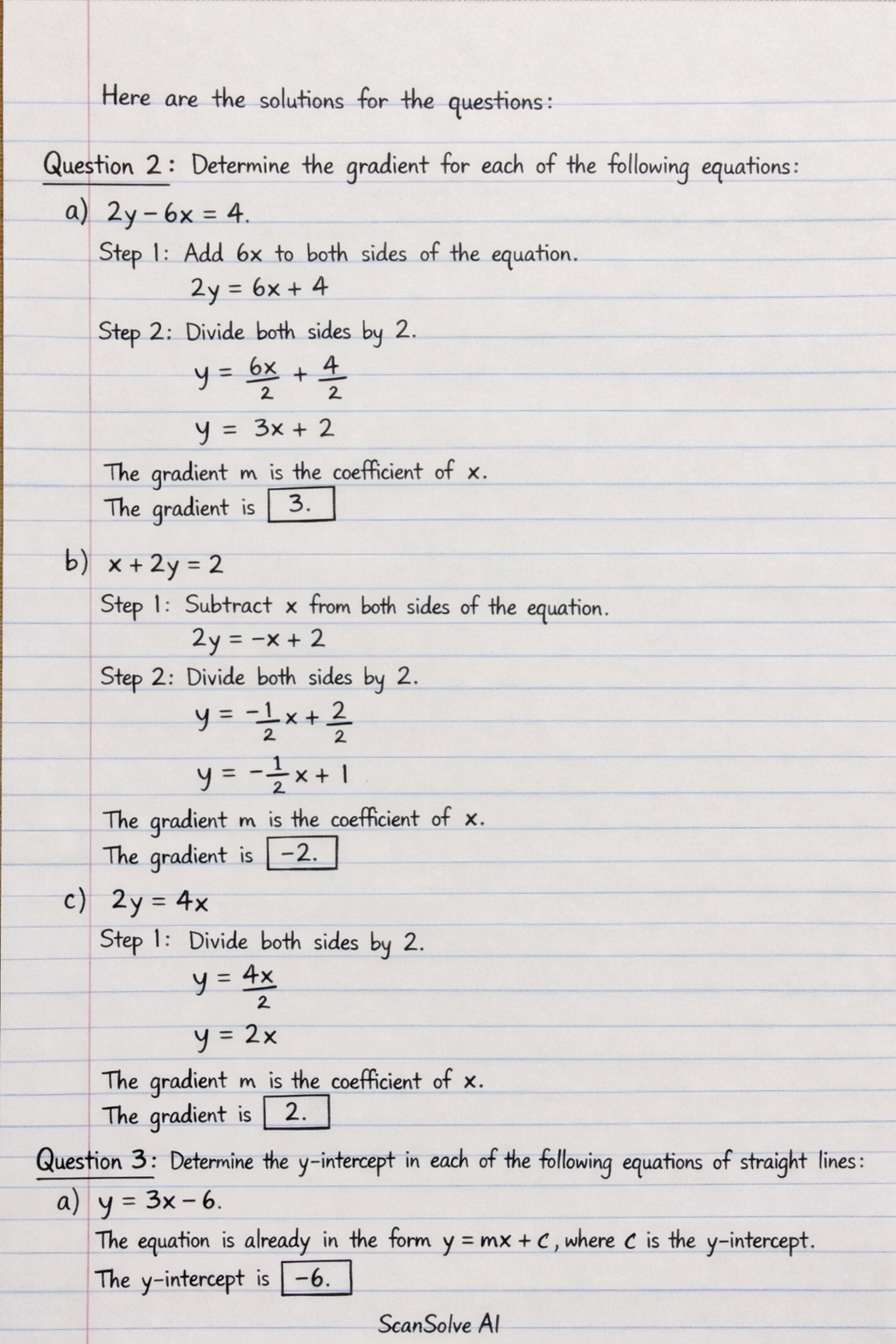
Handwritten Step-by-Step Solution
Get this as a handwritten image on WhatsApp — like a tutor wrote it for you.
Try on WhatsApp