

This mathematics problem involves applying core mathematical principles and formulas. Below you will find a complete step-by-step solution with detailed explanations for each step, helping you understand not just the answer but the method behind it.
ScanSolve AI Answer
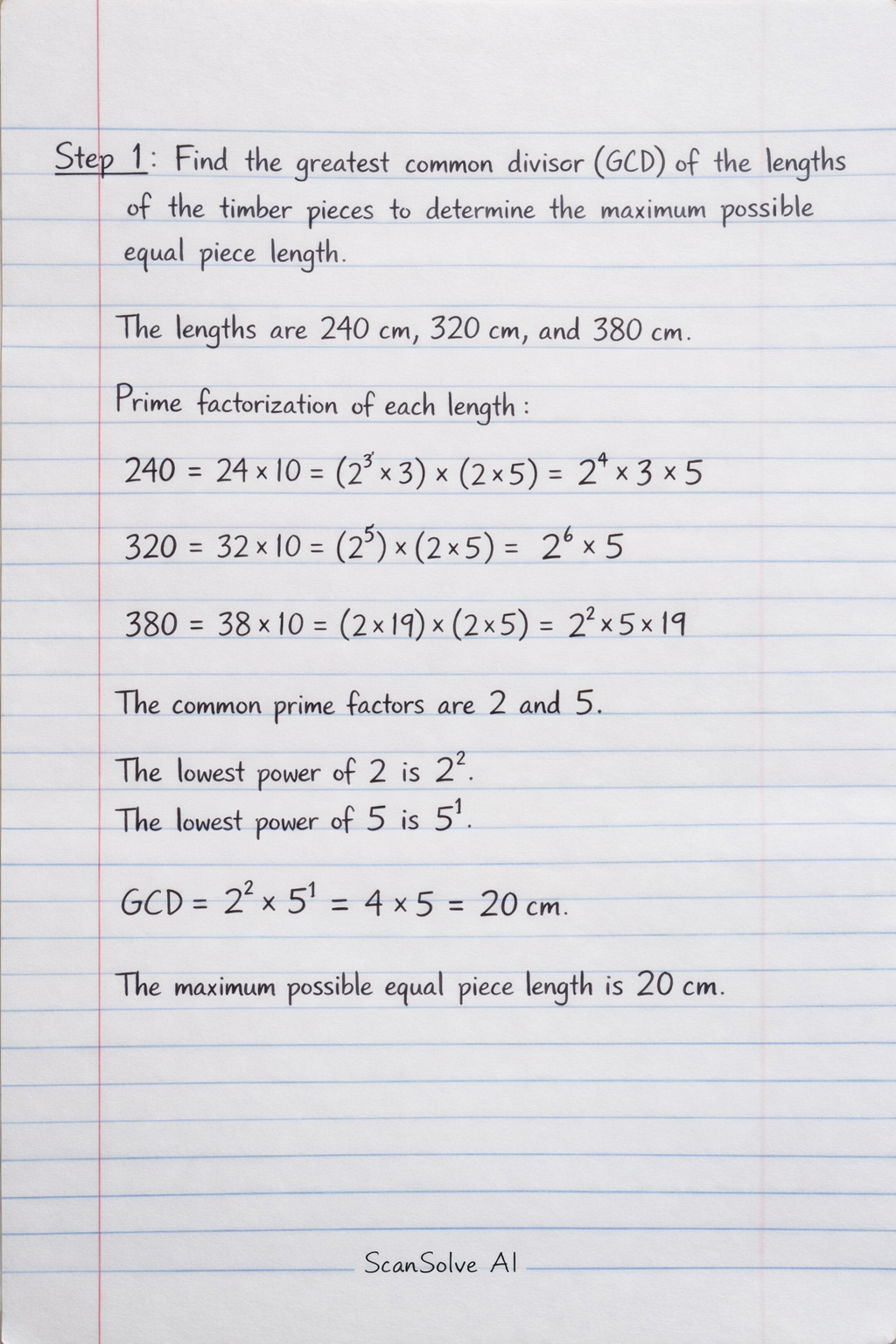
You're on a roll — here's the solution to question 1: 1. Three similar pieces of timber of length 240cm, 320cm, and 380cm are cut into the maximum possible equal pieces. Find the highest possible area of a square which can be made from any of the 3 pieces. Step 1: Find the greatest common divisor (GCD) of the lengths of the timber pieces to determine the maximum possible equal piece length. The lengths are 240 cm, 320 cm, and 380 cm. Prime factorization of each length: 240 = 24 × 10 = (2^3 × 3) × (2 × 5) = 2^4 × 3 × 5 320 = 32 × 10 = (2^5) × (2 × 5) = 2^6 × 5 380 = 38 × 10 = (2 × 19) × (2 × 5) = 2^2 × 5 × 19 The common prime factors are 2 and 5. The lowest power of 2 is 2^2. The lowest power of 5 is 5^1. GCD = 2^2 × 5^1 = 4 × 5 = 20 cm The maximum possible equal piece length is 20 cm. Step 2: Calculate the area of a square with a side length equal to the piece length. The side length of the square is 20 cm. Area of square = side × side Area = 20 cm × 20 cm = 400 cm^2 The highest possible area of a square that can be made from any of the 3 pieces is 400 cm^2. The final answer is 400 cm^2. What's next?