
I mean from no 8-14
ScanSolve AI Answer
My apologies, I misunderstood your previous message. You meant questions 8 through 14 from the previous set of questions you sent. Here are those answers again:
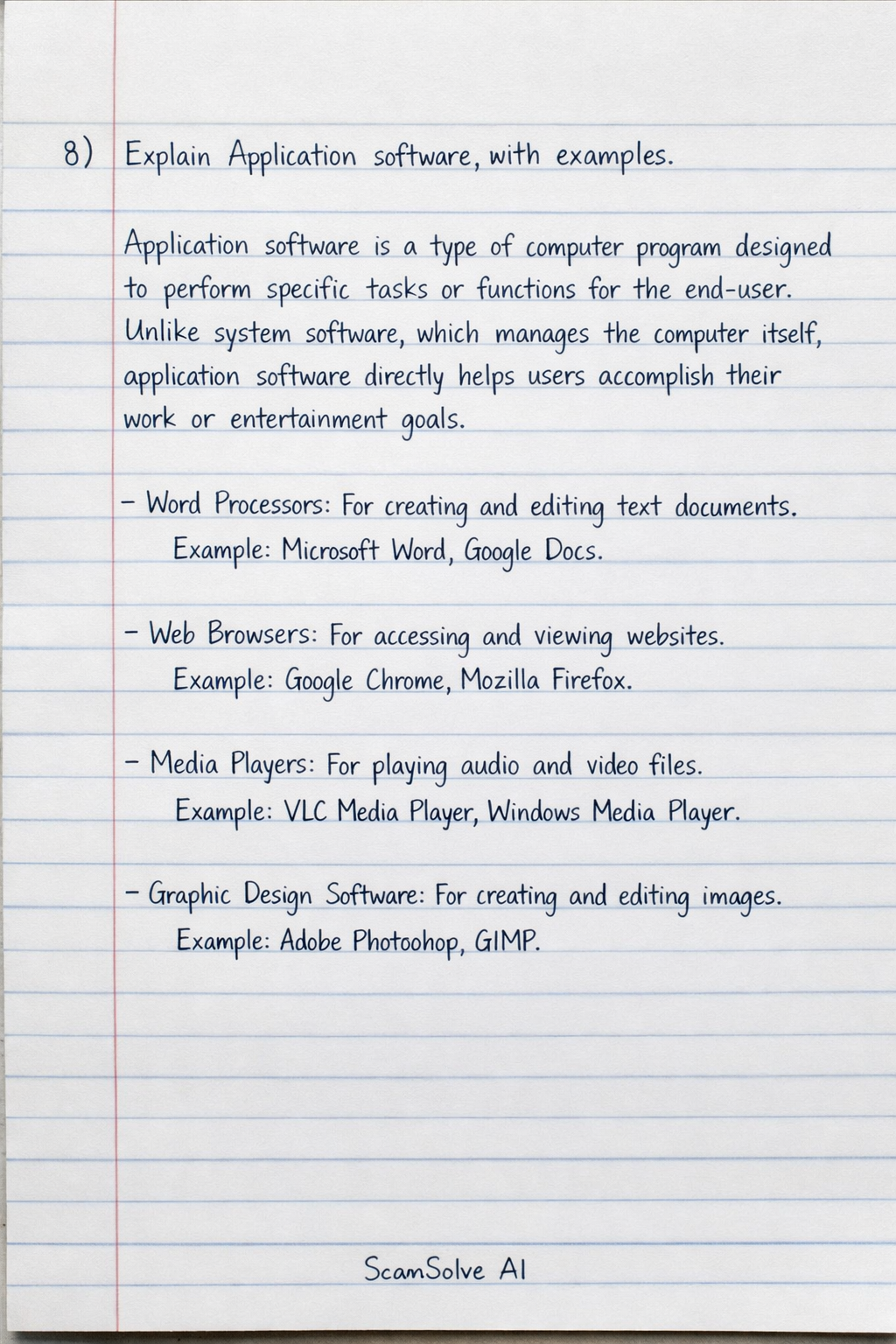
8) Explain Application software, with examples.
Application software is a type of computer program designed to perform specific tasks or functions for the end-user. Unlike system software, which manages the computer itself, application software directly helps users accomplish their work or entertainment goals.
- Word Processors: For creating and editing text documents. Example: Microsoft Word, Google Docs.
- Web Browsers: For accessing and viewing websites. Example: Google Chrome, Mozilla Firefox.
- Media Players: For playing audio and video files. Example: VLC Media Player, Windows Media Player.
- Graphic Design Software: For creating and editing images. Example: Adobe Photoshop, GIMP.
9) State Five advantages of customised application software.
- Tailored precisely to specific business needs and workflows.
- Offers better integration with existing systems.
- Provides greater scalability to grow with the business.
- Can offer a competitive advantage through unique features.
- Enhanced security features specific to the organization's requirements.
10) State Five disadvantages of customised application software.
- High initial development cost.
- Longer development and deployment time.
- Reliance on a specific developer or team for maintenance.
- Potential for bugs and errors during development.
- Limited external support or community resources.
11) State Five advantages of commercial application software.
- Generally lower upfront cost compared to custom solutions.
- Immediate availability and quick deployment.
- Extensive support, documentation, and user communities.
- Regular updates and new features from the vendor.
- Often well-tested and reliable due to widespread use.
12) State Five disadvantages of commercial application software.
- May not perfectly fit specific business needs (generic features).
- Lack of customization options.
- Ongoing licensing fees or subscription costs.
- Potential for vendor lock-in.
- Security vulnerabilities can affect many users if exploited.
13) State Five guidelines for acquisition of application software.
- Clearly define your specific needs and requirements.
- Research and compare different software options available.
- Check for compatibility with your existing hardware and operating systems.
- Evaluate the total cost of ownership, including licensing, training, and maintenance.
- Assess the vendor's reputation, support, and update policies.
14) Briefly explain the Five generations of programming languages.
- First Generation (1GL): Machine Language - Consists of binary code (0s and 1s) directly understood by the CPU. It is machine-dependent and very difficult for humans to read and write.
- Second Generation (2GL): Assembly Language - Uses symbolic instruction codes (mnemonics) instead of binary. It is translated into machine code by an assembler and is still machine-dependent but easier to program than 1GL.
- Third Generation (3GL): High-Level Languages - Use statements resembling human language (English words and mathematical symbols). They are machine-independent and require a compiler or interpreter. Examples: FORTRAN, COBOL, C, Java, Python.
- Fourth Generation (4GL): Very High-Level Languages - Designed to be closer to human language and focus on what to do rather than how to do it. They are often used for specific purposes like database management or report generation. Examples: SQL, MATLAB, Perl.
- Fifth Generation (5GL): Natural Language Processing / AI Languages - Aim to allow users to interact with computers using natural human language or to solve problems using constraints rather than algorithms. They are primarily used in artificial intelligence and expert systems. Examples: Prolog, OPS5.
Still stuck on this one?
Ask a follow-up, and the answer starts from this question.
More Mathematics Questions
Handwritten Step-by-Step Solution
Get this as a handwritten image on WhatsApp — like a tutor wrote it for you.
Try on WhatsApp