

This mathematics problem involves applying core mathematical principles and formulas. Below you will find a complete step-by-step solution with detailed explanations for each step, helping you understand not just the answer but the method behind it.
ScanSolve AI Answer
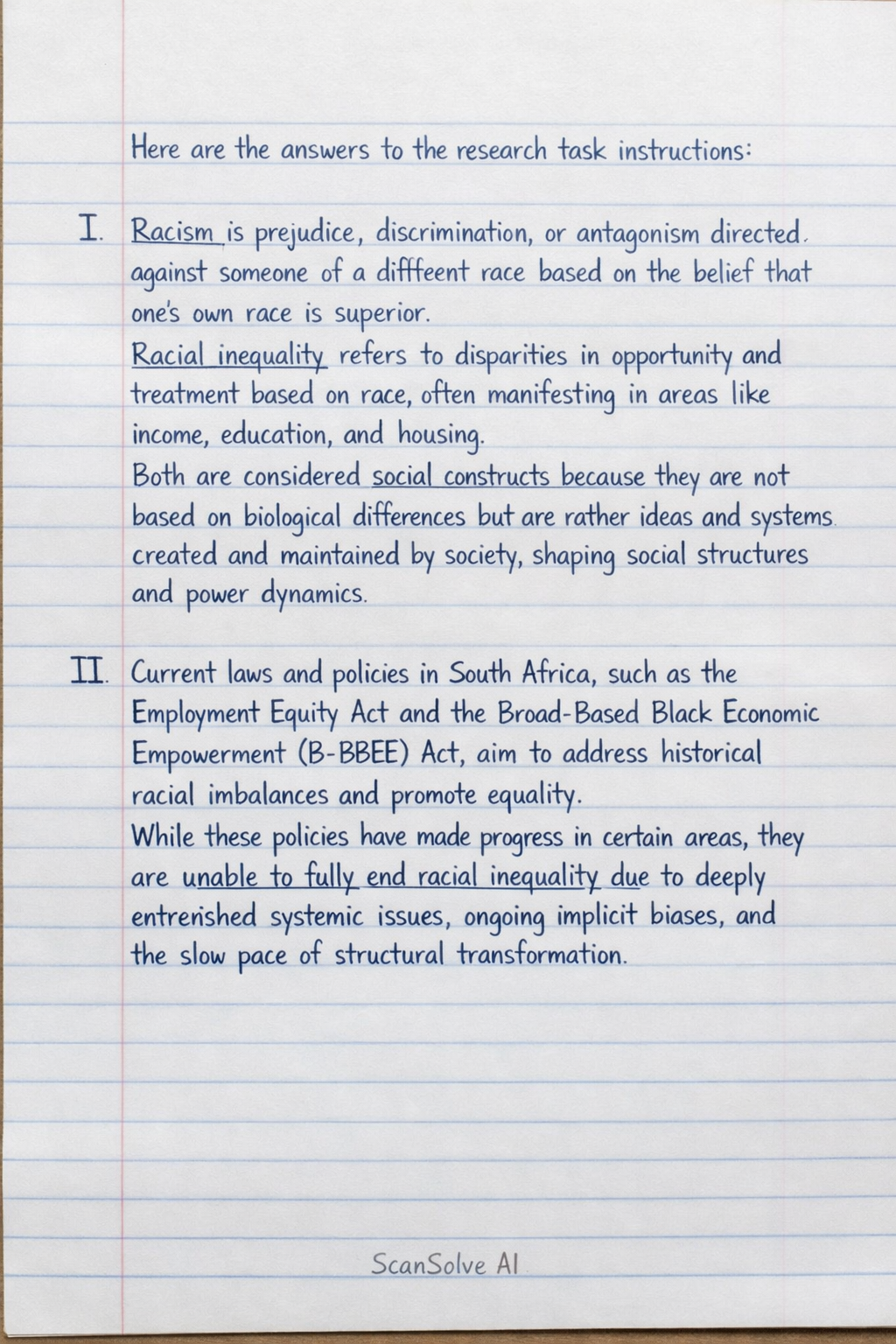
Here are the answers to the research task instructions: I. Racism is prejudice, discrimination, or antagonism directed against someone of a different race based on the belief that one's own race is superior. Racial inequality refers to disparities in opportunity and treatment based on race, often manifesting in areas like income, education, and housing. Both are considered social constructs because they are not based on biological differences but are rather ideas and systems created and maintained by society, shaping social structures and power dynamics. II. Current laws and policies in South Africa, such as the Employment Equity Act and the Broad-Based Black Economic Empowerment (B-BBEE) Act, aim to address historical racial imbalances and promote equality. While these policies have made progress in certain areas, they are unable to fully end racial inequality due to deeply entrenched systemic issues, ongoing implicit biases, and the slow pace of structural transformation. III. The Black Consciousness philosophy, while instrumental in raising awareness and fostering pride among Black people during Apartheid, failed to fully challenge Apartheid and racial inequality in its immediate goals due to severe state repression, the imprisonment and assassination of its leaders like Steve Biko, and its inability to mobilize a unified front across all racial groups against the regime. Its impact was more profound in shaping long-term political consciousness rather than directly dismantling the system. IV. The integration of Whites and Blacks in post-Apartheid South Africa has, in some instances, perpetuated socio-economic challenges through racism. This can occur through subtle forms of discrimination in workplaces, educational institutions, and social settings, where historical power imbalances and racial biases continue to disadvantage Black individuals. Economic integration has often been superficial, with wealth and opportunities remaining concentrated, thus maintaining existing racialized socio-economic disparities. V. Elitism in the new democratic South Africa is indeed helping to maintain Apartheid-era privileges through entrenched racial inequality. This occurs when a small, powerful group, often benefiting from historical advantages, controls resources and opportunities, thereby limiting upward mobility for the majority. This perpetuates a cycle where those with existing capital, networks, and access (often historically privileged groups) continue to dominate key sectors, reinforcing the economic and social divides inherited from Apartheid. 3 done, 2 left today. You're making progress.