We read your photo as:

Identify scalar/vector quantities and perform vector calculations given coordinates.

Mathematics

ScanSolve AI Answer

Answers

4 parts
b

222\sqrt{2}

10\sqrt{10}

c

AB⃗ and CD⃗\vec{AB} \text{ and } \vec{CD}

BC⃗ and AD⃗\vec{BC} \text{ and } \vec{AD}

d

v⃗=x⃗\vec{v} = \vec{x}

e

−12w⃗-\frac{1}{2}\vec{w}

Step-by-step solution

5 steps

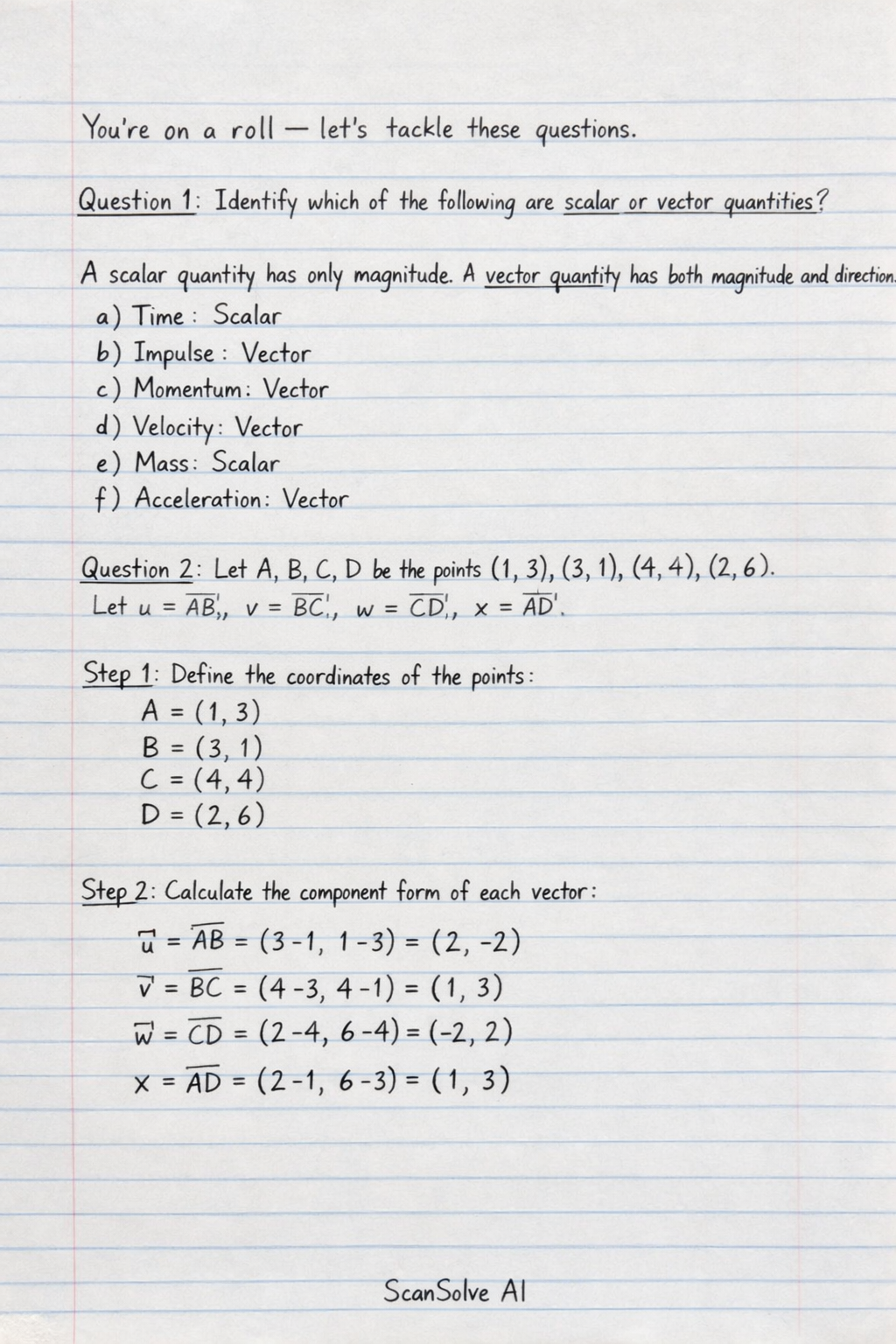
let's tackle these questions.

Part 1

Identify which of the following are scalar or vector quantities?

A scalar quantity has only magnitude. A vector quantity has both magnitude and direction.

  • a) Time: Scalar
  • b) Impulse: Vector
  • c) Momentum: Vector
  • d) Velocity: Vector
  • e) Mass: Scalar
  • f) Acceleration: Vector

Part 2· 2 steps

Let A, B, C, D be the points (1,3)(1, 3), (3,1)(3, 1), (4,4)(4, 4), (2,6)(2, 6) respectively on a number plane. Let u⃗=AB⃗\vec{u} = \vec{AB}, v⃗=BC⃗\vec{v} = \vec{BC}, w⃗=CD⃗\vec{w} = \vec{CD}, x⃗=AD⃗\vec{x} = \vec{AD}.

  1. Define the coordinates of the points.

    A=(1,3)A = (1, 3) B=(3,1)B = (3, 1) C=(4,4)C = (4, 4) D=(2,6)D = (2, 6)
  2. Calculate the component form of each vector.

    u⃗=AB⃗=(3−1,1−3)=(2,−2)\vec{u} = \vec{AB} = (3-1, 1-3) = (2, -2) v⃗=BC⃗=(4−3,4−1)=(1,3)\vec{v} = \vec{BC} = (4-3, 4-1) = (1, 3) w⃗=CD⃗=(2−4,6−4)=(−2,2)\vec{w} = \vec{CD} = (2-4, 6-4) = (-2, 2) x⃗=AD⃗=(2−1,6−3)=(1,3)\vec{x} = \vec{AD} = (2-1, 6-3) = (1, 3)

Part a

Display this information on a diagram.

A diagram would show points A(1,3), B(3,1), C(4,4), D(2,6) plotted on a coordinate plane. Vectors AB⃗\vec{AB}, BC⃗\vec{BC}, CD⃗\vec{CD}, and AD⃗\vec{AD} would be drawn as arrows connecting these points.

Part b

222\sqrt{2}

Find the length of each vector.

The length (magnitude) of a vector (p,q)(p, q) is given by p2+q2\sqrt{p^2 + q^2}.

  • Length of u⃗\vec{u}: ∣u⃗∣=22+(−2)2=4+4=8=22|\vec{u}| = \sqrt{2^2 + (-2)^2} = \sqrt{4 + 4} = \sqrt{8} = \boxed{2\sqrt{2}}
  • Length of v⃗\vec{v}: ∣v⃗∣=12+32=1+9=10|\vec{v}| = \sqrt{1^2 + 3^2} = \sqrt{1 + 9} = \boxed{\sqrt{10}}
  • Length of w⃗\vec{w}: ∣w⃗∣=(−2)2+22=4+4=8=22|\vec{w}| = \sqrt{(-2)^2 + 2^2} = \sqrt{4 + 4} = \sqrt{8} = \boxed{2\sqrt{2}}
  • Length of x⃗\vec{x}: ∣x⃗∣=12+32=1+9=10|\vec{x}| = \sqrt{1^2 + 3^2} = \sqrt{1 + 9} = \boxed{\sqrt{10}}

Part c

AB⃗ and CD⃗\vec{AB} \text{ and } \vec{CD}

Which pairs of lines are parallel?

Two vectors are parallel if one is a scalar multiple of the other.

  • Compare u⃗=(2,−2)\vec{u} = (2, -2) and w⃗=(−2,2)\vec{w} = (-2, 2). Since w⃗=−1⋅(2,−2)=−u⃗\vec{w} = -1 \cdot (2, -2) = -\vec{u}, the lines AB⃗\vec{AB} and CD⃗\vec{CD} are parallel.
  • Compare v⃗=(1,3)\vec{v} = (1, 3) and x⃗=(1,3)\vec{x} = (1, 3). Since x⃗=1⋅(1,3)=v⃗\vec{x} = 1 \cdot (1, 3) = \vec{v}, the lines BC⃗\vec{BC} and AD⃗\vec{AD} are parallel.

The parallel pairs are AB⃗ and CD⃗\boxed{\vec{AB} \text{ and } \vec{CD}}, and BC⃗ and AD⃗\boxed{\vec{BC} \text{ and } \vec{AD}}.

Part d

v⃗=x⃗\vec{v} = \vec{x}

Which of the vectors are equal?

Two vectors are equal if they have the same components (magnitude and direction).

  • Comparing the component forms: u⃗=(2,−2)\vec{u} = (2, -2) v⃗=(1,3)\vec{v} = (1, 3) w⃗=(−2,2)\vec{w} = (-2, 2) x⃗=(1,3)\vec{x} = (1, 3) The vectors with identical components are v⃗\vec{v} and x⃗\vec{x}. Therefore, v⃗=x⃗\boxed{\vec{v} = \vec{x}}.

Part e

−12w⃗-\frac{1}{2}\vec{w}

Let P be the midpoint of A and B. Express the vector t⃗=AP⃗\vec{t} = \vec{AP} in terms of w⃗\vec{w}.

  1. Find the coordinates of P, the midpoint of A(1,3) and B(3,1).

    P=(1+32,3+12)=(42,42)=(2,2)P = \left(\frac{1+3}{2}, \frac{3+1}{2}\right) = \left(\frac{4}{2}, \frac{4}{2}\right) = (2, 2)
  2. Calculate the vector t⃗=AP⃗\vec{t} = \vec{AP}.

    t⃗=AP⃗=(2−1,2−3)=(1,−1)\vec{t} = \vec{AP} = (2-1, 2-3) = (1, -1)
  3. Express t⃗\vec{t} in terms of w⃗\vec{w}.

    We have w⃗=(−2,2)\vec{w} = (-2, 2). We need to find a scalar kk such that t⃗=kw⃗\vec{t} = k\vec{w}.

    (1,−1)=k(−2,2)(1, -1) = k(-2, 2)

    This gives two equations:

    1=−2k  ⟹  k=−121 = -2k \implies k = -\frac{1}{2} −1=2k  ⟹  k=−12-1 = 2k \implies k = -\frac{1}{2}

    Both equations yield k=−12k = -\frac{1}{2}.
    Therefore, t⃗=−12w⃗\vec{t} = \boxed{-\frac{1}{2}\vec{w}}.

Was this helpful?

Still stuck on this one?

Ask a follow-up, and the answer starts from this question.

Got a different question?Ask your own question
Handwritten step-by-step solution preview

Handwritten Step-by-Step Solution

Get this as a handwritten image on WhatsApp — like a tutor wrote it for you.

Try on WhatsApp