
We read your photo as:
Identify the digit in the first decimal place, which is 0.
ScanSolve AI Answer
Step-by-step solution
8 stepsHere are the solutions to the problems:
1. (a) Express 6.093 to one decimal place.
Identify the digit in the first decimal place, which is 0.
Look at the digit immediately to its right, which is 9.
Since , round up the digit in the first decimal place.
1. (b) Evaluate .
Find a common denominator for $4, 2,$ and 3.
The least common multiple (LCM) is 12.
Convert each fraction to have a denominator of 12.
Perform the addition and subtraction.
2. Given the sets and .
2. (a) Find .
Assuming that is the universal set for this context, the complement of () would be the set of elements in the universal set that are not in .2. (b) Find .
represents the intersection of sets and , which includes all elements common to both sets.The elements common to both sets are .
2. (c) Find .
represents the number of elements in set .There are 4 elements in set .
3. Complete the truth table below.
Fill the column by negating the truth values of .
Fill the column by applying the OR operator to the values in the column and the column.
The OR operator is true if at least one of its operands is true.
P Q T T F T T F F F F T T T F F T T
Still stuck on this one?
Ask a follow-up, and the answer starts from this question.
More Mathematics Questions
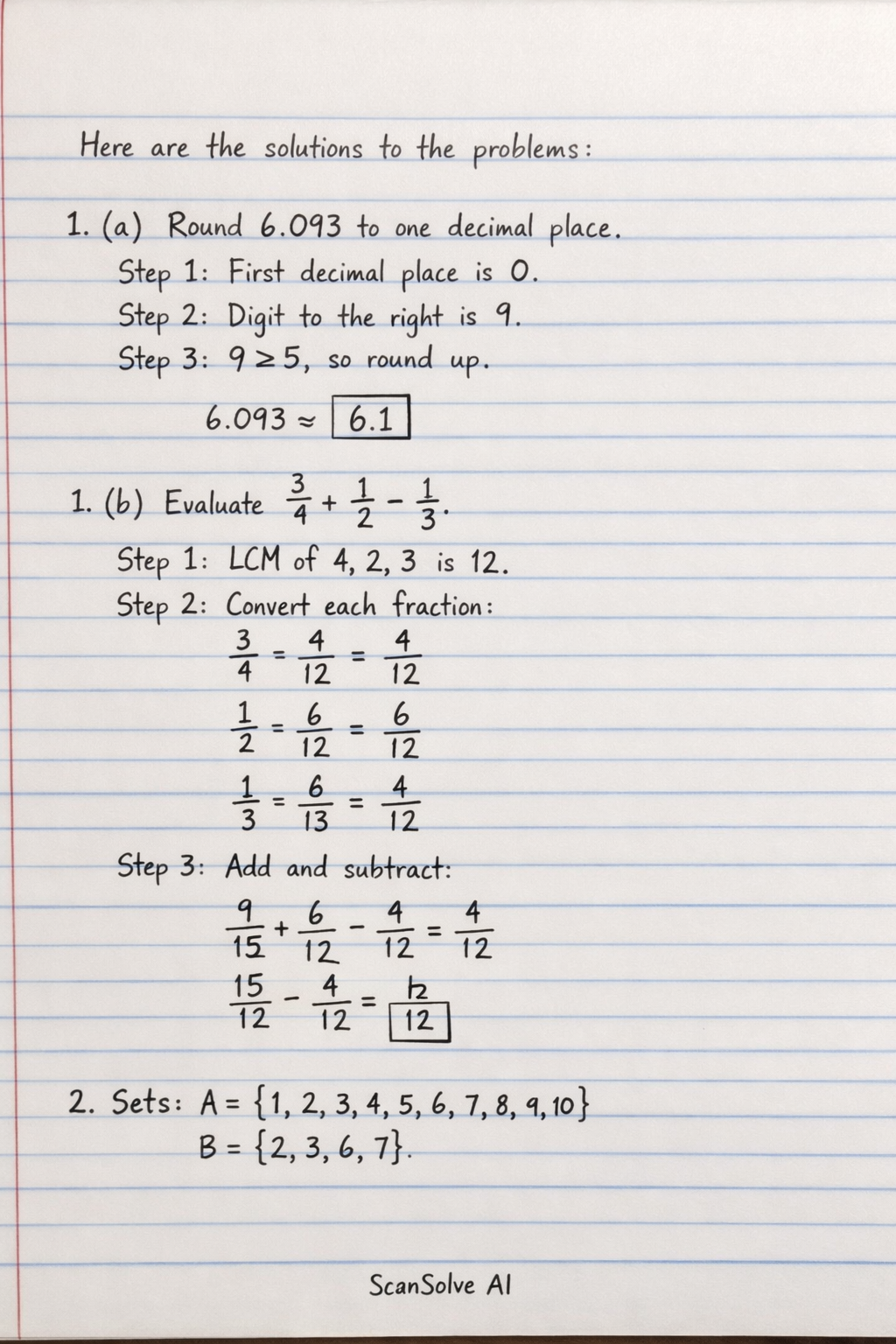
Handwritten Step-by-Step Solution
Get this as a handwritten image on WhatsApp — like a tutor wrote it for you.
Try on WhatsApp