This mathematics problem involves applying core mathematical principles and formulas. Below you will find a complete step-by-step solution with detailed explanations for each step, helping you understand not just the answer but the method behind it.
ScanSolve AI Answer
50.
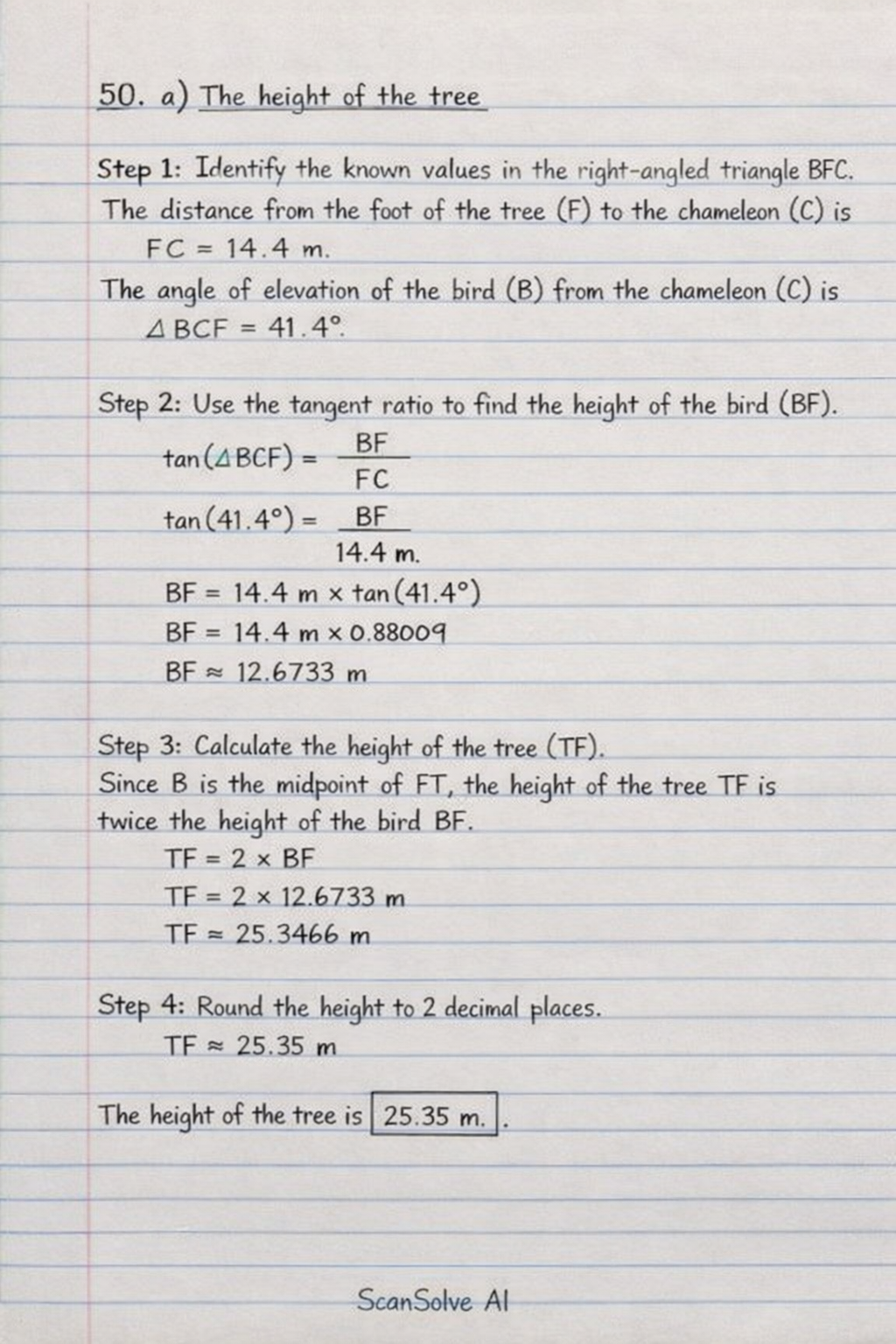
a) The height of the tree
Step 1: Identify the known values in the right-angled triangle BFC.
The distance from the foot of the tree (F) to the chameleon (C) is $FC = 14.4 \text{ m}$.
The angle of elevation of the bird (B) from the chameleon (C) is $\angle BCF = 41.4^\circ$.
Step 2: Use the tangent ratio to find the height of the bird (BF).
$$\tan(\angle BCF) = \frac{BF}{FC}$$
$$\tan(41.4^\circ) = \frac{BF}{14.4 \text{ m}}$$
$$BF = 14.4 \text{ m} \times \tan(41.4^\circ)$$
$$BF = 14.4 \text{ m} \times 0.88009$$
$$BF \approx 12.6733 \text{ m}$$
Step 3: Calculate the height of the tree (TF).
Since B is the midpoint of FT, the height of the tree TF is twice the height of the bird BF.
$$TF = 2 \times BF$$
$$TF = 2 \times 12.6733 \text{ m}$$
$$TF \approx 25.3466 \text{ m}$$
Step 4: Round the height to 2 decimal places.
$$TF \approx 25.35 \text{ m}$$
The height of the tree is $\boxed{25.35 \text{ m}}$.
b) The angle of depression of the chameleon from point T
Step 1: Identify the known values in the right-angled triangle TFC.
The height of the tree $TF \approx 25.3466 \text{ m}$ (from part a).
The distance from the foot of the tree (F) to the chameleon (C) is $FC = 14.4 \text{ m}$.
Step 2: The angle of depression of the chameleon from point T is equal to the angle of elevation of T from C, which is $\angle TCF$. Use the tangent ratio.
$$\tan(\angle TCF) = \frac{TF}{FC}$$
$$\tan(\angle TCF) = \frac{25.3466 \text{ m}}{14.4 \text{ m}}$$
$$\tan(\angle TCF) \approx 1.76018$$
Step 3: Calculate the angle $\angle TCF$.
$$\angle TCF = \arctan(1.76018)$$
$$\angle TCF \approx 60.399^\circ$$
Step 4: Round the angle to 2 decimal places.
$$\angle TCF \approx 60.40^\circ$$
The angle of depression of the chameleon from point T is $\boxed{60.40^\circ}$.
51.
Step 1: Convert the side length of the cubical stone from cm to m.
$$s = 40 \text{ cm} = 0.4 \text{ m}$$
Step 2: Calculate the volume of the cubical stone in m$^3$.
$$V = s^3$$
$$V = (0.4 \text{ m})^3$$
$$V = 0.064 \text{ m}^3$$
Step 3: Use the given mass and calculated volume to determine the density.
$$m = 12 \text{ kg}$$
$$\rho = \frac{m}{V}$$
$$\rho = \frac{12 \text{ kg}}{0.064 \text{ m}^3}$$
$$\rho = 187.5 \text{ kg/m}^3$$
The density of the stone is $\boxed{187.5 \text{ kg/m}^3}$.
52.
Step 1: Use the area formula for a triangle to find $\angle PQR$.
Given Area $= 30\sqrt{3} \text{ cm}^2$, $PQ = 10 \text{ cm}$, $QR = 12 \text{ cm}$.
$$\text{Area} = \frac{1}{2} \times PQ \times QR \times \sin(\angle PQR)$$
$$30\sqrt{3} = \frac{1}{2} \times 10 \times 12 \times \sin(\angle PQR)$$
$$30\sqrt{3} = 60 \times \sin(\angle PQR)$$
$$\sin(\angle PQR) = \frac{30\sqrt{3}}{60}$$
$$\sin(\angle PQR) = \frac{\sqrt{3}}{2}$$
Step 2: Determine the obtuse angle $\angle PQR$.
Since $\sin(\angle PQR) = \frac{\sqrt{3}}{2}$, the acute angle is $60^\circ$. As $\angle PQR$ is obtuse,
$$\angle PQR = 180^\circ - 60^\circ = 120^\circ$$
Step 3: Use the Cosine Rule to find the length of PR.
$$PR^2 = PQ^2 + QR^2 - 2 \times PQ \times QR \times \cos(\angle PQR)$$
$$PR^2 = (10 \text{ cm})^2 + (12 \text{ cm})^2 - 2 \times 10 \text{ cm} \times 12 \text{ cm} \times \cos(120^\circ)$$
$$PR^2 = 100 \text{ cm}^2 + 144 \text{ cm}^2 - 240 \text{ cm}^2 \times \left(-\frac{1}{2}\right)$$
$$PR^2 = 244 \text{ cm}^2 + 120 \text{ cm}^2$$
$$PR^2 = 364 \text{ cm}^2$$
$$PR = \sqrt{364} \text{ cm}$$
$$PR \approx 19.0787 \text{ cm}$$
Step 4: Calculate the perimeter of the triangle.
$$\text{Perimeter} = PQ + QR + PR$$
$$\text{Perimeter} = 10 \text{ cm} + 12 \text{ cm} + 19.0787 \text{ cm}$$
$$\text{Perimeter} = 41.0787 \text{ cm}$$
Step 5: Round the perimeter to 2 decimal places.
$$\text{Perimeter} \approx 41.08 \text{ cm}$$
The perimeter of the triangle is $\boxed{41.08 \text{ cm}}$.
53.
Step 1: Calculate the total time elapsed from Monday 6:00 a.m. to Friday 6:00 a.m.
From Monday 6:00 a.m. to Friday 6:00 a.m. is 4 full days.
Total hours = $4 \text{ days} \times 24 \text{ hours/day} = 96 \text{ hours}$.
Step
Identify the known values in the right-angled triangle BFC.
|Mathematics
Identify the known values in the right-angled triangle BFC.
ScanSolve AI Answer
50.a) The height of the tree
Step 1: Identify the known values in the right-angled triangle BFC.
The distance from the foot of the tree (F) to the chameleon (C) is FC=14.4 m.
The angle of elevation of the bird (B) from the chameleon (C) is ∠BCF=41.4∘.
Step 2: Use the tangent ratio to find the height of the bird (BF).
tan(∠BCF)=FCBFtan(41.4∘)=14.4mBFBF=14.4m×tan(41.4∘)BF=14.4m×0.88009BF≈12.6733 m
Step 3: Calculate the height of the tree (TF).
Since B is the midpoint of FT, the height of the tree TF is twice the height of the bird BF.
TF=2×BFTF=2×12.6733 mTF≈25.3466 m
Step 4: Round the height to 2 decimal places.
TF≈25.35 m
The height of the tree is 25.35m.
b) The angle of depression of the chameleon from point T
Step 1: Identify the known values in the right-angled triangle TFC.
The height of the tree TF≈25.3466 m (from part a).
The distance from the foot of the tree (F) to the chameleon (C) is FC=14.4 m.
Step 2: The angle of depression of the chameleon from point T is equal to the angle of elevation of T from C, which is ∠TCF. Use the tangent ratio.
tan(∠TCF)=FCTFtan(∠TCF)=14.4m25.3466mtan(∠TCF)≈1.76018
Step 3: Calculate the angle ∠TCF.
∠TCF=arctan(1.76018)∠TCF≈60.399∘
Step 4: Round the angle to 2 decimal places.
∠TCF≈60.40∘
The angle of depression of the chameleon from point T is 60.40∘.
51.
Step 1: Convert the side length of the cubical stone from cm to m.
s=40cm=0.4 m
Step 2: Calculate the volume of the cubical stone in m3.
V=s3V=(0.4m)3V=0.064m3
Step 3: Use the given mass and calculated volume to determine the density.
m=12 kgρ=Vmρ=0.064m312kgρ=187.5kg/m3
The density of the stone is 187.5kg/m3.
52.
Step 1: Use the area formula for a triangle to find ∠PQR.
Given Area =303cm2, PQ=10 cm, QR=12 cm.
Area=21×PQ×QR×sin(∠PQR)303=21×10×12×sin(∠PQR)303=60×sin(∠PQR)sin(∠PQR)=60303sin(∠PQR)=23
Step 2: Determine the obtuse angle ∠PQR.
Since sin(∠PQR)=23, the acute angle is 60∘. As ∠PQR is obtuse,
∠PQR=180∘−60∘=120∘
Step 3: Use the Cosine Rule to find the length of PR.
PR2=PQ2+QR2−2×PQ×QR×cos(∠PQR)PR2=(10cm)2+(12cm)2−2×10cm×12cm×cos(120∘)PR2=100cm2+144cm2−240cm2×(−21)PR2=244cm2+120cm2PR2=364cm2PR=364 cmPR≈19.0787 cm
Step 4: Calculate the perimeter of the triangle.
Perimeter=PQ+QR+PRPerimeter=10cm+12cm+19.0787 cmPerimeter=41.0787 cm
Step 5: Round the perimeter to 2 decimal places.
Perimeter≈41.08 cm
The perimeter of the triangle is 41.08cm.
53.
Step 1: Calculate the total time elapsed from Monday 6:00 a.m. to Friday 6:00 a.m.
From Monday 6:00 a.m. to Friday 6:00 a.m. is 4 full days.
Total hours = 4days×24hours/day=96 hours.
Step
Need help with your own homework?
Get instant step-by-step solutions to any question. Free to start.