
We read your photo as:
Identify the pattern in each sequence and find the missing number.
ScanSolve AI Answer
Step-by-step solution
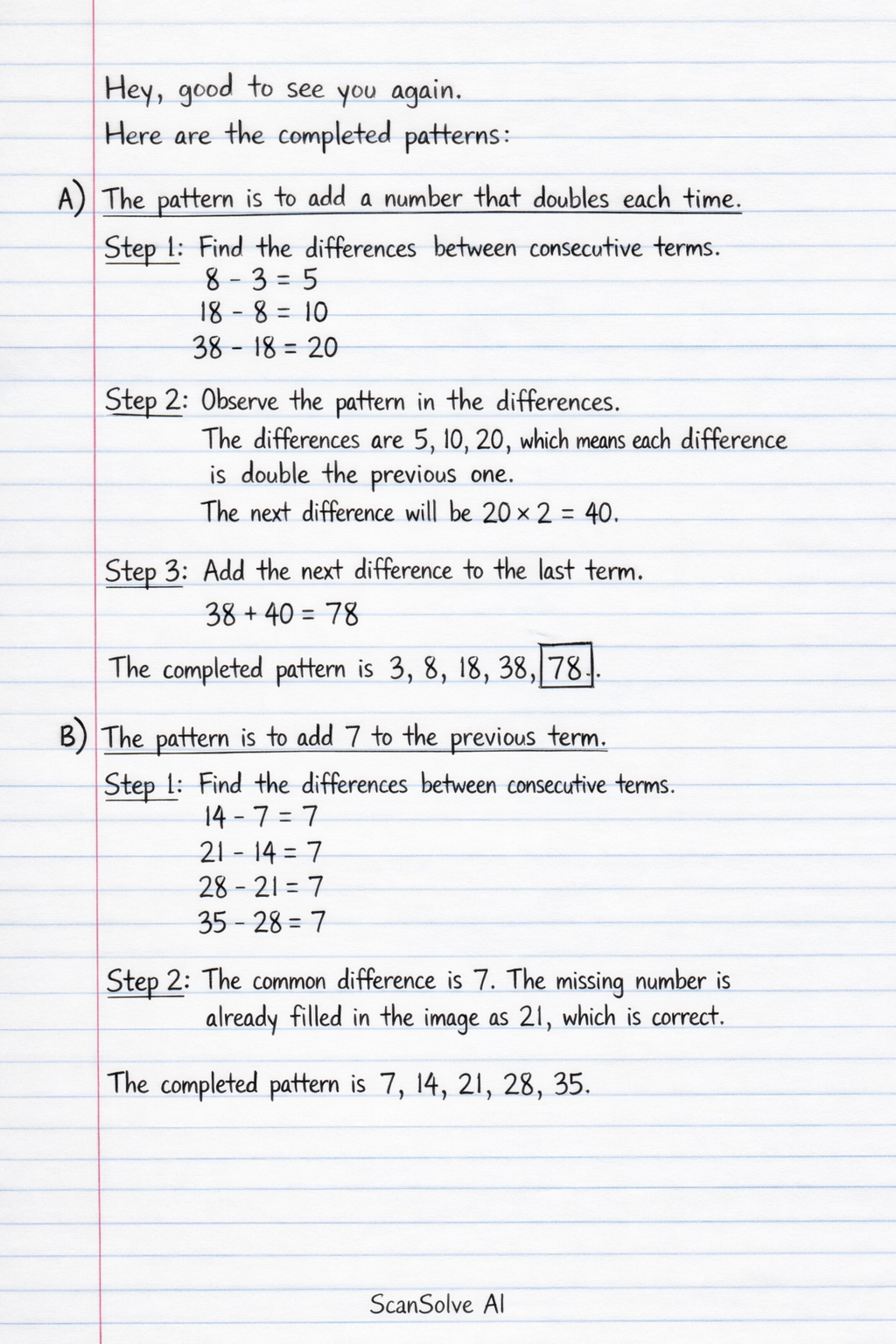
18 stepsHere are the completed patterns:
A) The pattern is to add a number that doubles each time.
Find the differences between consecutive terms.
Observe the pattern in the differences.
The differences are , which means each difference is double the previous one. The next difference will be .
Add the next difference to the last term.
The completed pattern is .B) The pattern is to add 7 to the previous term.
Find the differences between consecutive terms.
The common difference is 7.
The missing number is already filled in the image as 21, which is correct.
The completed pattern is .C) The pattern is to subtract a number that increases by 1 each time.
Find the differences between consecutive terms.
Observe the pattern in the differences.
The differences are . The next difference will be .
Subtract the next difference from the last term.
The completed pattern is .D) The pattern is to subtract numbers following the sequence .
Find the differences between consecutive terms.
Observe the pattern in the subtractions
. The pattern for these subtractions is to subtract 8, then add 2, then add 2. So, . The next number to subtract is 8.
Subtract the next number in the sequence of subtractions from the last term.
The completed pattern is .E) The pattern is to add a number that doubles each time.
Find the differences between consecutive terms.
Observe the pattern in the differences.
The differences are , which means each difference is double the previous one. The next difference will be .
Add the next difference to the last known term.
Verify the next step with the given number.
The next difference would be .
. This matches the given number.
The completed pattern is .F) The pattern is to divide the previous term by 3.
Find the relationship between consecutive terms.
The common operation is division by 3.
Apply this to find the missing term.
Verify the next step.
. This matches the given number.
The completed pattern is .
Still stuck on this one?
Ask a follow-up, and the answer starts from this question.
More Mathematics Questions
Handwritten Step-by-Step Solution
Get this as a handwritten image on WhatsApp — like a tutor wrote it for you.
Try on WhatsApp