
We read your photo as:
Identify the shapes and their properties.
ScanSolve AI Answer
Answers
2 partsStep-by-step solution
8 stepsHere's an analysis of the figures provided:
Part a· 3 steps
Triangle ABC
This is a right-angled triangle with the right angle at A. We are given the hypotenuse and one leg . We can find the length of the other leg, , using the Pythagorean theorem.
Apply the Pythagorean theorem.
Substitute the given values.
Solve for .
Part b
Triangle DEF
This is a right-angled triangle with the right angle at E. We are given the lengths of the two legs, and . We can find the length of the hypotenuse, , using the Pythagorean theorem.
Apply the Pythagorean theorem.
Substitute the given values.
Solve for .
Part c· 1 step
Quadrilateral ABCD
Identify the properties of the quadrilateral.
The figure shows a quadrilateral with all four angles marked as right angles (). The adjacent sides have different lengths ( and ).
This shape is a rectangle.
Part d· 1 step
Quadrilateral PQRS
Identify the properties of the quadrilateral.
The figure shows a quadrilateral with all four angles marked as right angles (). The adjacent sides have equal lengths ( and ).
This shape is a square.
Try one yourself
A new problem that tests the same skill.
Still stuck on this one?
Ask a follow-up, and the answer starts from this question.
More Mathematics Questions
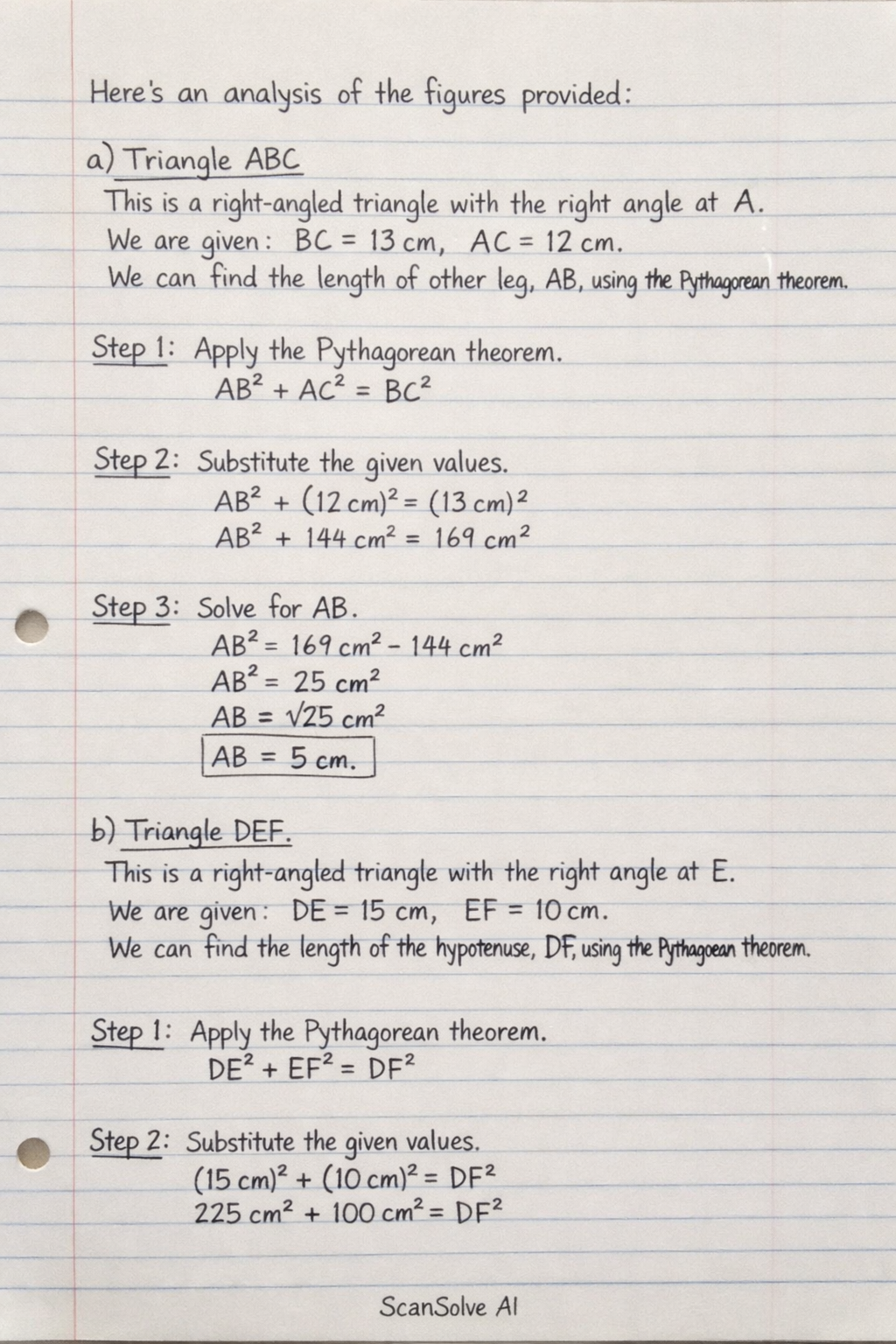
Handwritten Step-by-Step Solution
Get this as a handwritten image on WhatsApp — like a tutor wrote it for you.
Try on WhatsApp