

This mathematics problem involves applying core mathematical principles and formulas. Below you will find a complete step-by-step solution with detailed explanations for each step, helping you understand not just the answer but the method behind it.
ScanSolve AI Answer
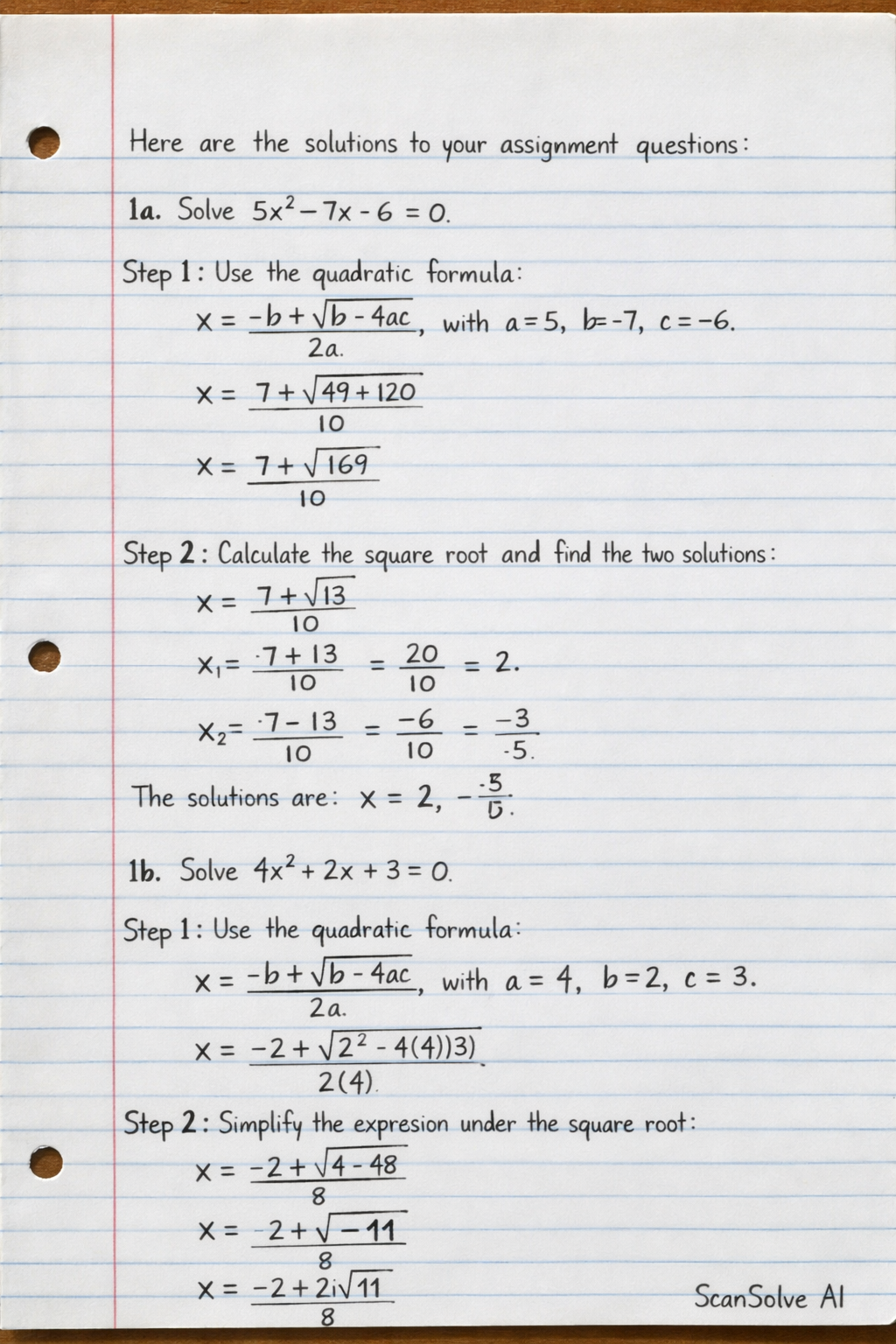
Here are the solutions to your assignment questions: 1a. Solve 5x^2 - 7x - 6 = 0. Step 1: Use the quadratic formula x = -b ± sqrt(b^2 - 4ac)2a with a=5, b=-7, c=-6. x = -(-7) ± sqrt((-7)^2 - 4(5)(-6))2(5) Step 2: Simplify the expression under the square root. x = 7 ± sqrt(49 + 120)10 x = 7 ± sqrt(169)10 Step 3: Calculate the square root and find the two solutions. x = (7 ± 13)/(10) x_1 = (7 + 13)/(10) = (20)/(10) = 2 x_2 = (7 - 13)/(10) = (-6)/(10) = -(3)/(5) The solutions are x = 2, -(3)/(5). 1b. Solve 4x^2 + 2x + 3 = 0. Step 1: Use the quadratic formula x = -b ± sqrt(b^2 - 4ac)2a with a=4, b=2, c=3. x = -2 ± sqrt(2^2 - 4(4)(3))2(4) Step 2: Simplify the expression under the square root. x = -2 ± sqrt(4 - 48)8 x = -2 ± sqrt(-44)8 Step 3: Simplify the square root involving the imaginary unit i. x = -2 ± sqrt(4 × -11)8 x = -2 ± 2isqrt(11)8 Step 4: Simplify the fraction. x = 2(-1 ± isqrt(11))8 x = -1 ± isqrt(11)4 The solutions are x = -1 ± isqrt(11)4. 2a. Convert 101101_2 to base ten. Step 1: Write out the place values for each digit in base 2. 101101_2 = 1 × 2^5 + 0 × 2^4 + 1 × 2^3 + 1 × 2^2 + 0 × 2^1 + 1 × 2^0 Step 2: Calculate the value of each term. = 1 × 32 + 0 × 16 + 1 × 8 + 1 × 4 + 0 × 2 + 1 × 1 = 32 + 0 + 8 + 4 + 0 + 1 Step 3: Sum the values. = 45 The base ten equivalent is 45_10. 2b. Convert 156_10 to base two. Step 1: Divide 156 by 2 and record the remainder. Continue dividing the quotient by 2 until the quotient is 0. 156 ÷ 2 = 78 R 0 78 ÷ 2 = 39 R 0 39 ÷ 2 = 19 R 1 19 ÷ 2 = 9 R 1 9 ÷ 2 = 4 R 1 4 ÷ 2 = 2 R 0 2 ÷ 2 = 1 R 0 1 ÷ 2 = 0 R 1 Step 2: Read the remainders from bottom to top. The base two equivalent is 10011100_2. 3a. Evaluate sqrt(50) + sqrt(18). Step 1: Simplify each square root by finding perfect square factors. sqrt(50) = sqrt(25 × 2) = sqrt(25) × sqrt(2) = 5sqrt(2) sqrt(18) = sqrt(9 × 2) = sqrt(9) × sqrt(2) = 3sqrt(2) Step 2: Substitute the simplified terms back into the expression. 5sqrt(2) + 3sqrt(2) Step 3: Combine the like terms. (5+3)sqrt(2) = 8sqrt(2) The evaluated expression is 8sqrt(2). 3b. Simplify sqrt(12) - 2sqrt(27). Step 1: Simplify each square root. sqrt(12) = sqrt(4 × 3) = sqrt(4) × sqrt(3) = 2sqrt(3) sqrt(27) = sqrt(9 × 3) = sqrt(9) × sqrt(3) = 3sqrt(3) Step 2: Substitute the simplified terms back into the expression. 2sqrt(3) - 2(3sqrt(3)) Step 3: Perform the multiplication and combine the like terms. 2sqrt(3) - 6sqrt(3) = (2-6)sqrt(3) = -4sqrt(3) The simplified expression is -4sqrt(3). 4a. Simplify (3a)^3 × (9a^5)^-1. Step 1: Apply the exponent rule (xy)^n = x^n y^n to the first term. (3a)^3 = 3^3 a^3 = 27a^3 Step 2: Apply the exponent rule x^-n = (1)/(x^n) to the second term. (9a^5)^-1 = (1)/(9a^5) Step 3: Multiply the simplified terms. 27a^3 × (1)/(9a^5) = (27a^3)/(9a^5) Step 4: Simplify the fraction using exponent rule (x^m)/(x^n) = x^m-n. = (27)/(9) × a^3-5 = 3a^-2 = (3)/(a^2) The simplified expression is (3)/(a^2). 4b. Simplify 2 - (3)/(x+2) + (4)/((x+3)^2). Step 1: Find a common denominator, which is (x+2)(x+3)^2. 2 - (3)/(x+2) + (4)/((x+3)^2) = (2(x+2)(x+3)^2)/((x+2)(x+3)^2) - (3(x+3)^2)/((x+2)(x+3)^2) + (4(x+2))/((x+2)(x+3)^2) Step 2: Combine the numerators over the common denominator. = (2(x+2)(x+3)^2 - 3(x+3)^2 + 4(x+2))/((x+2)(x+3)^2) Step 3: Expand (x+3)^2 = x^2 + 6x + 9 and then expand the numerator. = (2(x+2)(x^2+6x+9) - 3(x^2+6x+9) + 4x+8)/((x+2)(x+3)^2) = (2(x^3+6x^2+9x+2x^2+12x+18) - 3x^2-18x-27 + 4x+8)/((x+2)(x+3)^2) = (2(x^3+8x^2+21x+18) - 3x^2-18x-27 + 4x+8)/((x+2)(x+3)^2) = (2x^3+16x^2+42x+36 - 3x^2-18x-27 + 4x+8)/((x+2)(x+3)^2) Step 4: Combine like terms in the numerator. = (2x^3 + (16-3)x^2 + (42-18+4)x + (36-27+8))/((x+2)(x+3)^2) = (2x^3 + 13x^2 + 28x + 17)/((x+2)(x+3)^2) The simplified expression is (2x^3 + 13x^2 + 28x + 17)/((x+2)(x+3)^2). 5a. Simplify (2x)/(x+y) + (3y)/(x+y). Step 1: Since the denominators are the same, add the numerators. = (2x+3y)/(x+y) The simplified expression is (2x+3y)/(x+y). 5b. If 2x+5=17 find the value of x. Step 1: Subtract 5 from both sides of the equation. 2x + 5 - 5 = 17 - 5 2x = 12 Step 2: Divide both sides by 2. (2x)/(2) = (12)/(2) x = 6 The value of x is 6.