

This mathematics problem involves applying core mathematical principles and formulas. Below you will find a complete step-by-step solution with detailed explanations for each step, helping you understand not just the answer but the method behind it.
ScanSolve AI Answer
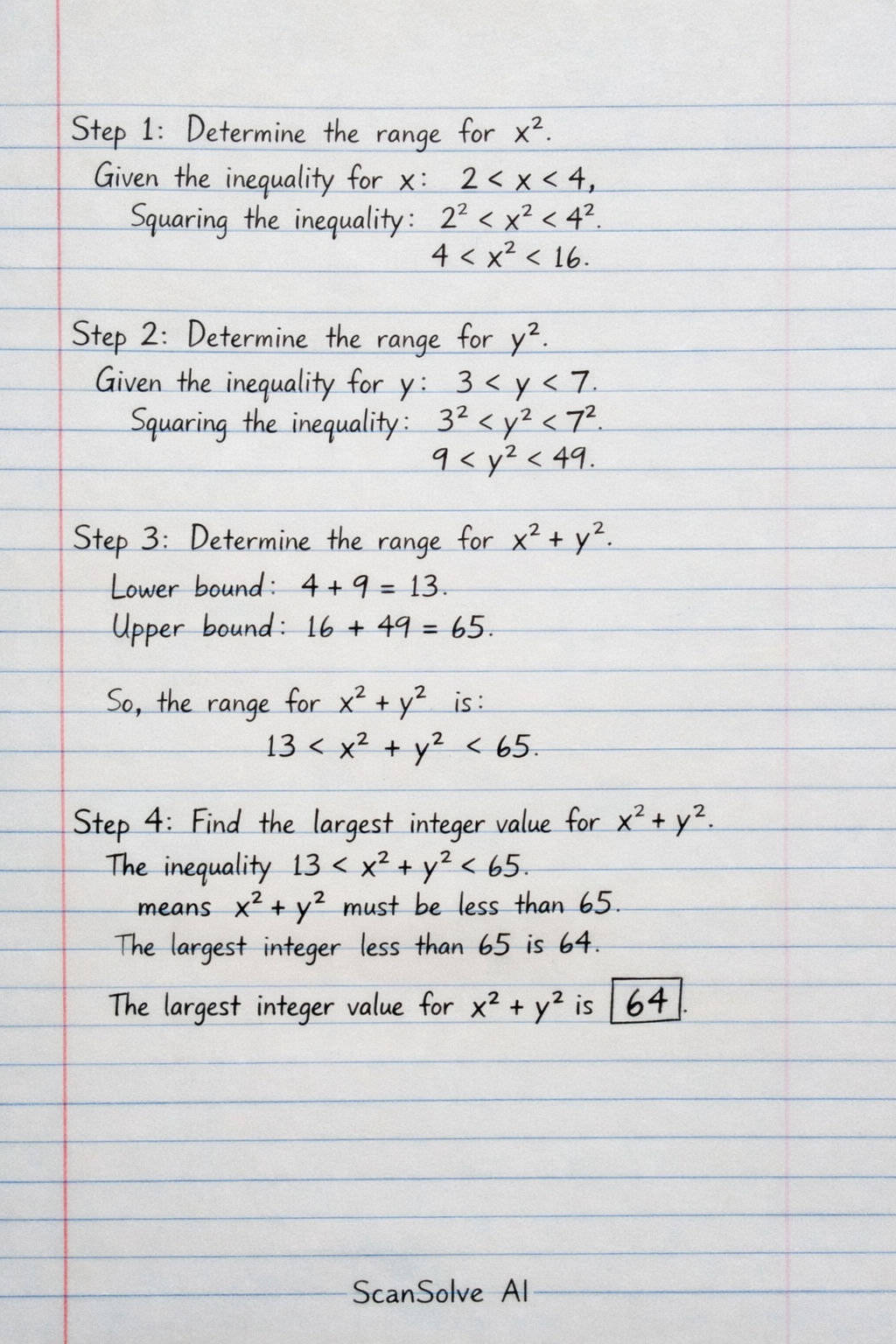
Step 1: Determine the range for x^2. Given the inequality for x: 2 < x < 4 Since x is positive, squaring all parts of the inequality will maintain the direction of the inequalities: 2^2 < x^2 < 4^2 4 < x^2 < 16 Step 2: Determine the range for y^2. Given the inequality for y: 3 < y < 7 Since y is positive, squaring all parts of the inequality will maintain the direction of the inequalities: 3^2 < y^2 < 7^2 9 < y^2 < 49 Step 3: Determine the range for x^2 + y^2. To find the range for the sum x^2 + y^2, we add the corresponding lower bounds and upper bounds of the individual ranges: Lower bound: 4 + 9 = 13 Upper bound: 16 + 49 = 65 So, the range for x^2 + y^2 is: 13 < x^2 + y^2 < 65 Step 4: Find the largest integer value for x^2 + y^2. The inequality 13 < x^2 + y^2 < 65 means that x^2 + y^2 must be strictly less than 65. The largest integer that is strictly less than 65 is 64. The largest integer value for x^2 + y^2 is 64. Send me the next one 📸