
We read your photo as:
If an amount becomes 1.21 times itself in 2 years, what is the compound interest rate?
Mathematics
ScanSolve AI Answer
Answer
Step-by-step solution
4 stepsIdentify the given information.
Let the principal amount be .
The amount after 2 years is .
The time period is years.
We need to find the annual compound interest rate .Use the compound interest formula.
The formula for compound interest is:
Substitute the given values into the formula.
Solve for .
Divide both sides by :
Take the square root of both sides:
Subtract 1 from both sides:
Multiply by 100:
The annual compound interest rate is . This matches option (c).
The final answer is .
Was this helpful?
Try one yourself
A new problem that tests the same skill.
Still stuck on this one?
Ask a follow-up, and the answer starts from this question.
Got a different question?Ask your own question
More Mathematics Questions
QCalculate simple interest for 1 year and total amount after 2 years, and compound interest for 2…QA sum of money becomes four times itself in 15 years at simple interest. What is the rate of…QIdentify the compound interest for the first year (CI1) and the second year (CI2).QHow do you calculate compound interest?QNo.3 At what annual rate of compound interest will R2000 grow to R2721 after 4 years?
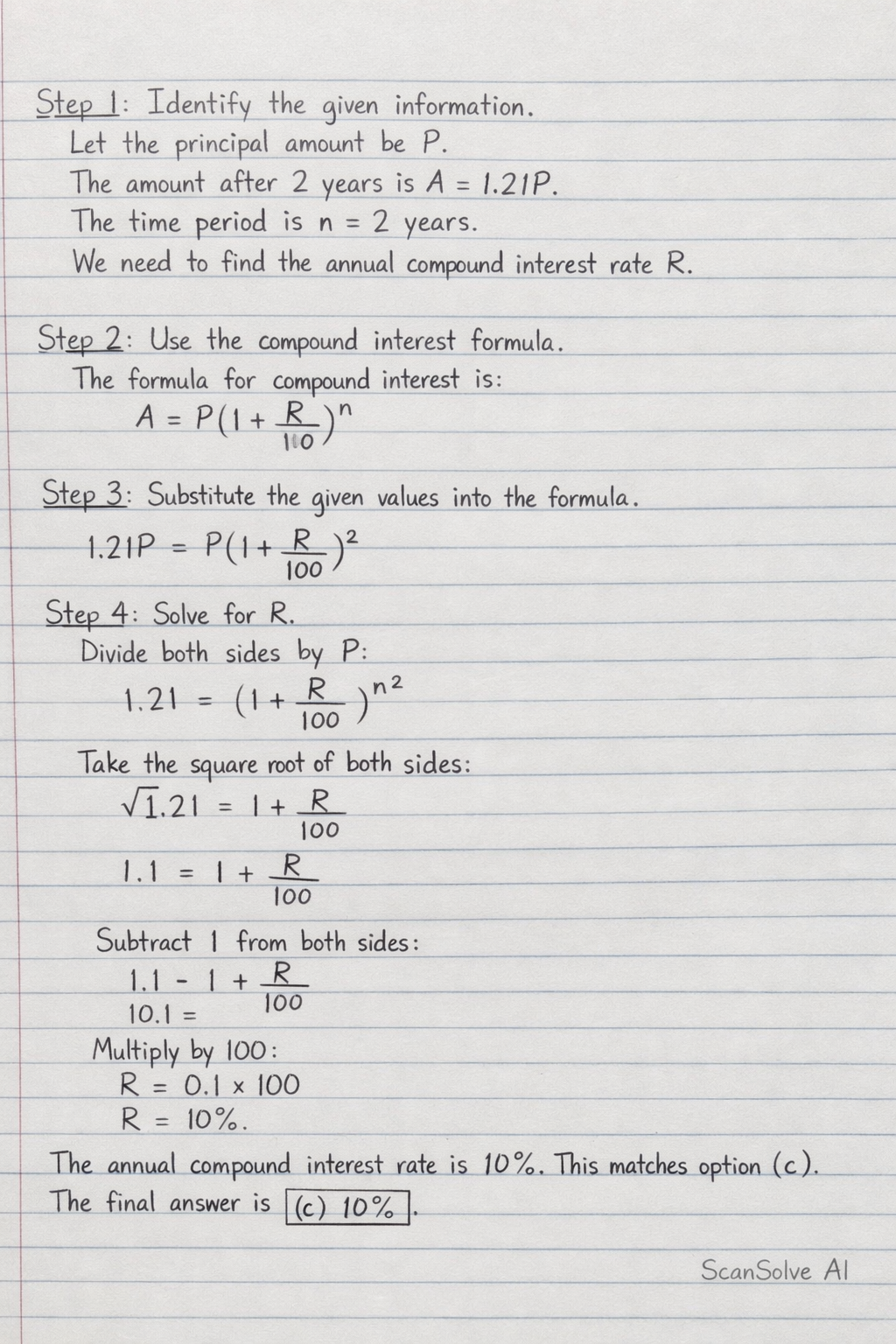
Handwritten Step-by-Step Solution
Get this as a handwritten image on WhatsApp — like a tutor wrote it for you.
Try on WhatsApp