We read your photo as:

Determine if the following equations represent linear functions. Show your work.

Mathematics

ScanSolve AI Answer

Step-by-step solution

15 steps

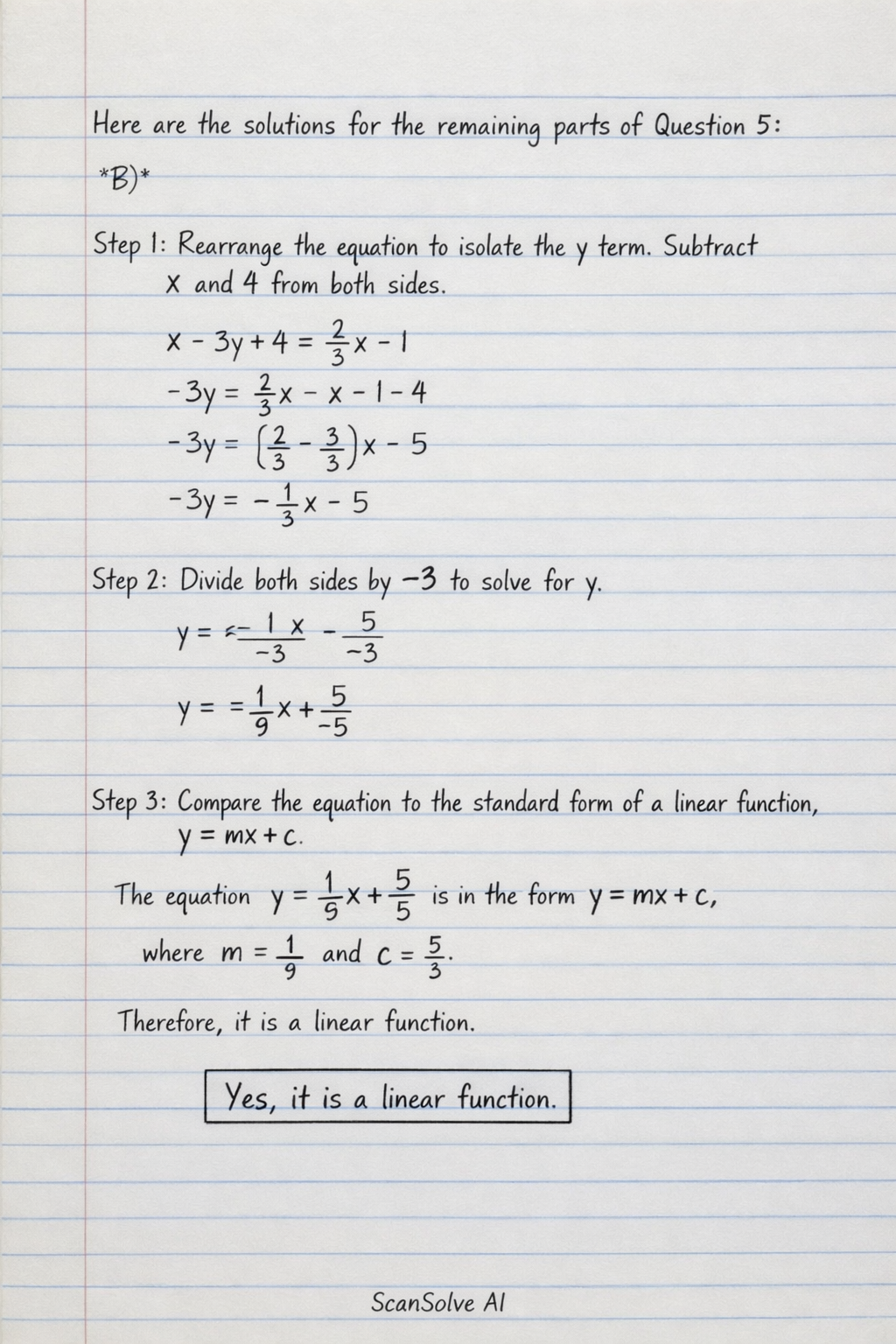
Here are the solutions for the remaining parts of Question 5:

B)

  1. Rearrange the equation to isolate the yy term.

    Subtract xx and 4 from both sides.

    x−3y+4=23x−1x - 3y + 4 = \frac{2}{3}x - 1 −3y=23x−x−1−4-3y = \frac{2}{3}x - x - 1 - 4 −3y=(23−33)x−5-3y = \left(\frac{2}{3} - \frac{3}{3}\right)x - 5 −3y=−13x−5-3y = -\frac{1}{3}x - 5
  2. Divide both sides by −3-3 to solve for yy.

    y=−13x−3−5−3y = \frac{-\frac{1}{3}x}{-3} - \frac{5}{-3} y=19x+53y = \frac{1}{9}x + \frac{5}{3}
  3. Compare the equation to the standard form of a linear function, y=mx+cy = mx + c.

    The equation y=19x+53y = \frac{1}{9}x + \frac{5}{3} is in the form y=mx+cy = mx + c, where m=19m = \frac{1}{9} and c=53c = \frac{5}{3}.
    Therefore, it is a linear function.

    Yes, it is a linear function.\boxed{\text{Yes, it is a linear function.}}

    C)

  4. Eliminate the denominators by multiplying both sides by $2x$.

    x−y2x=2x−3y2\frac{x-y}{2x} = \frac{2x-3y}{2} 2(x−y)=2x(2x−3y)2(x-y) = 2x(2x-3y) x−y=x(2x−3y)x-y = x(2x-3y)
  5. Expand the right side of the equation.

    x−y=2x2−3xyx-y = 2x^2 - 3xy
  6. Attempt to isolate yy.

    −y+3xy=2x2−x-y + 3xy = 2x^2 - x y(−1+3x)=2x2−xy(-1 + 3x) = 2x^2 - x y=2x2−x3x−1y = \frac{2x^2 - x}{3x - 1}
  7. Compare the equation to the standard form of a linear function, y=mx+cy = mx + c.

    The equation contains x2x^2 and xx in the denominator, which means it cannot be written in the form y=mx+cy = mx + c.
    Therefore, it is not a linear function.

    No, it is not a linear function.\boxed{\text{No, it is not a linear function.}}

    D)

  8. Simplify the left side of the equation.

    Assuming x−y≠0x-y \neq 0, the fraction x−yx−y\frac{x-y}{x-y} simplifies to 1.

    x−yx−y=x+y\frac{x-y}{x-y} = x + y 1=x+y1 = x + y
  9. Isolate yy by subtracting xx from both sides.

    y=−x+1y = -x + 1
  10. Compare the equation to the standard form of a linear function, y=mx+cy = mx + c.

    The equation y=−x+1y = -x + 1 is in the form y=mx+cy = mx + c, where m=−1m = -1 and c=1c = 1.
    Therefore, it is a linear function (with the condition x≠yx \neq y).

    Yes, it is a linear function.\boxed{\text{Yes, it is a linear function.}}

    E)

  11. Eliminate the denominators by multiplying both sides by the least common multiple of 3 and 2, which is 6.

    2x+2y3=3(x+2y)2\frac{2x+2y}{3} = \frac{3(x+2y)}{2} 6⋅2x+2y3=6⋅3(x+2y)26 \cdot \frac{2x+2y}{3} = 6 \cdot \frac{3(x+2y)}{2} 2(2x+2y)=3⋅3(x+2y)2(2x+2y) = 3 \cdot 3(x+2y) 4x+4y=9(x+2y)4x+4y = 9(x+2y)
  12. Expand the right side of the equation.

    4x+4y=9x+18y4x+4y = 9x+18y
  13. Collect yy terms on one side and xx terms on the other side.

    4y−18y=9x−4x4y - 18y = 9x - 4x −14y=5x-14y = 5x
  14. Solve for yy by dividing both sides by −14-14.

    y=−514xy = -\frac{5}{14}x
  15. Compare the equation to the standard form of a linear function, y=mx+cy = mx + c.

    The equation y=−514xy = -\frac{5}{14}x is in the form y=mx+cy = mx + c, where m=−514m = -\frac{5}{14} and c=0c = 0.
    Therefore, it is a linear function.

    Yes, it is a linear function.\boxed{\text{Yes, it is a linear function.}}
Was this helpful?

Still stuck on this one?

Ask a follow-up, and the answer starts from this question.

Got a different question?Ask your own question
Handwritten step-by-step solution preview

Handwritten Step-by-Step Solution

Get this as a handwritten image on WhatsApp — like a tutor wrote it for you.

Try on WhatsApp