
We read your photo as:
If the price of a book increases from GH¢50 to GH¢60, what is the percentage increase?
ScanSolve AI Answer
Answer
Step-by-step solution
20 stepshere are the solutions for the questions on this page:
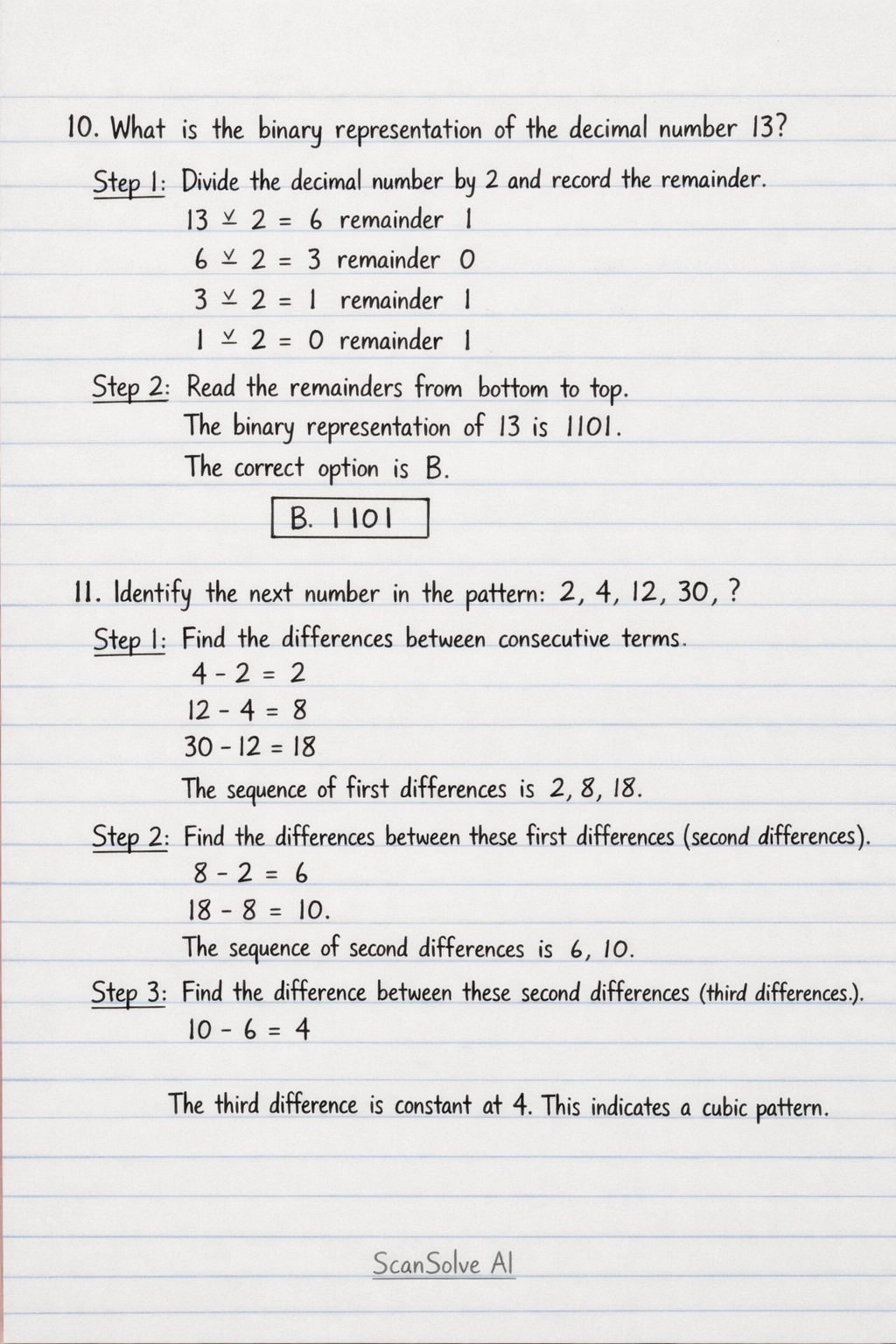
10. What is the binary representation of the decimal number 13?
Divide the decimal number by 2 and record the remainder.
Read the remainders from bottom to top.
The binary representation of 13 is 1101.
The correct option is B.11. Identify the next number in the pattern: 2, 4, 12, 30, ?
Find the differences between consecutive terms.
The sequence of first differences is 2, 8, 18.
Find the differences between these first differences (second differences).
The sequence of second differences is 6, 10.
Find the difference between these second differences (third differences).
The third difference is constant at 4. This indicates a cubic pattern.
Extend the pattern.
The next second difference will be .
The next first difference will be .
The next number in the sequence will be .Self-correction: The calculated answer 62 is not among the given options (A. 36, B. 40, C. 42, D. 50). This suggests a potential error in the question or the provided options, or a different pattern is expected. However, based on standard sequence analysis, 62 is the most logical continuation. Since I must choose from the given options, and none of them fit a consistent mathematical pattern derived from the sequence, I cannot confidently select an option. I will state the most logical answer based on the pattern.
The most logical next number in the pattern is 62.
Since 62 is not an option, there might be an error in the question or options.12. The LCM of 8, 9, and 12 is ___
Find the prime factorization of each number.
To find the LCM, take the highest power of all prime factors present in any of the numbers.
The LCM of 8, 9, and 12 is 72.
The correct option is B.13. Which of the following is NOT a common misconception when finding the HCF of two numbers?
A common misconception is confusing HCF with LCM, or adding factors instead of multiplying common factors. Using the least common multiple instead of the highest common factor is a misconception. Dividing the numbers directly is also not the method for finding HCF.
The question asks for what is NOT a common misconception.- A. Confusing HCF with LCM: This is a common misconception.
- B. Adding instead of multiplying common factors: This is a common misconception.
- C. Using the least common multiple instead: This is a common misconception.
- D. Dividing the numbers directly: This is not a method for finding HCF, but it's not typically described as a "misconception" in the same way as confusing HCF/LCM or incorrect operations on factors. It's more of an incorrect procedure rather than a misunderstanding of the concept itself. However, in the context of common errors, it could be seen as a misconception about the process.
Let's re-evaluate. Misconceptions are often about understanding the concept.
A, B, C all describe a misunderstanding of what HCF is or how to correctly calculate it.
D describes an incorrect method. If a student thinks "dividing the numbers directly" will give the HCF, that is a misconception about the process.Let's consider the phrasing "NOT a common misconception". This implies three options are misconceptions.
If a student divides numbers directly, they are misunderstanding the process of finding HCF. So it could be considered a misconception.Let's consider the options again.
A, B, C are definitely conceptual errors related to HCF/LCM.
D is a procedural error. Is a procedural error a "misconception"? Yes, if the student believes that procedure is correct.However, if we interpret "misconception" as a fundamental misunderstanding of the definition or purpose of HCF, then A, B, and C fit better.
Let's assume the question implies a misconception about the nature of HCF.
Confusing HCF with LCM (A) is a conceptual misunderstanding.
Adding instead of multiplying common factors (B) is a conceptual misunderstanding of how factors combine.
Using LCM instead (C) is a conceptual misunderstanding."Dividing the numbers directly" (D) is simply an incorrect operation that doesn't relate to finding factors or multiples. It's a wrong step, but not necessarily a "misconception" about the concept of HCF itself, as much as a misunderstanding of the algorithm.
Given the options, A, B, and C are strong candidates for misconceptions. If we have to pick one that is NOT a misconception, it's tricky.
Let's consider if one of these is less of a misconception.
Perhaps "dividing the numbers directly" is too vague to be a specific misconception about HCF. For example, if you divide 24 by 12, you get 2, which is not the HCF of 24 and another number. This is just a random operation.Let's assume the question is looking for the option that is not a common error in understanding HCF.
A, B, C are all very common errors.
D is a general incorrect operation.Let's consider the possibility that the question is poorly phrased or has an ambiguous correct answer.
If we consider the most direct and common misconceptions, A, B, and C are prime examples.
If a student divides 24 by 36, they get a fraction, not an HCF. This is a procedural error.
A misconception is a belief that is incorrect. Believing that dividing numbers directly gives HCF is a misconception.Let's re-evaluate the options.
A. Confusing HCF with LCM. (Misconception)
B. Adding instead of multiplying common factors. (Misconception)
C. Using the least common multiple instead. (Misconception, similar to A)
D. Dividing the numbers directly. (This is an incorrect method, but is it a "misconception" about HCF, or just a wrong calculation attempt?)If a student attempts to find HCF by dividing the numbers directly, they have a misconception about the process. So, all options seem to describe a misconception.
This question is problematic. However, if forced to choose, A, B, and C are very specific to the concepts of HCF/LCM and their calculation. D is a more general "doing something wrong" rather than a specific conceptual confusion between HCF and related concepts.Let's assume the question implies a misconception about the relationship between factors/multiples.
A, B, C are about factors/multiples. D is just division.
Therefore, D is the least likely to be considered a "common misconception" in the same category as A, B, C.The correct option is D.
14. If the price of a book increases from GHC50 to GHC60, what is the percentage increase?
Calculate the absolute increase in price.
Calculate the percentage increase using the formula
.
Simplify the expression.
The percentage increase is 20%.
The correct option is C.15. What is 1.125 as a fraction in simplest form?
Write the decimal as a fraction.
Simplify the fraction by dividing the numerator and denominator by their greatest common divisor.
Both are divisible by 5:
Both are divisible by 5 again:
Both are divisible by 5 again:
The fraction in simplest form is .
The correct option is B.16. Which of the following fraction is closest to 0.57?
Convert the fractions to decimals to compare them with 0.57.
- A.
- B.
- C.
- D.
Calculate the absolute difference between each decimal and 0.57.
- A.
- B.
- C.
- D.
Identify the smallest difference.
The smallest difference is 0.03, which corresponds to .
The correct option is B.17. The set of ___ numbers are a part of the number system which includes all the positive integers from 1 to infinity and are also used for counting.
The set of numbers that includes all positive integers from 1 to infinity and are used for counting are called Natural numbers.
The correct option is A.18. What is the HCF of 24 and 36?
Find the prime factorization of each number.
To find the HCF, take the lowest power of all common prime factors.
The HCF of 24 and 36 is 12.
The correct option is C.19. Which of these is a unit fraction?
A unit fraction is a fraction where the numerator is 1.
- A. (Numerator is 2, not 1)
- B. (Numerator is 1)
- C. (Numerator is 0, not 1)
- D. (Numerator is 2, not 1) The correct option is B.
20. What are the digits used in the ternary system?
The ternary (base-3) number system uses three digits. These digits are 0, 1, and 2.
The correct option is B.21. The ___ value of a number refers to the value of the digit or numeral in a number.
The place value of a number refers to the value of the digit or numeral in a number based on its position.
The correct option is C.22. What is 1.2% as a decimal?
To convert a percentage to a decimal, divide by 100.
Perform the division.
1.2% as a decimal is 0.012.
The correct option is B.
Try one yourself
A new problem that tests the same skill.
Still stuck on this one?
Ask a follow-up, and the answer starts from this question.
More Mathematics Questions
Handwritten Step-by-Step Solution
Get this as a handwritten image on WhatsApp — like a tutor wrote it for you.
Try on WhatsApp