We read your photo as:

If vector a = 2i − j − k and vector b = λi + j + 5k and a ⊥ b, then λ = ?

Mathematics

ScanSolve AI Answer

Answers

3 parts
16

(c)\text{(c)}

17

(b)\text{(b)}

18

(d)\text{(d)}

Step-by-step solution

8 steps

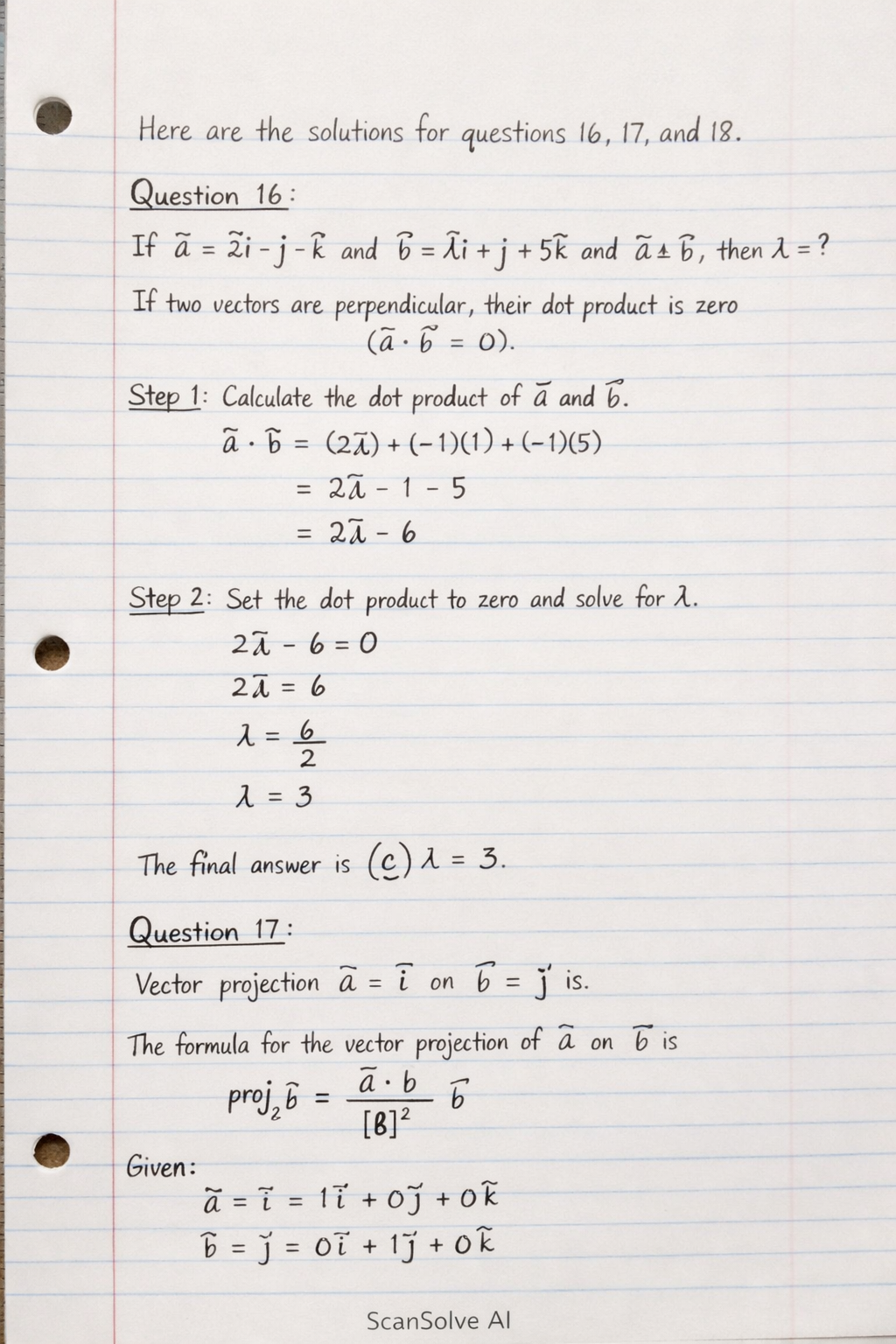
Here are the solutions for questions 16, 17, and 18.

Part 16· 2 steps

If a⃗=2i^−j^−k^\vec{a} = 2\hat{i} - \hat{j} - \hat{k} and b⃗=λi^+j^+5k^\vec{b} = \lambda\hat{i} + \hat{j} + 5\hat{k} and a⃗⊥b⃗\vec{a} \perp \vec{b}, then λ=_\lambda = \_

If two vectors are perpendicular, their dot product is zero (a⃗⋅b⃗=0\vec{a} \cdot \vec{b} = 0).

  1. Calculate the dot product of a⃗\vec{a} and b⃗\vec{b}.

    a⃗⋅b⃗=(2)(λ)+(−1)(1)+(−1)(5)\vec{a} \cdot \vec{b} = (2)(\lambda) + (-1)(1) + (-1)(5) a⃗⋅b⃗=2λ−1−5\vec{a} \cdot \vec{b} = 2\lambda - 1 - 5 a⃗⋅b⃗=2λ−6\vec{a} \cdot \vec{b} = 2\lambda - 6
  2. Set the dot product to zero and solve for λ\lambda.

    2λ−6=02\lambda - 6 = 0 2λ=62\lambda = 6 λ=62\lambda = \frac{6}{2} λ=3\lambda = 3

    The final answer is (c)\boxed{\text{(c)}}.

Part 17

(b)\text{(b)}

Vector projection a⃗=i^\vec{a} = \hat{i} on b⃗=j^\vec{b} = \hat{j} is

The formula for the vector projection of a⃗\vec{a} on b⃗\vec{b} is projb⃗a⃗=(a⃗⋅b⃗∣b⃗∣2)b⃗\text{proj}_{\vec{b}} \vec{a} = \left( \frac{\vec{a} \cdot \vec{b}}{|\vec{b}|^2} \right) \vec{b}.

Given:
a⃗=i^=1i^+0j^+0k^\vec{a} = \hat{i} = 1\hat{i} + 0\hat{j} + 0\hat{k}
b⃗=j^=0i^+1j^+0k^\vec{b} = \hat{j} = 0\hat{i} + 1\hat{j} + 0\hat{k}

  1. Calculate the dot product a⃗⋅b⃗\vec{a} \cdot \vec{b}.

    a⃗⋅b⃗=(1)(0)+(0)(1)+(0)(0)\vec{a} \cdot \vec{b} = (1)(0) + (0)(1) + (0)(0) a⃗⋅b⃗=0\vec{a} \cdot \vec{b} = 0
  2. Calculate the magnitude squared of b⃗\vec{b}, ∣b⃗∣2|\vec{b}|^2.

    ∣b⃗∣2=(0)2+(1)2+(0)2=1|\vec{b}|^2 = (0)^2 + (1)^2 + (0)^2 = 1
  3. Calculate the vector projection.

    projb⃗a⃗=(01)j^\text{proj}_{\vec{b}} \vec{a} = \left( \frac{0}{1} \right) \hat{j} projb⃗a⃗=0⋅j^\text{proj}_{\vec{b}} \vec{a} = 0 \cdot \hat{j} projb⃗a⃗=0⃗\text{proj}_{\vec{b}} \vec{a} = \vec{0}

    The final answer is (b)\boxed{\text{(b)}}.

Part 18

(d)\text{(d)}

Scalar projection vector i^−j^−k^\hat{i} - \hat{j} - \hat{k} on vector 3i^+j^+3k^3\hat{i} + \hat{j} + 3\hat{k} is

The formula for the scalar projection of u⃗\vec{u} on v⃗\vec{v} is compv⃗u⃗=u⃗⋅v⃗∣v⃗∣\text{comp}_{\vec{v}} \vec{u} = \frac{\vec{u} \cdot \vec{v}}{|\vec{v}|}.

Given:
u⃗=i^−j^−k^\vec{u} = \hat{i} - \hat{j} - \hat{k}
v⃗=3i^+j^+3k^\vec{v} = 3\hat{i} + \hat{j} + 3\hat{k}

  1. Calculate the dot product u⃗⋅v⃗\vec{u} \cdot \vec{v}.

    u⃗⋅v⃗=(1)(3)+(−1)(1)+(−1)(3)\vec{u} \cdot \vec{v} = (1)(3) + (-1)(1) + (-1)(3) u⃗⋅v⃗=3−1−3\vec{u} \cdot \vec{v} = 3 - 1 - 3 u⃗⋅v⃗=−1\vec{u} \cdot \vec{v} = -1
  2. Calculate the magnitude of v⃗\vec{v}, ∣v⃗∣|\vec{v}|.

    ∣v⃗∣=(3)2+(1)2+(3)2|\vec{v}| = \sqrt{(3)^2 + (1)^2 + (3)^2} ∣v⃗∣=9+1+9|\vec{v}| = \sqrt{9 + 1 + 9} ∣v⃗∣=19|\vec{v}| = \sqrt{19}
  3. Calculate the scalar projection.

    compv⃗u⃗=−119\text{comp}_{\vec{v}} \vec{u} = \frac{-1}{\sqrt{19}}

    Comparing this result with the given options (a) 0, (b) 0⃗\vec{0}, (c) k^\hat{k}, (d) None, our calculated scalar value −119\frac{-1}{\sqrt{19}} does not match any of the options (a), (b), or (c).

    The final answer is (d)\boxed{\text{(d)}}.

Was this helpful?

Try one yourself

A new problem that tests the same skill.

Still stuck on this one?

Ask a follow-up, and the answer starts from this question.

Got a different question?Ask your own question
Handwritten step-by-step solution preview

Handwritten Step-by-Step Solution

Get this as a handwritten image on WhatsApp — like a tutor wrote it for you.

Try on WhatsApp