This mathematics problem involves applying core mathematical principles and formulas. Below you will find a complete step-by-step solution with detailed explanations for each step, helping you understand not just the answer but the method behind it.
ScanSolve AI Answer
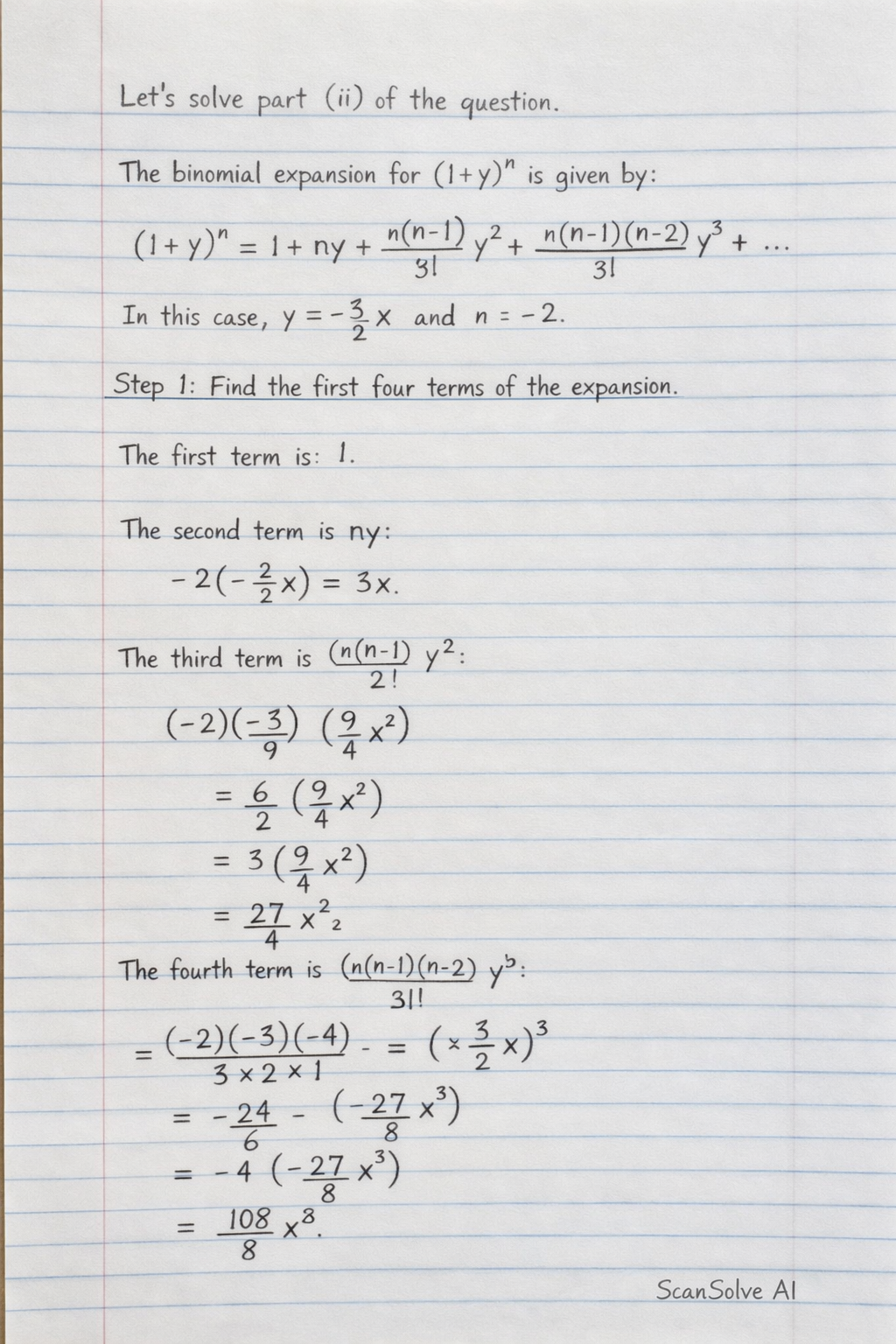
Let's solve part (ii) of the question.
ii) Obtain the first four terms of the binomial expansion of $(1 - \frac{3}{2}x)^{-2}$ and find the set of values of $x$ for which the expansion is valid.
The binomial expansion for $(1+y)^n$ is given by:
$$(1+y)^n = 1 + ny + \frac{n(n-1)}{2!}y^2 + \frac{n(n-1)(n-2)}{3!}y^3 + \dots$$
In this case, $y = -\frac{3}{2}x$ and $n = -2$.
Step 1: Find the first four terms of the expansion.
The first term is $1$.
The second term is $ny$:
$$(-2)\left(-\frac{3}{2}x\right) = 3x$$
The third term is $\frac{n(n-1)}{2!}y^2$:
$$\frac{(-2)(-2-1)}{2 \times 1}\left(-\frac{3}{2}x\right)^2 = \frac{(-2)(-3)}{2}\left(\frac{9}{4}x^2\right) = \frac{6}{2}\left(\frac{9}{4}x^2\right) = 3\left(\frac{9}{4}x^2\right) = \frac{27}{4}x^2$$
The fourth term is $\frac{n(n-1)(n-2)}{3!}y^3$:
$$\frac{(-2)(-2-1)(-2-2)}{3 \times 2 \times 1}\left(-\frac{3}{2}x\right)^3 = \frac{(-2)(-3)(-4)}{6}\left(-\frac{27}{8}x^3\right) = \frac{-24}{6}\left(-\frac{27}{8}x^3\right) = -4\left(-\frac{27}{8}x^3\right) = \frac{108}{8}x^3 = \frac{27}{2}x^3$$
So, the first four terms of the expansion are:
$$1 + 3x + \frac{27}{4}x^2 + \frac{27}{2}x^3$$
Step 2: Find the set of values of $x$ for which the expansion is valid.
The binomial expansion $(1+y)^n$ is valid when $|y| < 1$.
In this expansion, $y = -\frac{3}{2}x$.
So, we must have:
$$\left|-\frac{3}{2}x\right| < 1$$
$$\frac{3}{2}|x| < 1$$
$$|x| < \frac{1}{3/2}$$
$$|x| < \frac{2}{3}$$
This inequality can also be written as:
$$-\frac{2}{3} < x < \frac{2}{3}$$
The first four terms of the expansion are $\boxed{1 + 3x + \frac{27}{4}x^2 + \frac{27}{2}x^3}$.
The expansion is valid for $\boxed{|x| < \frac{2}{3}}$ or $\boxed{-\frac{2}{3} < x < \frac{2}{3}}$.
What's next?
ii) Obtain the first four terms of the binomial expansion of (1 - (3)/(2)x)^-2 and find the set of values of x for which the expansion is valid.
|Mathematics
ii) Obtain the first four terms of the binomial expansion of (1 - (3)/(2)x)^-2 and find the set of values of x for which the expansion is valid.
ScanSolve AI Answer
Let's solve part (ii) of the question.
ii) Obtain the first four terms of the binomial expansion of (1−23x)−2 and find the set of values of x for which the expansion is valid.
The binomial expansion for (1+y)n is given by:
(1+y)n=1+ny+2!n(n−1)y2+3!n(n−1)(n−2)y3+…
In this case, y=−23x and n=−2.
Step 1: Find the first four terms of the expansion.
The first term is 1.
The second term is ny:
(−2)(−23x)=3x
The third term is 2!n(n−1)y2:
2×1(−2)(−2−1)(−23x)2=2(−2)(−3)(49x2)=26(49x2)=3(49x2)=427x2
The fourth term is 3!n(n−1)(n−2)y3:
3×2×1(−2)(−2−1)(−2−2)(−23x)3=6(−2)(−3)(−4)(−827x3)=6−24(−827x3)=−4(−827x3)=8108x3=227x3
So, the first four terms of the expansion are:
1+3x+427x2+227x3
Step 2: Find the set of values of x for which the expansion is valid.
The binomial expansion (1+y)n is valid when ∣y∣<1.
In this expansion, y=−23x.
So, we must have:
−23x<123∣x∣<1∣x∣<3/21∣x∣<32
This inequality can also be written as:
−32<x<32
The first four terms of the expansion are 1+3x+427x2+227x3.
The expansion is valid for ∣x∣<32 or −32<x<32.
What's next?
Need help with your own homework?
Get instant step-by-step solutions to any question. Free to start.