

This mathematics problem involves applying core mathematical principles and formulas. Below you will find a complete step-by-step solution with detailed explanations for each step, helping you understand not just the answer but the method behind it.
ScanSolve AI Answer
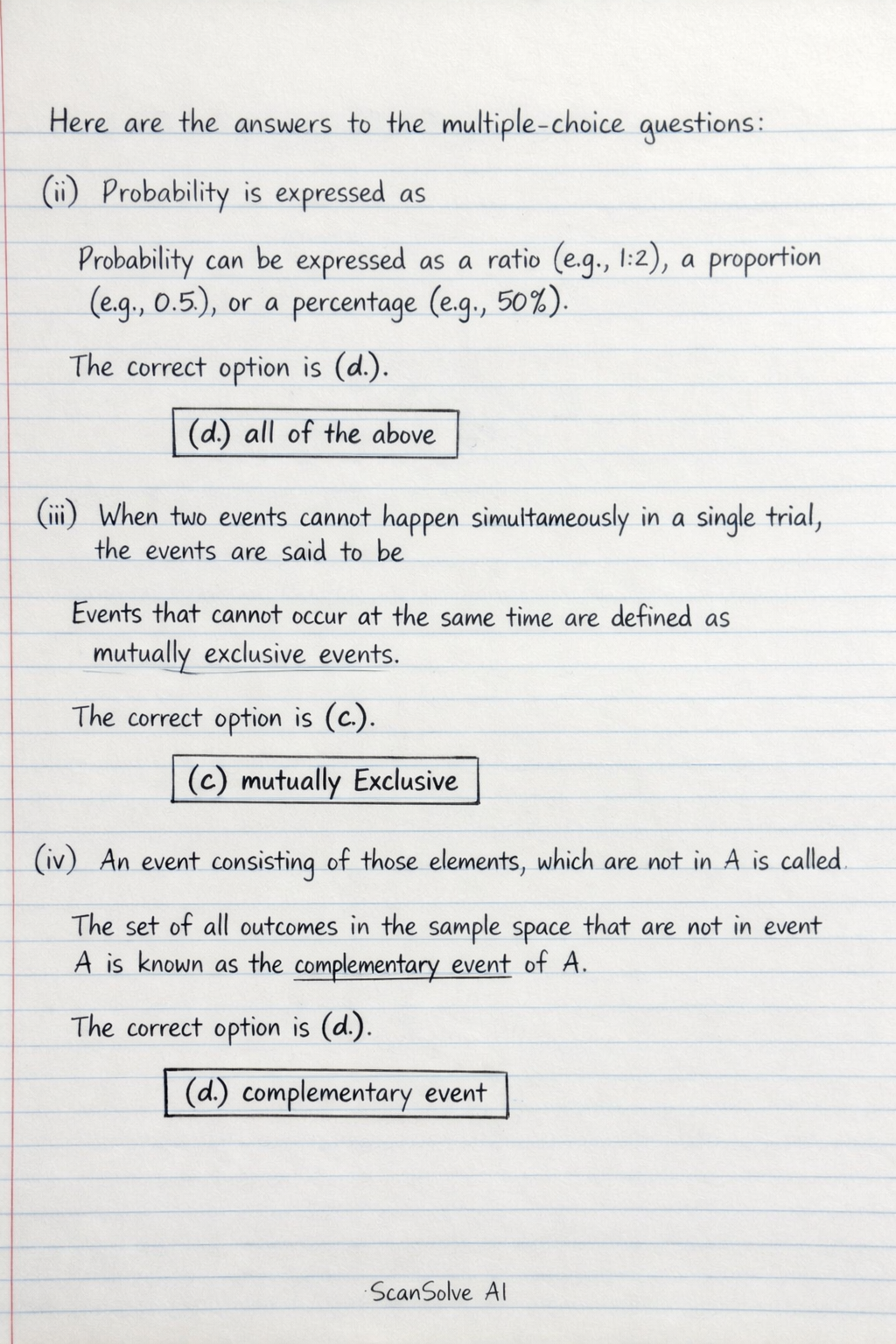
Here are the answers to the multiple-choice questions: (ii) Probability is expressed as Probability can be expressed as a ratio (e.g., 1:2), a proportion (e.g., 0.5), or a percentage (e.g., 50%). The correct option is (d). (d) all of the above (iii) When two events cannot happen simultaneously in a single trial, the events are said to be Events that cannot occur at the same time are defined as mutually exclusive events. The correct option is (c). (c) mutually Exclusive (iv) An event consisting of those elements, which are not in A is called The set of all outcomes in the sample space that are not in event A is known as the complementary event of A. The correct option is (d). (d) complementary event (v) If A is an event, the conditional probability of A given A is equal to The conditional probability P(A|A) means the probability of event A occurring, given that event A has already occurred. If A has already occurred, its probability is certain. P(A|A) = (P(A A))/(P(A)) = (P(A))/(P(A)) = 1 The correct option is (b). (b) one (vi) If a coin is tossed three times, then the probability of getting at most one head is equal to Step 1: List all possible outcomes when a coin is tossed three times. The sample space S = \HHH, HHT, HTH, THH, HTT, THT, TTH, TTT\. The total number of outcomes is 8. Step 2: Identify outcomes with "at most one head" (meaning 0 heads or 1 head). Outcomes with 0 heads: \TTT\ (1 outcome) Outcomes with 1 head: \HTT, THT, TTH\ (3 outcomes) Total favorable outcomes = 1 + 3 = 4. Step 3: Calculate the probability. P(at most one head) = Number of favorable outcomesTotal number of outcomes = (4)/(8) = (1)/(2) The correct option is (c). (c) 1/2 (vii) The probability of throwing an even sum with two fair dice is Step 1: Determine the total number of outcomes. When two fair dice are thrown, each die has 6 possible outcomes. The total number of combined outcomes is 6 × 6 = 36. Step 2: Determine the number of outcomes that result in an even sum. A sum is even if both dice show even numbers (E, E) or both dice show odd numbers (O, O). • Even numbers on a die: \2, 4, 6\ (3 outcomes) • Odd numbers on a die: \1, 3, 5\ (3 outcomes) Number of (E, E) outcomes = 3 × 3 = 9. Number of (O, O) outcomes = 3 × 3 = 9. Total favorable outcomes (even sum) = 9 + 9 = 18. Step 3: Calculate the probability. P(even sum) = Number of favorable outcomesTotal number of outcomes = (18)/(36) = (1)/(2) The correct option is (d). (d) 1/2 (viii) The probability of six on a fair die is 1/6. The probability of not six is Let A be the event of rolling a six. P(A) = (1)/(6). The probability of not rolling a six is the complement of event A, denoted as P(A'). P(A') = 1 - P(A) P(not six) = 1 - (1)/(6) = (6)/(6) - (1)/(6) = (5)/(6) The correct option is (b). (b) 5/6 (ix) P(A) + P(A) is equal to P(A) is the probability of an event A occurring, and P(A) (or P(A')) is the probability of event A not occurring (its complement). The sum of the probability of an event and the probability of its complement is always 1. The correct option is (c). (c) 1 (x) A fair die and a fair coin are thrown at a time. The number of combined outcomes is Step 1: Determine the number of outcomes for each independent event. Number of outcomes for a fair die = 6 (i.e., \1, 2, 3, 4, 5, 6\). Number of outcomes for a fair coin = 2 (i.e., \Head, Tail\). Step 2: Calculate the total number of combined outcomes. For independent events, the total number of combined outcomes is the product of the number of outcomes for each event. Total combined outcomes = (Outcomes for die) × (Outcomes for coin) = 6 × 2 = 12. The correct option is (b). (b) 12 Last free one today — make it count tomorrow, or type /upgrade for unlimited.