
We read your photo as:
In a class of 45 students, 32 offer Physics and 28 offer Government. If 12 students offer neither subject, find how many offer both subjects. Draw a Venn diagram.
ScanSolve AI Answer
Answers
5 partsStep-by-step solution
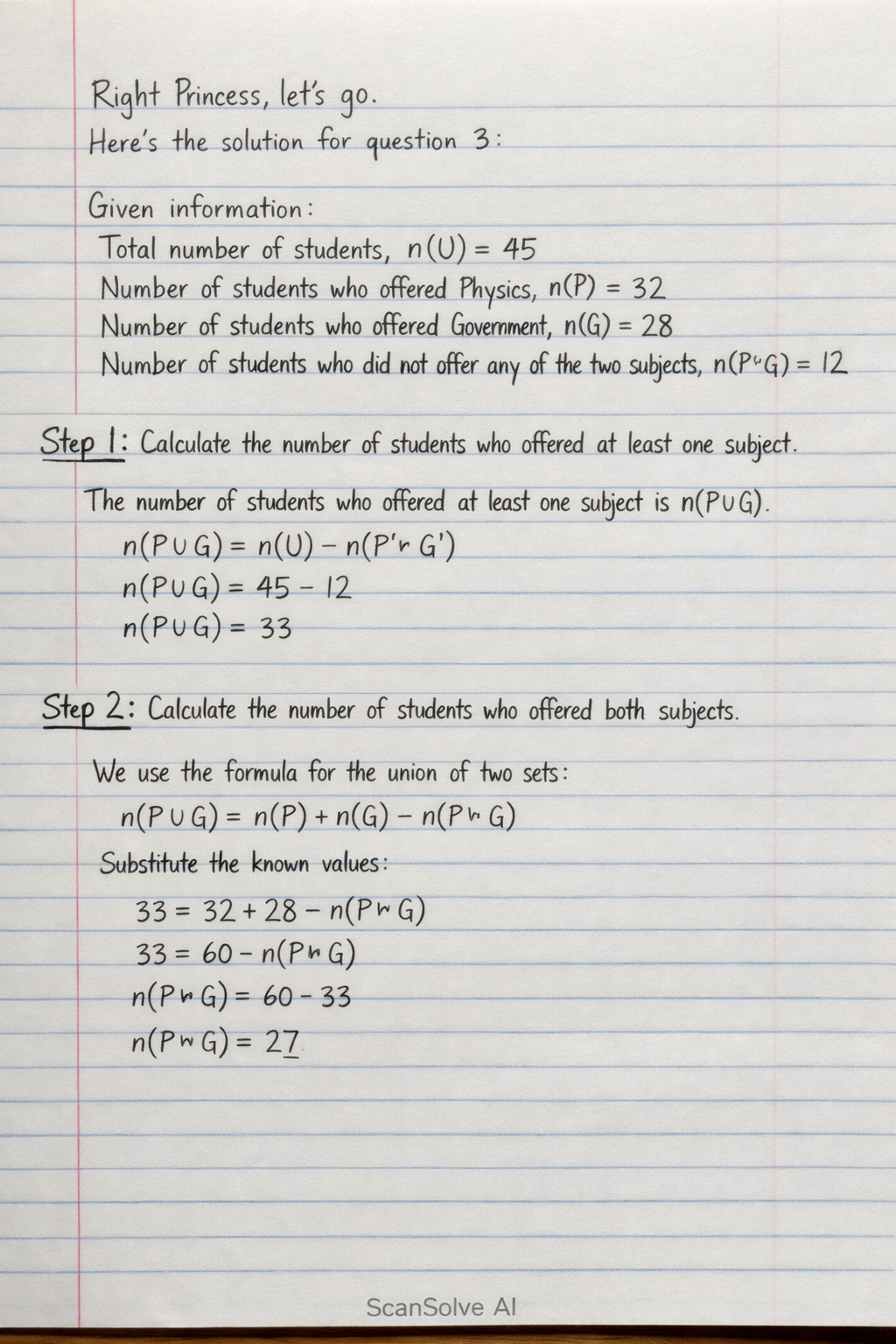
3 stepsHere's the solution for question 3:
Given information:
Total number of students,
Number of students who offered Physics,
Number of students who offered Government,
Number of students who did not offer any of the two subjects,
Calculate the number of students who offered at least one subject.
The number of students who offered at least one subject is .
Calculate the number of students who offered both subjects.
We use the formula for the union of two sets:
Substitute the known values:
Calculate the number of students who offered Physics only and Government only.
Number of students who offered Physics only:
Number of students who offered Government only:
a) Draw the Venn diagram to represent the information.
A Venn diagram would show two overlapping circles, one for Physics (P) and one for Government (G), inside a rectangle representing the universal set (U).- The intersection of P and G would contain 27 students.
- The part of circle P outside the intersection (Physics only) would contain 5 students.
- The part of circle G outside the intersection (Government only) would contain 1 student.
- The area outside both circles but inside the rectangle (neither subject) would contain 12 students. The sum of these parts is , which is the total number of students.
b) How many students offered both subjects?
This is .c) What is ?
This is the number of students who offered Physics or Government or both.d) What is ?
This is the number of students who offered neither Physics nor Government.e) What is ?
This is the number of students who offered Government but not Physics (Government only).f) What is ?
This is the number of students who offered Physics but not Government (Physics only).
Still stuck on this one?
Ask a follow-up, and the answer starts from this question.
More Mathematics Questions
Handwritten Step-by-Step Solution
Get this as a handwritten image on WhatsApp — like a tutor wrote it for you.
Try on WhatsApp