
We read your photo as:
In a group of 100 students, 25 failed only in Physics, 20 failed only in Chemistry, and 15 failed in both. Calculate the conditional probabilities of failing Chemistry given Physics, and Physics given
ScanSolve AI Answer
Answers
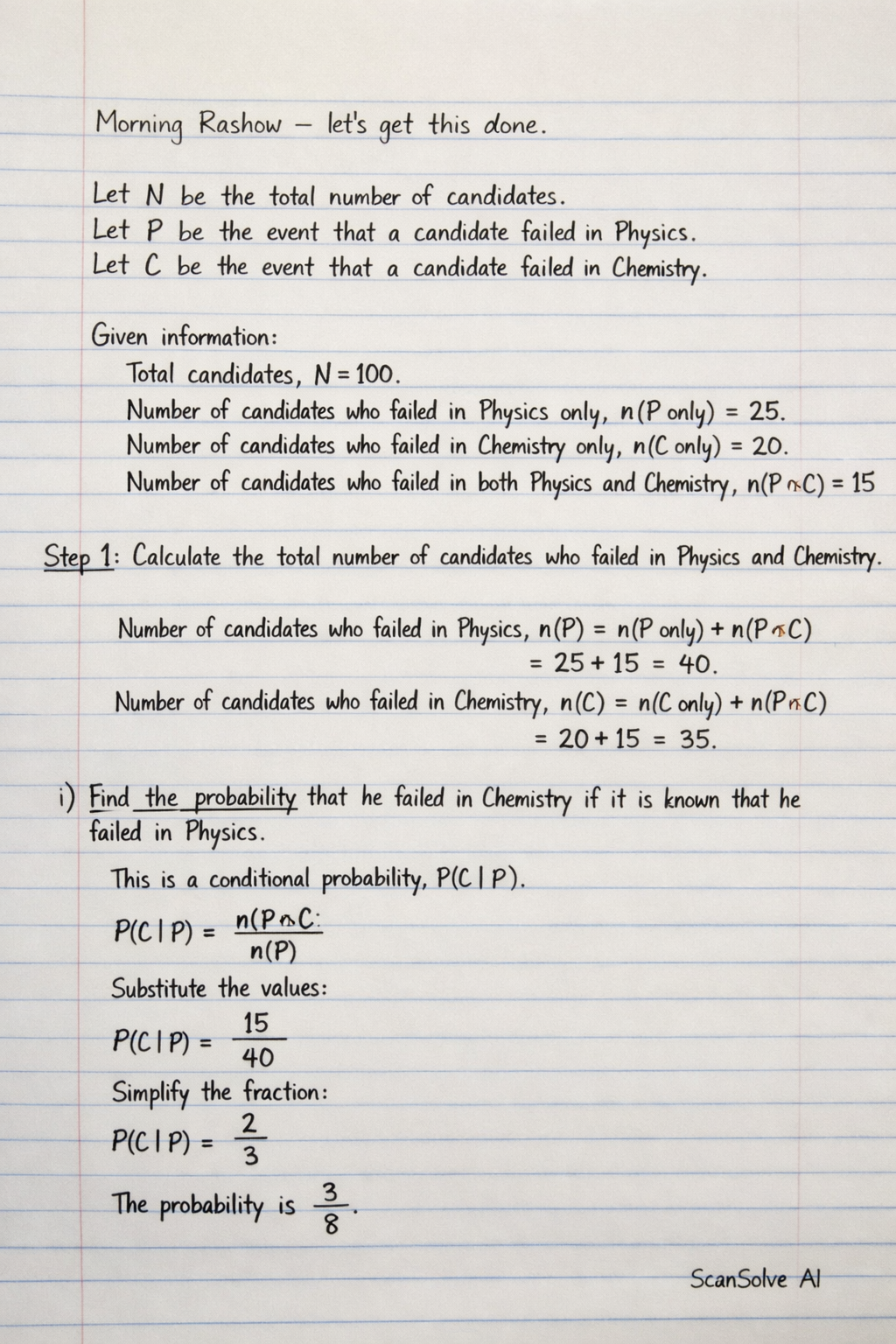
3 partsLet be the total number of candidates.
Let be the event that a candidate failed in Physics.
Let be the event that a candidate failed in Chemistry.
Given information:
Total candidates, .
Number of candidates who failed in Physics only, .
Number of candidates who failed in Chemistry only, .
Number of candidates who failed in both Physics and Chemistry, .
Step 1: Calculate the total number of candidates who failed in Physics and Chemistry.
Number of candidates who failed in Physics, .
Number of candidates who failed in Chemistry, .
i) Find the probability that he failed in Chemistry if it is known that he failed in Physics.
This is a conditional probability, .
Substitute the values:
Simplify the fraction:
The probability is .
ii) Find the probability that he failed in Physics if it is known that he failed in Chemistry.
This is a conditional probability, .
Substitute the values:
Simplify the fraction:
The probability is .
iii) Find the probability that he failed either in Physics or in Chemistry but not in both.
This means the candidate failed in Physics only OR Chemistry only.
Number of candidates who failed in Physics only = 25.
Number of candidates who failed in Chemistry only = 20.
Number of candidates who failed either in Physics or in Chemistry but not in both = .
The probability is the number of such candidates divided by the total number of candidates:
Substitute the values:
Simplify the fraction:
The probability is .
Try one yourself
A new problem that tests the same skill.
Still stuck on this one?
Ask a follow-up, and the answer starts from this question.
More Mathematics Questions
Handwritten Step-by-Step Solution
Get this as a handwritten image on WhatsApp — like a tutor wrote it for you.
Try on WhatsApp