
This mathematics problem involves applying core mathematical principles and formulas. Below you will find a complete step-by-step solution with detailed explanations for each step, helping you understand not just the answer but the method behind it.
ScanSolve AI Answer
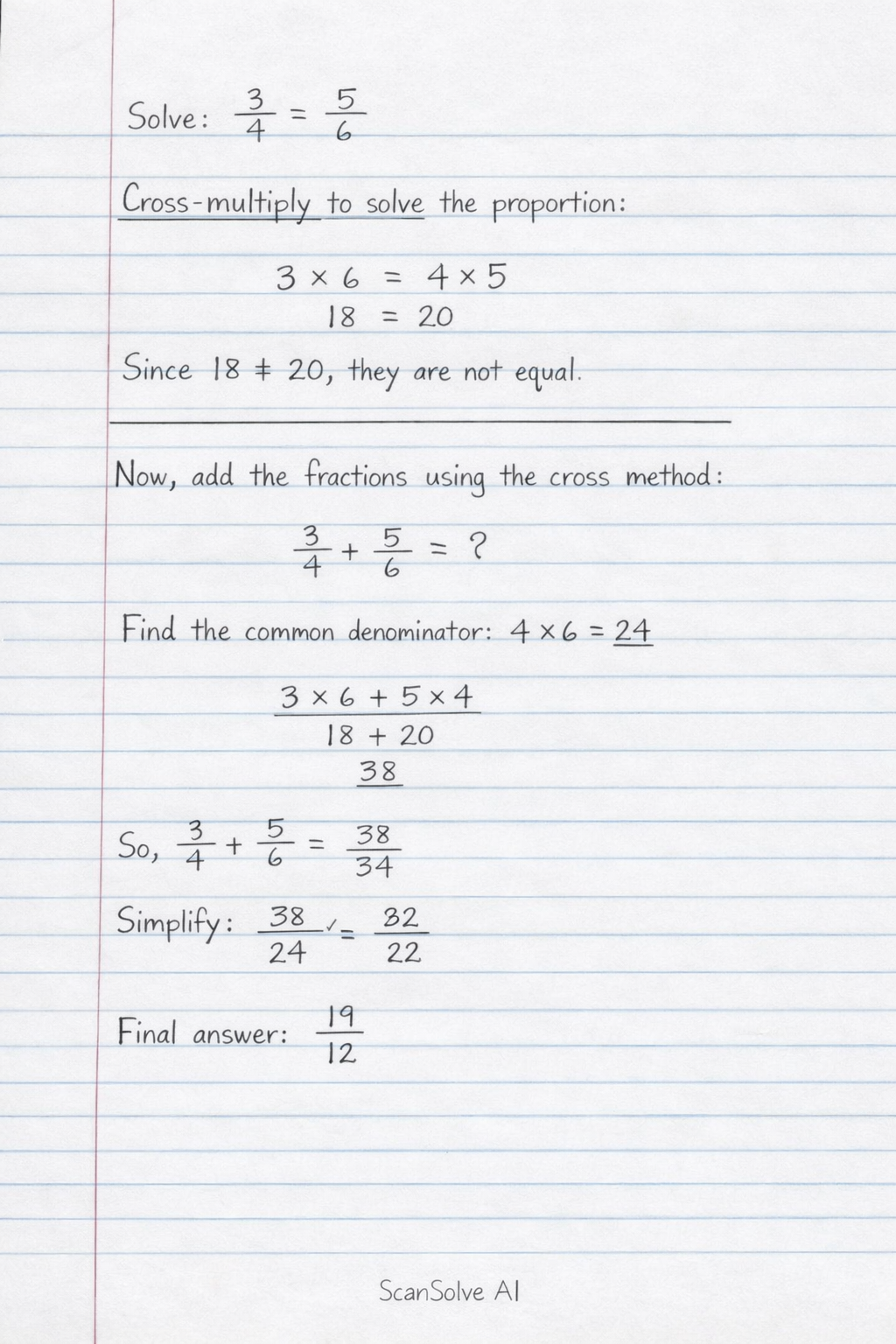
The "cross method" can refer to two main operations involving ratios or fractions: 1. Cross-multiplication for solving proportions: When two ratios are set equal to each other, forming a proportion, like (a)/(b) = (c)/(d), the cross method involves multiplying the numerator of one ratio by the denominator of the other. This gives the equality: a × d = b × c In this context, there isn't a direct "++" operation that is typically equated to something. 2. Cross method for adding fractions (ratios): When adding two fractions (ratios) like (a)/(b) + (c)/(d), the "cross method" is used to find a common denominator and combine the numerators. (a)/(b) + (c)/(d) = ((a × d) + (b × c))/(b × d) In this case, the "++" in your question likely refers to the sum of the cross products in the numerator: ++ = a × d + b × c And the denominator would be b × d. So, if you are referring to the addition of two ratios (a)/(b) and (c)/(d) using the cross method: (a)/(b) + (c)/(d) = (ad + bc)/(bd) Here, the "++" would be equal to the numerator, which is the sum of the cross products. The final answer is ad + bc. Drop the next question.