We read your photo as:

In Fig. 6.52, the bearings of R from P and Q are 330° and 240°, respectively. If |PQ| = 50 km, calculate |QR| and the bearing Q from R.

Mathematics

ScanSolve AI Answer

Step-by-step solution

4 steps

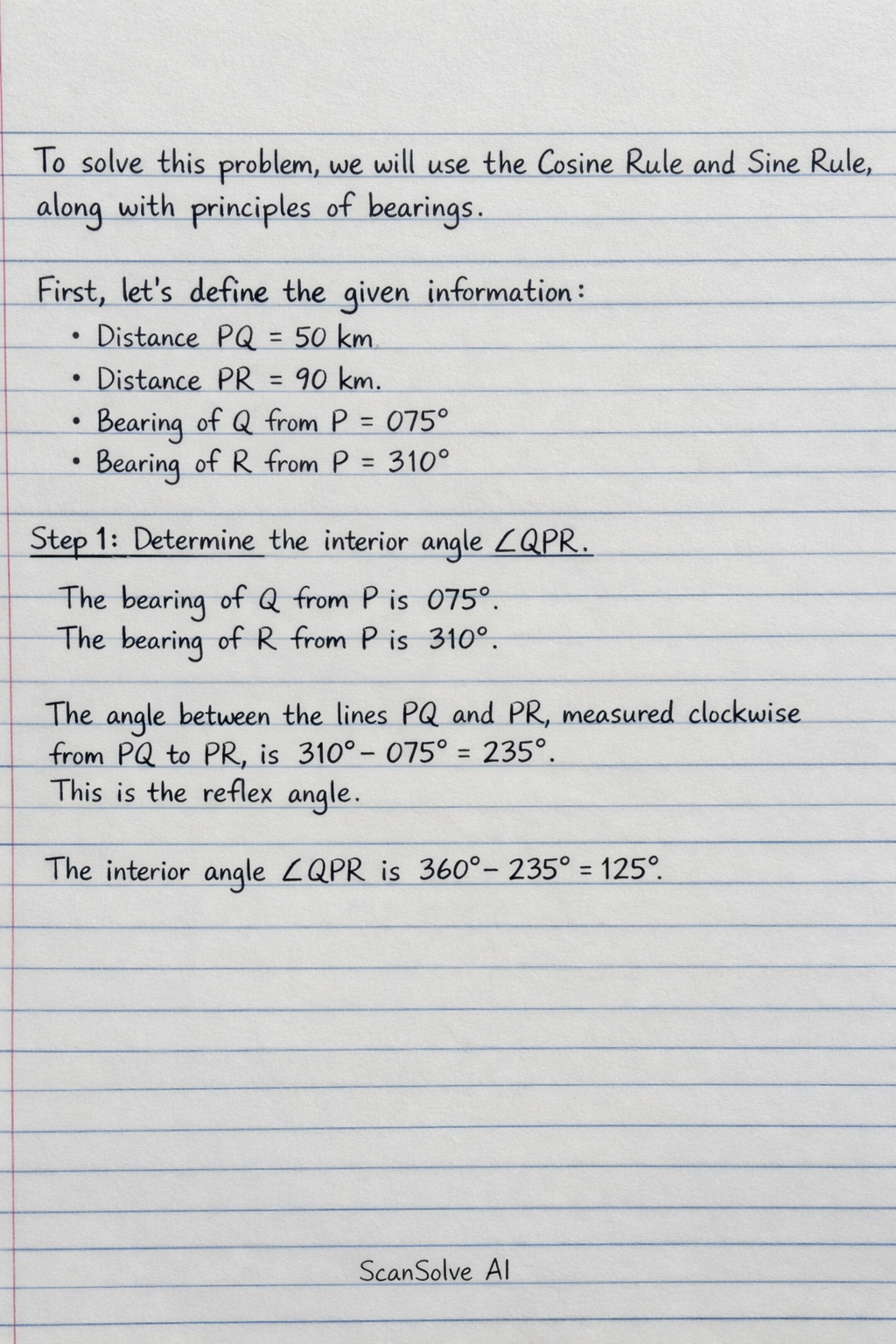
To solve this problem, we will use the Cosine Rule and Sine Rule, along with principles of bearings.

First, let's define the given information:

  • Distance PQ = 50 km
  • Distance PR = 90 km
  • Bearing of Q from P = 075∘075^\circ
  • Bearing of R from P = 310∘310^\circ
  1. Determine the interior angle ∠QPR\angle QPR.

    The bearing of Q from P is 075∘075^\circ.
    The bearing of R from P is 310∘310^\circ.
    The angle between the lines PQ and PR, measured clockwise from PQ to PR, is 310∘−075∘=235∘310^\circ - 075^\circ = 235^\circ. This is the reflex angle.
    The interior angle ∠QPR\angle QPR is 360∘−235∘=125∘360^\circ - 235^\circ = 125^\circ.

  2. Calculate the distance QR using the Cosine Rule (Part a).

    In △PQR\triangle PQR, we have two sides (PQ and PR) and the included angle (∠QPR\angle QPR). We can use the Cosine Rule:

    QR2=PQ2+PR2−2(PQ)(PR)cos⁡(∠QPR)QR^2 = PQ^2 + PR^2 - 2(PQ)(PR) \cos(\angle QPR)

    Substitute the known values:

    QR2=502+902−2(50)(90)cos⁡(125∘)QR^2 = 50^2 + 90^2 - 2(50)(90) \cos(125^\circ) QR2=2500+8100−9000cos⁡(125∘)QR^2 = 2500 + 8100 - 9000 \cos(125^\circ)

    We know that cos⁡(125∘)=−cos⁡(180∘−125∘)=−cos⁡(55∘)\cos(125^\circ) = -\cos(180^\circ - 125^\circ) = -\cos(55^\circ).

    cos⁡(55∘)≈0.573576\cos(55^\circ) \approx 0.573576 QR2=10600−9000(−0.573576)QR^2 = 10600 - 9000(-0.573576) QR2=10600+5162.184QR^2 = 10600 + 5162.184 QR2=15762.184QR^2 = 15762.184 QR=15762.184QR = \sqrt{15762.184} QR≈125.5475 kmQR \approx 125.5475 \text{ km}

    Rounding to two decimal places:
    The distance between Q and R is 125.55 km\boxed{\text{125.55 km}}.

  3. Calculate ∠PQR\angle PQR using the Sine Rule.

    Now we need to find an angle within △PQR\triangle PQR to help determine the bearing. Let's find ∠PQR\angle PQR.
    Using the Sine Rule:

    sin⁡(∠PQR)PR=sin⁡(∠QPR)QR\frac{\sin(\angle PQR)}{PR} = \frac{\sin(\angle QPR)}{QR} sin⁡(∠PQR)=PRsin⁡(∠QPR)QR\sin(\angle PQR) = \frac{PR \sin(\angle QPR)}{QR} sin⁡(∠PQR)=90sin⁡(125∘)125.5475\sin(\angle PQR) = \frac{90 \sin(125^\circ)}{125.5475}

    We know sin⁡(125∘)=sin⁡(180∘−125∘)=sin⁡(55∘)\sin(125^\circ) = \sin(180^\circ - 125^\circ) = \sin(55^\circ).

    sin⁡(55∘)≈0.819152\sin(55^\circ) \approx 0.819152 sin⁡(∠PQR)=90×0.819152125.5475\sin(\angle PQR) = \frac{90 \times 0.819152}{125.5475} sin⁡(∠PQR)=73.72368125.5475\sin(\angle PQR) = \frac{73.72368}{125.5475} sin⁡(∠PQR)≈0.58729\sin(\angle PQR) \approx 0.58729 ∠PQR=arcsin⁡(0.58729)\angle PQR = \arcsin(0.58729) ∠PQR≈35.96∘\angle PQR \approx 35.96^\circ
  4. Calculate the bearing of R from Q (Part b).

    First, find the back bearing of P from Q.
    The bearing of Q from P is 075∘075^\circ.
    The back bearing of P from Q is 075∘+180∘=255∘075^\circ + 180^\circ = 255^\circ. This means the line segment QP points in the direction 255∘255^\circ from the North line at Q.

    Now, we need to determine if ∠PQR\angle PQR is added to or subtracted from the bearing of P from Q.
    From P, Q is at 075∘075^\circ and R is at 310∘310^\circ. This means R is to the "right" (clockwise) of the line PQ when viewed from P (since 310∘>075∘310^\circ > 075^\circ).
    Therefore, when standing at Q and looking towards P (bearing 255∘255^\circ), R will be to your "right" (clockwise) relative to the line QP.
    So, the bearing of R from Q will be the bearing of P from Q plus ∠PQR\angle PQR.

    Bearing of R from Q=255∘+∠PQR\text{Bearing of R from Q} = 255^\circ + \angle PQR Bearing of R from Q=255∘+35.96∘\text{Bearing of R from Q} = 255^\circ + 35.96^\circ Bearing of R from Q=290.96∘\text{Bearing of R from Q} = 290.96^\circ

    Rounding to the nearest degree (or two decimal places as calculated):
    The bearing of R from Q is \boxed{\text{290.96^\circ}}.

Was this helpful?

Still stuck on this one?

Ask a follow-up, and the answer starts from this question.

Got a different question?Ask your own question
Handwritten step-by-step solution preview

Handwritten Step-by-Step Solution

Get this as a handwritten image on WhatsApp — like a tutor wrote it for you.

Try on WhatsApp