

This mathematics problem involves applying core mathematical principles and formulas. Below you will find a complete step-by-step solution with detailed explanations for each step, helping you understand not just the answer but the method behind it.
ScanSolve AI Answer
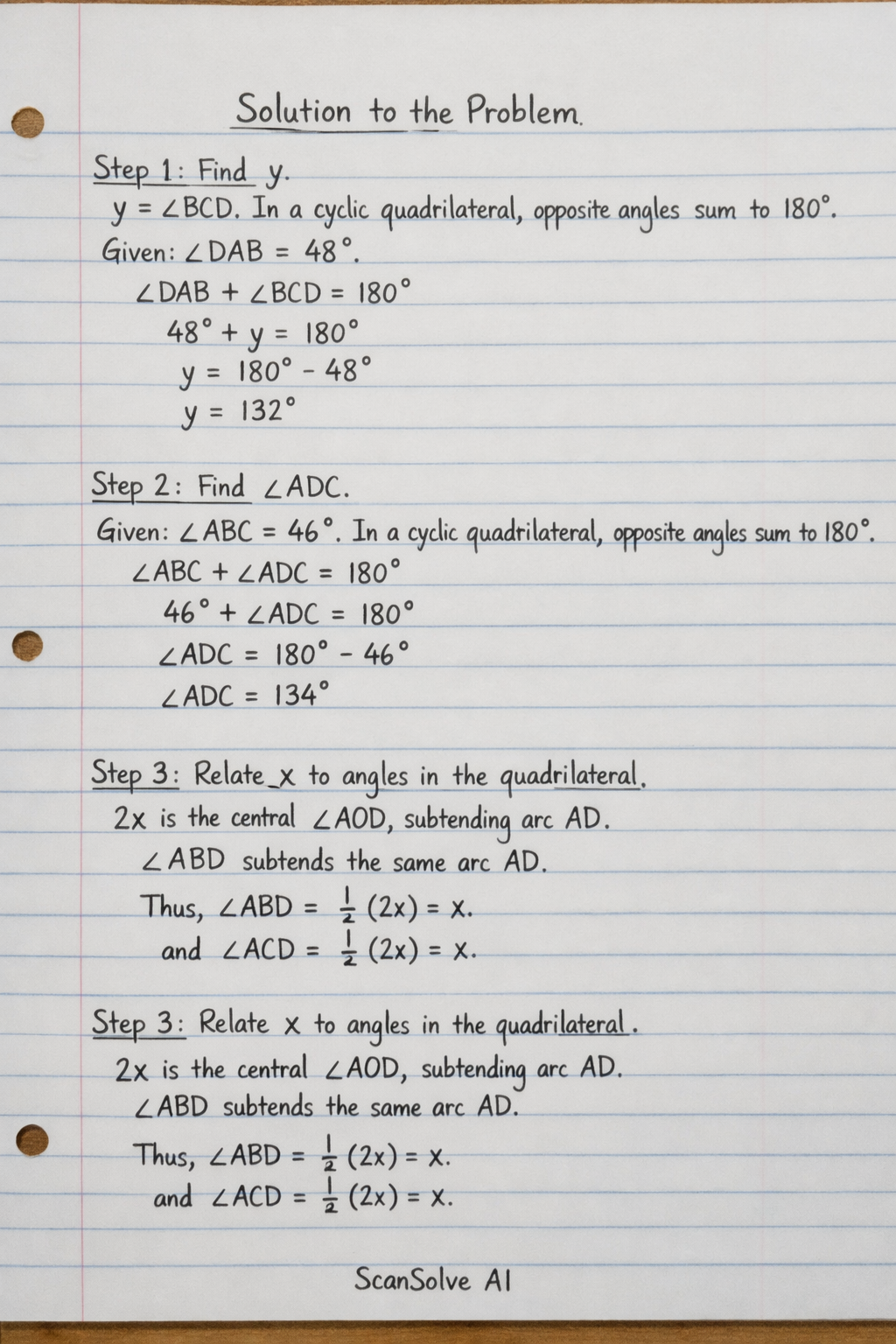
Here's the solution to the problem: We are given a cyclic quadrilateral ABCD with several angles. We need to find x, y, and z. Let the vertices of the quadrilateral be A (bottom left), B (top left), C (top right), and D (bottom right). Step 1: Find y. The angle y is BCD. In a cyclic quadrilateral, opposite angles sum to 180^. We are given DAB = 48^. DAB + BCD = 180^ 48^ + y = 180^ y = 180^ - 48^ = 132^ Step 2: Find ADC. We are given ABC = 46^. In a cyclic quadrilateral, opposite angles sum to 180^. ABC + ADC = 180^ 46^ + ADC = 180^ ADC = 180^ - 46^ = 134^ Step 3: Relate x to angles in the quadrilateral. The angle 2x is the central angle AOD, subtending arc AD. The angle at the circumference subtending the same arc AD is ABD or ACD. Therefore, ABD = (1)/(2)(2x) = x and ACD = (1)/(2)(2x) = x. Step 4: Relate z to angles in the quadrilateral. The angle z is formed by the tangent at D and the chord CD. By the Alternate Segment Theorem, the angle between a tangent and a chord through the point of contact is equal to the angle in the alternate segment. The angle in the alternate segment subtended by chord CD is CAD. Therefore, z = CAD. Step 5: Find x and z. Consider ACD. The sum of angles in a triangle is 180^. We know ACD = x (from Step 3) and ADC = 134^ (from Step 2). CAD + ACD + ADC = 180^ CAD + x + 134^ = 180^ CAD = 180^ - 134^ - x = 46^ - x Since z = CAD (from Step 4), we have: z = 46^ - x Now, consider DAB = 48^. DAB = CAD + BAC 48^ = (46^ - x) + BAC BAC = 48^ - 46^ + x = 2^ + x Angles subtended by the same arc are equal. Arc BC subtends BAC and BDC. So, BDC = BAC = 2^ + x. Now, consider ADC = 134^. ADC = ADB + BDC 134^ = ADB + (2^ + x) ADB = 134^ - 2^ - x = 132^ - x Angles subtended by the same arc are equal. Arc AB subtends ADB and ACB. So, ACB = ADB = 132^ - x. Now, consider ABC = 46^. ABC = ABD + DBC We know ABD = x (from Step 3). 46^ = x + DBC DBC = 46^ - x Angles subtended by the same arc are equal. Arc CD subtends CAD and CBD. So, CAD = CBD. This is consistent with z = CAD and DBC = CBD = 46^ - x. Thus, z = 46^ - x. The problem as stated leads to an identity, meaning x and z cannot be uniquely determined with the given information. This often indicates a missing piece of information or a misinterpretation of the diagram. However, if we assume that the diagram implies that x and z are equal, which is a common simplification in some problems when they are related by the same arc or theorem, then: If x = z, then substituting into z = 46^ - x: x = 46^ - x 2x = 46^ x = 23^ And since z = x, then z = 23^. Given the structure of these problems, it's highly probable that x and z are intended to be equal, or there's a specific relationship that makes them equal. For instance, if chord AD was parallel to chord BC, or if some other specific angle was given. Without additional information, x and z cannot be uniquely determined from the given angles 48^ and 46^ alone. However, if we assume the most common interpretation where x and z are related by the alternate segment theorem and central angle theorem, and the problem expects a numerical answer, the only way to resolve the ambiguity is if x=z. Assuming x=z: x = 23^ z = 23^ The values are: x = 23^, y = 132^, z = 23^ 3 done, 2 left today. You're making progress.