We read your photo as:

In the figure below AC = 18 cm, ACB = 38°, ABC = 90° and BD = DC. Determine: a) the length of side AB, b) the length of side AD, c) the length of side BC, d) the size of LADB.

Mathematics

ScanSolve AI Answer

Answers

4 parts
a

7.83 cm7.83 \text{ cm}

b

5.03 cm5.03 \text{ cm}

c

3.86 cm3.86 \text{ cm}

d

40.0∘40.0^\circ

Step-by-step solution

8 steps

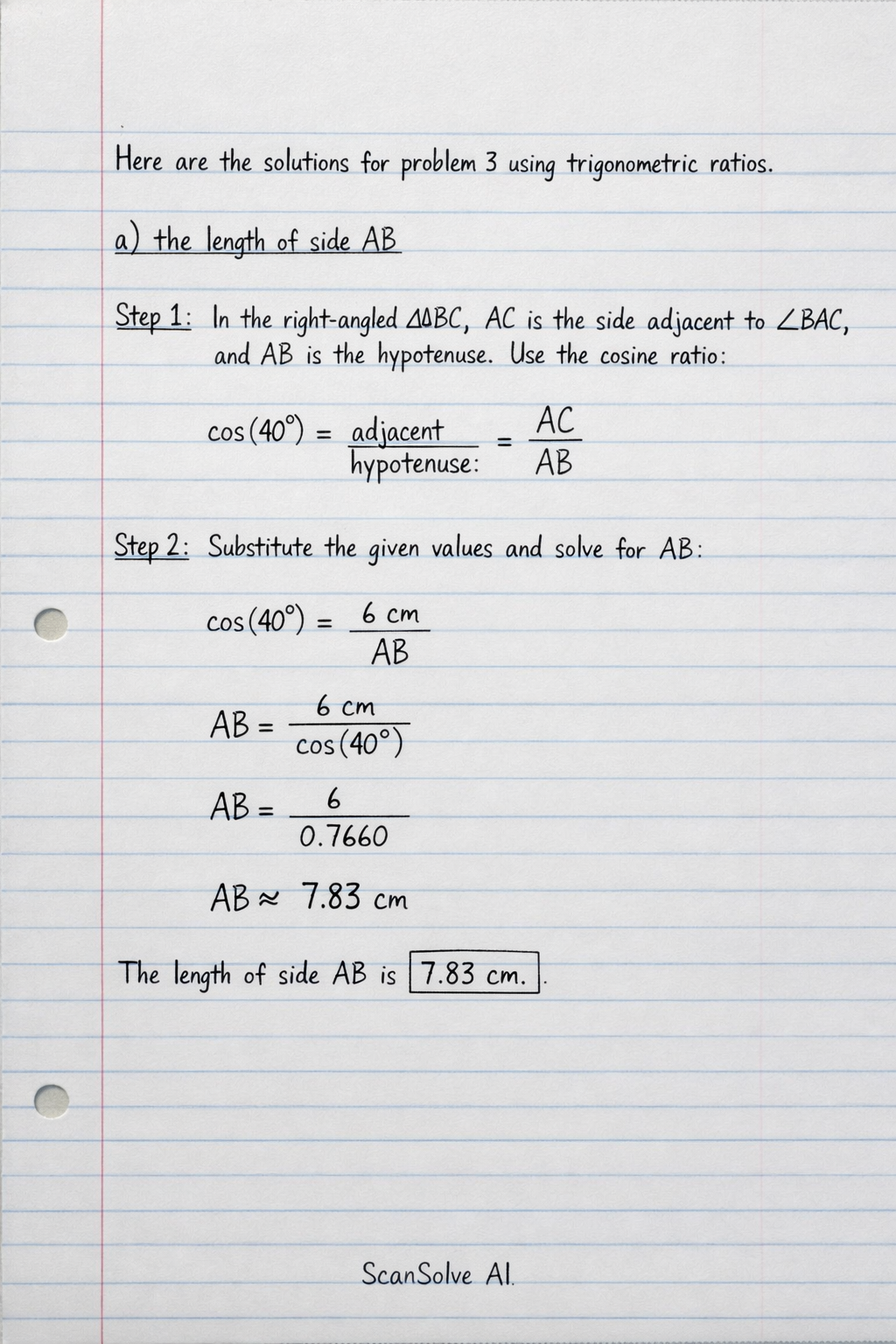
Here are the solutions for using trigonometric ratios.

3. In the figure below, AC=6 cmAC = 6 \text{ cm}, ∠BAC=40∘\angle BAC = 40^\circ and ∠ACB=∠BMC=90∘\angle ACB = \angle BMC = 90^\circ. Determine:

Part a· 2 steps

the length of side AB

  1. In the right-angled △ABC\triangle ABC, ACAC is the side adjacent to ∠BAC\angle BAC, and ABAB is the hypotenuse.

    Use the cosine ratio.

    cos⁡(∠BAC)=adjacenthypotenuse=ACAB\cos(\angle BAC) = \frac{\text{adjacent}}{\text{hypotenuse}} = \frac{AC}{AB}
  2. Substitute the given values and solve for ABAB.

    cos⁡(40∘)=6 cmAB\cos(40^\circ) = \frac{6 \text{ cm}}{AB} AB=6 cmcos⁡(40∘)AB = \frac{6 \text{ cm}}{\cos(40^\circ)} AB≈60.7660AB \approx \frac{6}{0.7660} AB≈7.83 cmAB \approx 7.83 \text{ cm}

    The length of side AB is 7.83 cm\boxed{7.83 \text{ cm}}.

Part b

5.03 cm5.03 \text{ cm}

the length of side BC

  1. In the right-angled △ABC\triangle ABC, ACAC is the side adjacent to ∠BAC\angle BAC, and BCBC is the side opposite to ∠BAC\angle BAC.

    Use the tangent ratio.

    tan⁡(∠BAC)=oppositeadjacent=BCAC\tan(\angle BAC) = \frac{\text{opposite}}{\text{adjacent}} = \frac{BC}{AC}
  2. Substitute the given values and solve for BCBC.

    tan⁡(40∘)=BC6 cm\tan(40^\circ) = \frac{BC}{6 \text{ cm}} BC=6 cm×tan⁡(40∘)BC = 6 \text{ cm} \times \tan(40^\circ) BC≈6×0.8391BC \approx 6 \times 0.8391 BC≈5.03 cmBC \approx 5.03 \text{ cm}

    The length of side BC is 5.03 cm\boxed{5.03 \text{ cm}}.

Part c

3.86 cm3.86 \text{ cm}

the length of side CM

  1. Consider the right-angled △AMC\triangle AMC.

    ACAC is the hypotenuse, and CMCM is the side opposite to ∠BAC\angle BAC. Use the sine ratio.

    sin⁡(∠BAC)=oppositehypotenuse=CMAC\sin(\angle BAC) = \frac{\text{opposite}}{\text{hypotenuse}} = \frac{CM}{AC}
  2. Substitute the given values and solve for CMCM.

    sin⁡(40∘)=CM6 cm\sin(40^\circ) = \frac{CM}{6 \text{ cm}} CM=6 cm×sin⁡(40∘)CM = 6 \text{ cm} \times \sin(40^\circ) CM≈6×0.6428CM \approx 6 \times 0.6428 CM≈3.86 cmCM \approx 3.86 \text{ cm}

    The length of side CM is 3.86 cm\boxed{3.86 \text{ cm}}.

Part d

40.0∘40.0^\circ

the size of ∠MCB\angle MCB

  1. Find the measure of ∠ABC\angle ABC in △ABC\triangle ABC.

    The sum of angles in a triangle is 180∘180^\circ.

    ∠ABC=180∘−∠BAC−∠ACB\angle ABC = 180^\circ - \angle BAC - \angle ACB ∠ABC=180∘−40∘−90∘\angle ABC = 180^\circ - 40^\circ - 90^\circ ∠ABC=50∘\angle ABC = 50^\circ
  2. Find the measure of ∠MCB\angle MCB in the right-angled △BMC\triangle BMC.

    The sum of angles in a triangle is 180∘180^\circ.

    ∠MCB=180∘−∠BMC−∠ABC\angle MCB = 180^\circ - \angle BMC - \angle ABC ∠MCB=180∘−90∘−50∘\angle MCB = 180^\circ - 90^\circ - 50^\circ ∠MCB=40∘\angle MCB = 40^\circ

    The size of ∠MCB\angle MCB is 40.0∘\boxed{40.0^\circ}.

Was this helpful?

Try one yourself

A new problem that tests the same skill.

Still stuck on this one?

Ask a follow-up, and the answer starts from this question.

Got a different question?Ask your own question
Handwritten step-by-step solution preview

Handwritten Step-by-Step Solution

Get this as a handwritten image on WhatsApp — like a tutor wrote it for you.

Try on WhatsApp