We read your photo as:

In the figure below OB=b;OC=3OB and OA = a. Given that OD = 1/3 OA and AN = 1/2 AC, CD and AB meet at M. Determine in terms of a and b (i) AB (ii) CD. Given that CM = K CD and AM = h AB. Determine the values of the scalars K and h. Show that O,M and N are collinear.

Mathematics

ScanSolve AI Answer

Answers

3 parts
a(i)

b−a\mathbf{b} - \mathbf{a}

a(ii)

13a−3b\frac{1}{3}\mathbf{a} - 3\mathbf{b}

b

K=34,h=34K = \frac{3}{4}, h = \frac{3}{4}

Step-by-step solution

9 steps

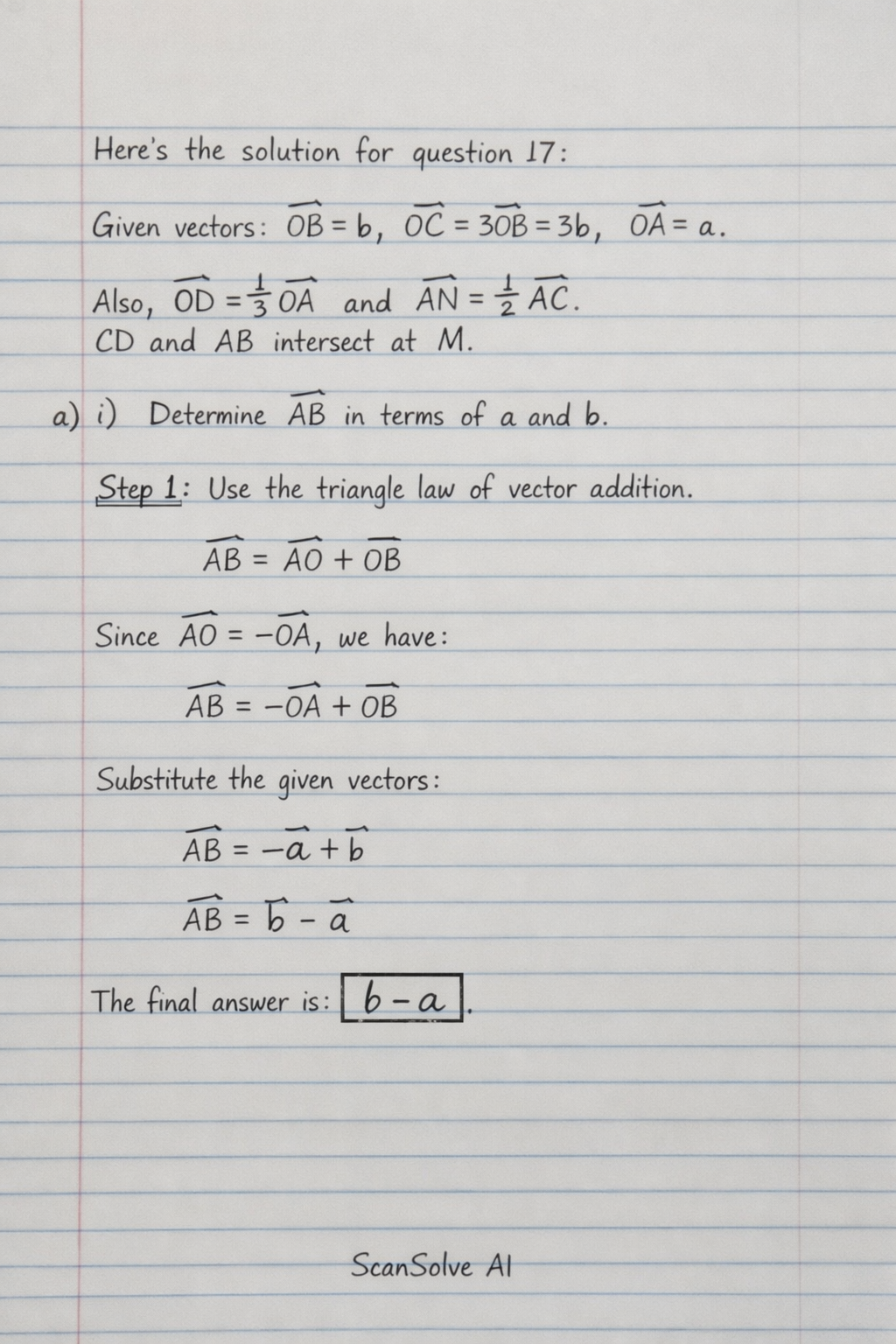
Here's the solution for question 17:

Given vectors: OB⃗=b\vec{OB} = \mathbf{b}, OC⃗=3OB⃗=3b\vec{OC} = 3\vec{OB} = 3\mathbf{b}, OA⃗=a\vec{OA} = \mathbf{a}.
Also, OD⃗=13OA⃗\vec{OD} = \frac{1}{3}\vec{OA} and AN⃗=12AC⃗\vec{AN} = \frac{1}{2}\vec{AC}.
CD and AB intersect at M.

Part a(i)· 1 step

Determine AB⃗\vec{AB} in terms of a\mathbf{a} and b\mathbf{b}.

  1. Use the triangle law of vector addition.

    AB⃗=AO⃗+OB⃗\vec{AB} = \vec{AO} + \vec{OB}

    Since AO⃗=−OA⃗\vec{AO} = -\vec{OA}, we have:

    AB⃗=−OA⃗+OB⃗\vec{AB} = -\vec{OA} + \vec{OB}

    Substitute the given vectors:

    AB⃗=−a+b\vec{AB} = -\mathbf{a} + \mathbf{b} AB⃗=b−a\vec{AB} = \mathbf{b} - \mathbf{a}

    The final answer is b−a\boxed{\mathbf{b} - \mathbf{a}}.

Part a(ii)

13a−3b\frac{1}{3}\mathbf{a} - 3\mathbf{b}

Determine CD⃗\vec{CD} in terms of a\mathbf{a} and b\mathbf{b}.

  1. Use the triangle law of vector addition.

    CD⃗=CO⃗+OD⃗\vec{CD} = \vec{CO} + \vec{OD}

    Since CO⃗=−OC⃗\vec{CO} = -\vec{OC}, we have:

    CD⃗=−OC⃗+OD⃗\vec{CD} = -\vec{OC} + \vec{OD}

    Substitute the given vectors OC⃗=3b\vec{OC} = 3\mathbf{b} and OD⃗=13OA⃗=13a\vec{OD} = \frac{1}{3}\vec{OA} = \frac{1}{3}\mathbf{a}:

    CD⃗=−3b+13a\vec{CD} = -3\mathbf{b} + \frac{1}{3}\mathbf{a} CD⃗=13a−3b\vec{CD} = \frac{1}{3}\mathbf{a} - 3\mathbf{b}

    The final answer is 13a−3b\boxed{\frac{1}{3}\mathbf{a} - 3\mathbf{b}}.

Part b

K=34,h=34K = \frac{3}{4}, h = \frac{3}{4}

Given that CM⃗=KCD⃗\vec{CM} = K\vec{CD} and AM⃗=hAB⃗\vec{AM} = h\vec{AB}. Determine the values of the scalars K and h.

  1. Express OM⃗\vec{OM} in terms of K.

    From CM⃗=KCD⃗\vec{CM} = K\vec{CD}:

    OM⃗−OC⃗=K(OD⃗−OC⃗)\vec{OM} - \vec{OC} = K(\vec{OD} - \vec{OC}) OM⃗=OC⃗+KOD⃗−KOC⃗\vec{OM} = \vec{OC} + K\vec{OD} - K\vec{OC} OM⃗=(1−K)OC⃗+KOD⃗\vec{OM} = (1-K)\vec{OC} + K\vec{OD}

    Substitute OC⃗=3b\vec{OC} = 3\mathbf{b} and OD⃗=13a\vec{OD} = \frac{1}{3}\mathbf{a}:

    OM⃗=(1−K)(3b)+K(13a)\vec{OM} = (1-K)(3\mathbf{b}) + K\left(\frac{1}{3}\mathbf{a}\right) OM⃗=K3a+(3−3K)b(Equation 1)\vec{OM} = \frac{K}{3}\mathbf{a} + (3-3K)\mathbf{b} \quad \text{(Equation 1)}
  2. Express OM⃗\vec{OM} in terms of h.

    From AM⃗=hAB⃗\vec{AM} = h\vec{AB}:

    OM⃗−OA⃗=h(OB⃗−OA⃗)\vec{OM} - \vec{OA} = h(\vec{OB} - \vec{OA}) OM⃗=OA⃗+hOB⃗−hOA⃗\vec{OM} = \vec{OA} + h\vec{OB} - h\vec{OA} OM⃗=(1−h)OA⃗+hOB⃗\vec{OM} = (1-h)\vec{OA} + h\vec{OB}

    Substitute OA⃗=a\vec{OA} = \mathbf{a} and OB⃗=b\vec{OB} = \mathbf{b}:

    OM⃗=(1−h)a+hb(Equation 2)\vec{OM} = (1-h)\mathbf{a} + h\mathbf{b} \quad \text{(Equation 2)}
  3. Equate the coefficients of a\mathbf{a} and b\mathbf{b} from Equation 1 and Equation 2.

    K3a+(3−3K)b=(1−h)a+hb\frac{K}{3}\mathbf{a} + (3-3K)\mathbf{b} = (1-h)\mathbf{a} + h\mathbf{b}

    Equating coefficients of a\mathbf{a}:

    K3=1−h(Equation 3)\frac{K}{3} = 1-h \quad \text{(Equation 3)}

    Equating coefficients of b\mathbf{b}:

    3−3K=h(Equation 4)3-3K = h \quad \text{(Equation 4)}
  4. Solve the simultaneous equations for K and h.

    Substitute Equation 4 into Equation 3:

    K3=1−(3−3K)\frac{K}{3} = 1 - (3-3K) K3=1−3+3K\frac{K}{3} = 1 - 3 + 3K K3=−2+3K\frac{K}{3} = -2 + 3K

    Multiply by 3:

    K=−6+9KK = -6 + 9K 6=8K6 = 8K K=68=34K = \frac{6}{8} = \frac{3}{4}

    Substitute K=34K = \frac{3}{4} into Equation 4:

    h=3−3(34)h = 3 - 3\left(\frac{3}{4}\right) h=3−94h = 3 - \frac{9}{4} h=124−94h = \frac{12}{4} - \frac{9}{4} h=34h = \frac{3}{4}

    The final answer is K=34,h=34\boxed{K = \frac{3}{4}, h = \frac{3}{4}}.

Part c· 3 steps

Show that O, M and N are collinear.

  1. Find OM⃗\vec{OM} using the values of K or h.

    Using Equation 2 with h=34h = \frac{3}{4}:

    OM⃗=(1−34)a+34b\vec{OM} = (1-\frac{3}{4})\mathbf{a} + \frac{3}{4}\mathbf{b} OM⃗=14a+34b\vec{OM} = \frac{1}{4}\mathbf{a} + \frac{3}{4}\mathbf{b}
  2. Find ON⃗\vec{ON}.

    We are given AN⃗=12AC⃗\vec{AN} = \frac{1}{2}\vec{AC}.

    ON⃗−OA⃗=12(OC⃗−OA⃗)\vec{ON} - \vec{OA} = \frac{1}{2}(\vec{OC} - \vec{OA}) ON⃗=OA⃗+12OC⃗−12OA⃗\vec{ON} = \vec{OA} + \frac{1}{2}\vec{OC} - \frac{1}{2}\vec{OA} ON⃗=(1−12)OA⃗+12OC⃗\vec{ON} = (1-\frac{1}{2})\vec{OA} + \frac{1}{2}\vec{OC}

    Substitute OA⃗=a\vec{OA} = \mathbf{a} and OC⃗=3b\vec{OC} = 3\mathbf{b}:

    ON⃗=12a+12(3b)\vec{ON} = \frac{1}{2}\mathbf{a} + \frac{1}{2}(3\mathbf{b}) ON⃗=12a+32b\vec{ON} = \frac{1}{2}\mathbf{a} + \frac{3}{2}\mathbf{b}
  3. Compare OM⃗\vec{OM} and ON⃗\vec{ON}.

    OM⃗=14a+34b\vec{OM} = \frac{1}{4}\mathbf{a} + \frac{3}{4}\mathbf{b} ON⃗=12a+32b\vec{ON} = \frac{1}{2}\mathbf{a} + \frac{3}{2}\mathbf{b}

    We can factor out a scalar from ON⃗\vec{ON}:

    ON⃗=2(14a+34b)\vec{ON} = 2\left(\frac{1}{4}\mathbf{a} + \frac{3}{4}\mathbf{b}\right) ON⃗=2OM⃗\vec{ON} = 2\vec{OM}

    Since ON⃗\vec{ON} is a scalar multiple of OM⃗\vec{OM} and both vectors originate from O, the points O, M, and N are collinear.

    3 zimekamilika, zimebaki 2 leo. Unapiga hatua.

Was this helpful?

Try one yourself

A new problem that tests the same skill.

Still stuck on this one?

Ask a follow-up, and the answer starts from this question.

Got a different question?Ask your own question
Handwritten step-by-step solution preview

Handwritten Step-by-Step Solution

Get this as a handwritten image on WhatsApp — like a tutor wrote it for you.

Try on WhatsApp