
We read your photo as:
In the given diagram, points P, Q, R, and S lie on a circle. If PQ = QS and angle PSQ = 80 degrees, what is the measure of angle QRS?
Mathematics
ScanSolve AI Answer
Step-by-step solution
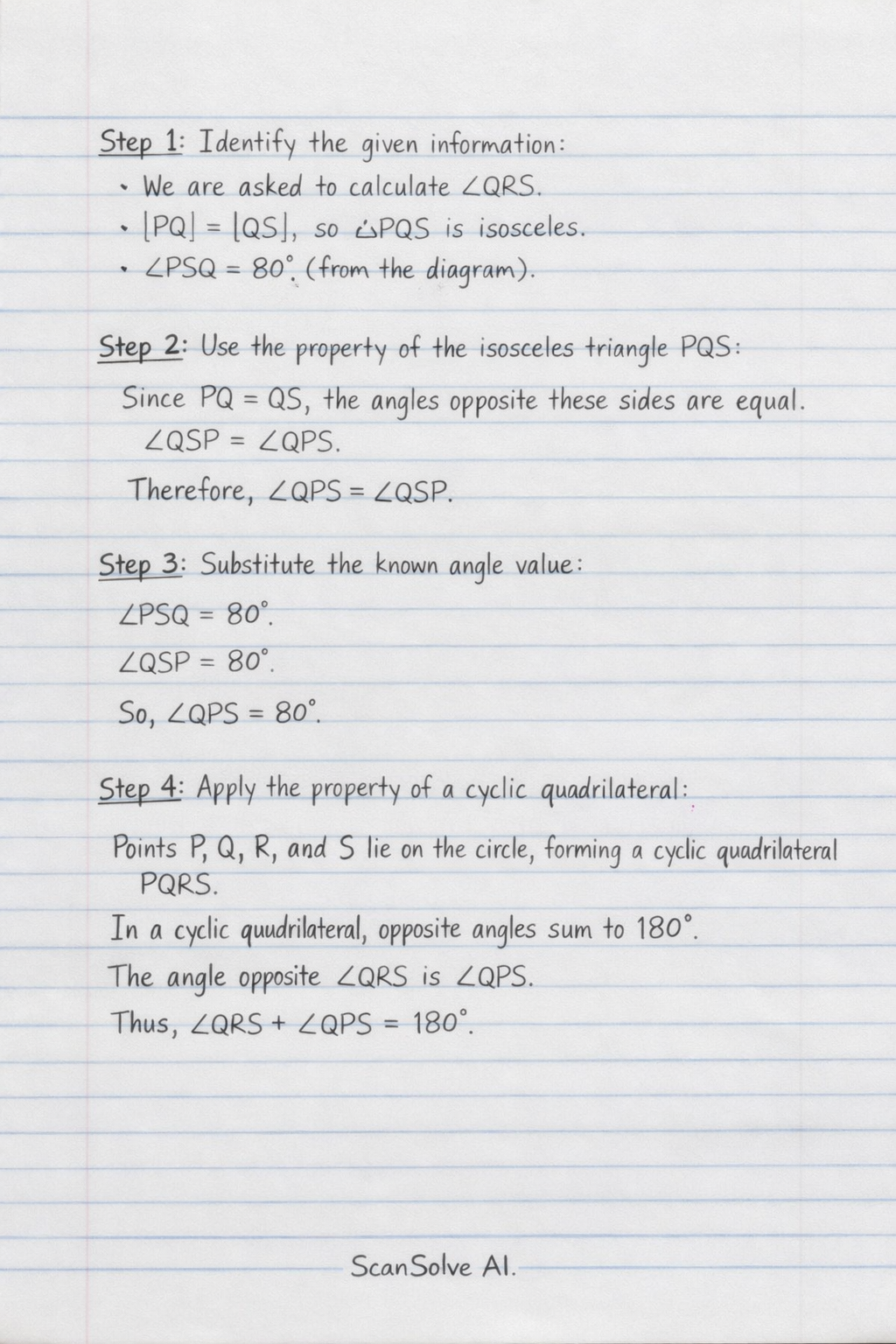
5 stepsIdentify the given information from the problem statement and the diagram.
- We are asked to calculate .
- We are given that . This means that triangle is an isosceles triangle.
- From the diagram, the angle is marked as .
Use the property of the isosceles triangle .
Since , the angles opposite these sides in are equal.
The angle opposite side is .
The angle opposite side is .
Therefore, .Substitute the known angle value.
We are given , which is the same as .
So, .Use the property of a cyclic quadrilateral.
The points P, Q, R, S lie on the circumference of the circle, forming a cyclic quadrilateral PQRS.
In a cyclic quadrilateral, the sum of opposite angles is .
The angle opposite to is .
Therefore, .Calculate .
Substitute the value of from Step 3 into the equation from Step 4:
The value of $\
Was this helpful?
Still stuck on this one?
Ask a follow-up, and the answer starts from this question.
Got a different question?Ask your own question
More Mathematics Questions
QIn the diagram PQ // RS, QU // PT and PSR = 42^. Find angle x.QA circle has points P, Q, R, S, T on its circumference with center O. Given central angle POQ is 125…QIn the diagram, O is the center of the circle. PQ and RS are tangents to the circle. The angle…QIn the diagram, |PQ| = |PR| = |RS| and ∠RPS = 32°. Find ∠QPR.QIn the diagram, P, Q, R and S are points on the circle with centre O and PQR = 104^. Find the angle…
Browse by topic:Geometry
Handwritten Step-by-Step Solution
Get this as a handwritten image on WhatsApp — like a tutor wrote it for you.
Try on WhatsApp