
We read your photo as:
Find the incorrect number in the series: 18, 20, 23, 32, 48, 73, 109.
ScanSolve AI Answer
Answer
Step-by-step solution
4 stepsTo find the incorrect number in the series, we will analyze the differences between consecutive terms.
The given series is: $18, 20, 23, 32, 48, 73, 109$.
Calculate the differences between consecutive terms.
The sequence of differences is .
Identify the pattern in the differences.
We observe that the last four differences are perfect squares:
This suggests that the pattern of differences should be consecutive squares starting from .
Determine the expected sequence of differences.
The expected differences are , which are .
Reconstruct the series using the first term and the expected differences to find the incorrect number.
- The first term is 18.
- The second term should be . (The given second term is 20).
- The third term should be . (The given third term is 23, which matches).
- The fourth term should be . (The given fourth term is 32, which matches).
- The fifth term should be . (The given fifth term is 48, which matches).
- The sixth term should be . (The given sixth term is 73, which matches).
- The seventh term should be . (The given seventh term is 109, which matches).
Comparing the given series () with the reconstructed series (), the number 20 is incorrect as it should be 19 to follow the pattern.
Try one yourself
A new problem that tests the same skill.
Still stuck on this one?
Ask a follow-up, and the answer starts from this question.
More Mathematics Questions
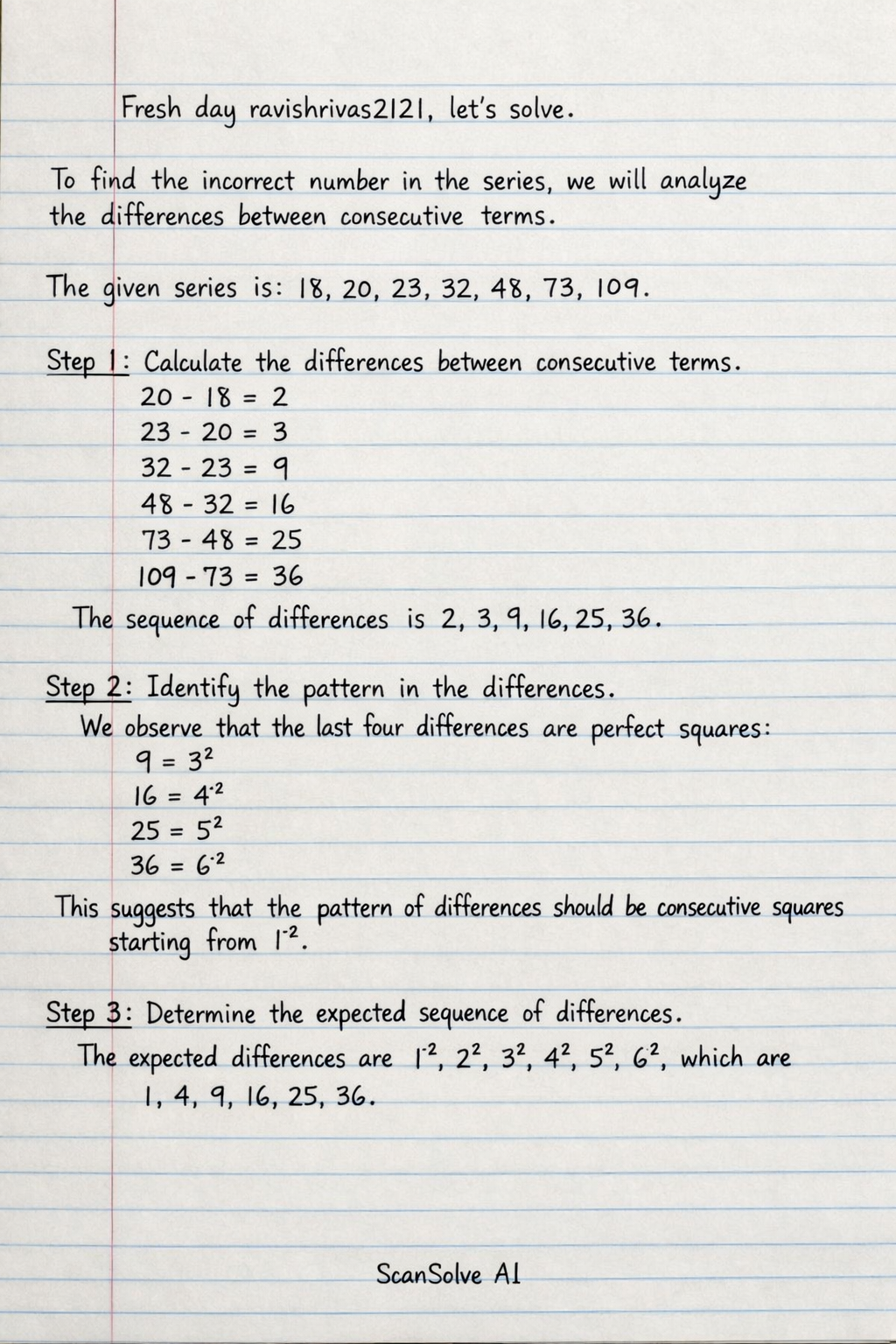
Handwritten Step-by-Step Solution
Get this as a handwritten image on WhatsApp — like a tutor wrote it for you.
Try on WhatsApp