
We read your photo as:
Solve the indicial equation 2 (2x+1)=27(x−1)
Mathematics
ScanSolve AI Answer
Step-by-step solution
5 stepsHere's how to solve the indicial equation:
The equation given is .
Expand both sides of the equation.
Group the terms with on one side and the constant terms on the other side.
Subtract from both sides:
Subtract 3 from both sides:
Simplify both sides of the equation.
Solve for by dividing both sides by .
Simplify the fraction and provide the decimal approximation.
Divide both the numerator and the denominator by their greatest common divisor, which is 3:
As a decimal, rounded to four decimal places:
The solution to the equation is .
Was this helpful?
Still stuck on this one?
Ask a follow-up, and the answer starts from this question.
Got a different question?Ask your own question
More Mathematics Questions
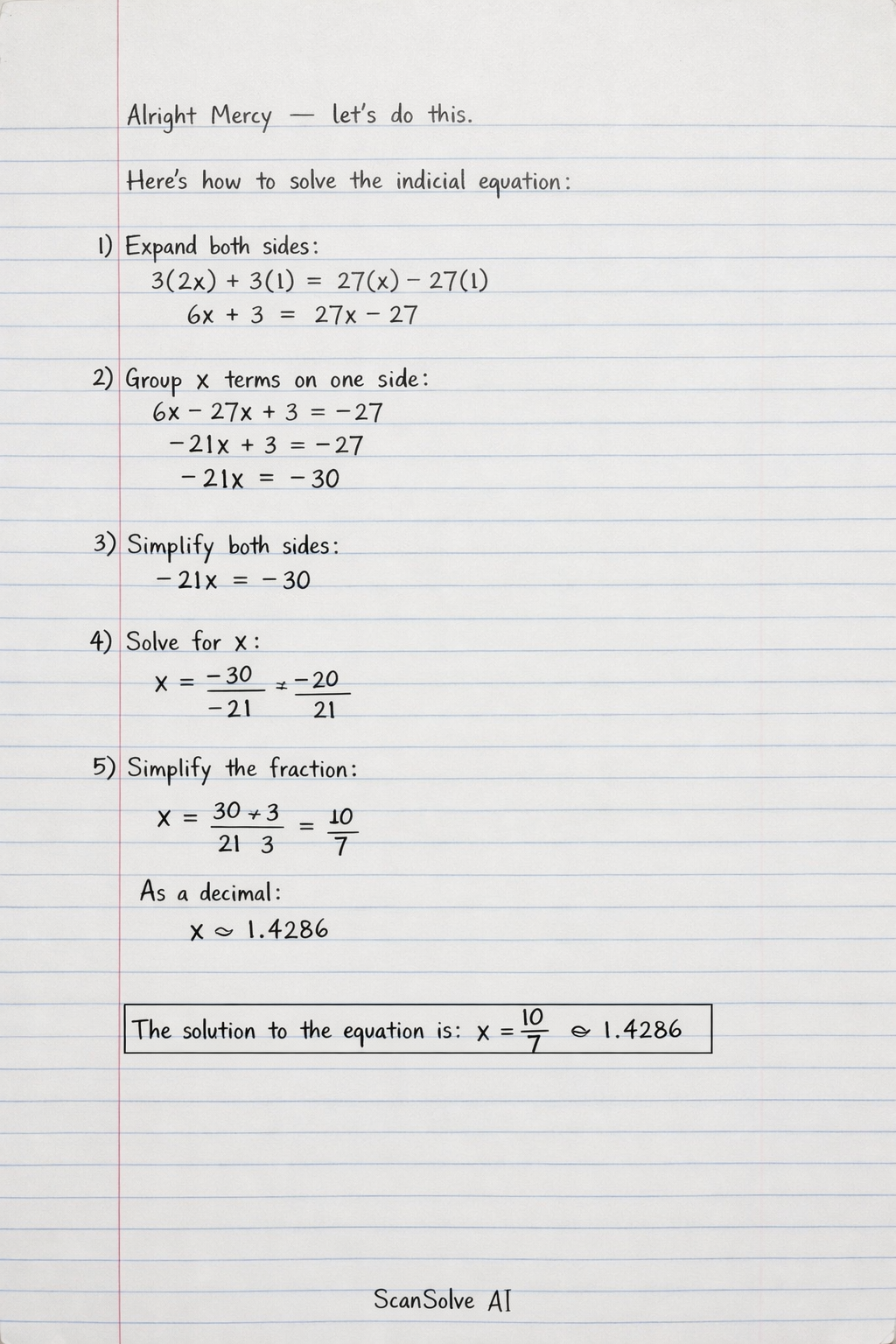
Handwritten Step-by-Step Solution
Get this as a handwritten image on WhatsApp — like a tutor wrote it for you.
Try on WhatsApp