This mathematics problem involves applying core mathematical principles and formulas. Below you will find a complete step-by-step solution with detailed explanations for each step, helping you understand not just the answer but the method behind it.
ScanSolve AI Answer
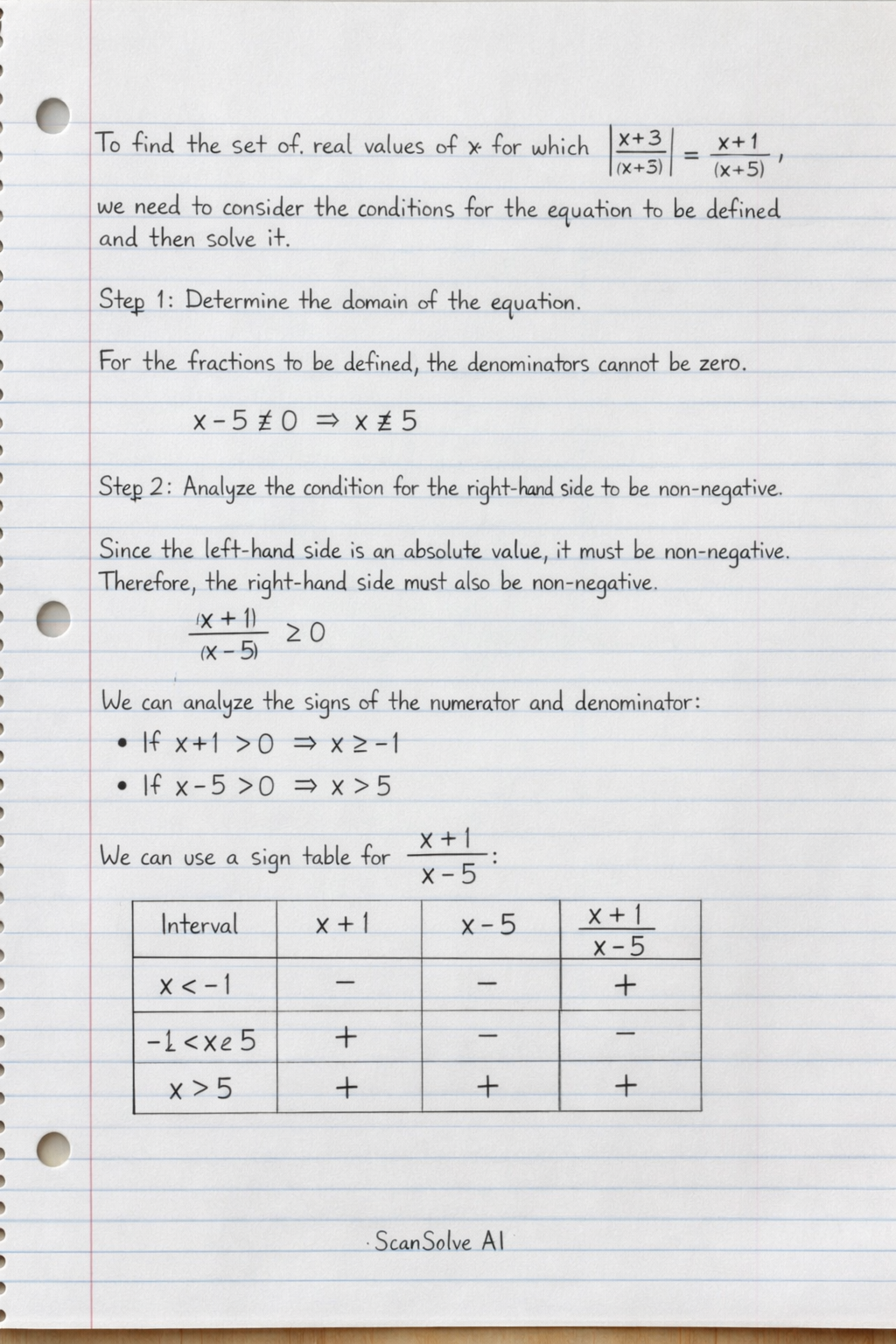
To find the set of real values of $x$ for which $\left|\frac{x+3}{x-5}\right| = \frac{x+1}{x-5}$, we need to consider the conditions for the equation to be defined and then solve it.
Step 1: Determine the domain of the equation.
For the fractions to be defined, the denominators cannot be zero.
$$ x - 5 \neq 0 \implies x \neq 5 $$
Step 2: Analyze the condition for the right-hand side to be non-negative.
Since the left-hand side is an absolute value, it must be non-negative. Therefore, the right-hand side must also be non-negative.
$$ \frac{x+1}{x-5} \ge 0 $$
We can analyze the signs of the numerator and denominator:
• If $x+1 \ge 0 \implies x \ge -1$
• If $x-5 > 0 \implies x > 5$
We can use a sign table for $\frac{x+1}{x-5}$:
| Interval | $x+1$ | $x-5$ | $\frac{x+1}{x-5}$ |
|---------------|-------|-------|-------------------|
| $x < -1$ | $-$ | $-$ | $+$ |
| $-1 \le x < 5$| $+$ | $-$ | $-$ |
| $x > 5$ | $+$ | $+$ | $+$ |
So, the condition $\frac{x+1}{x-5} \ge 0$ holds for $x \le -1$ or $x > 5$.
This is the valid domain for our solutions.
Step 3: Solve the equation $\left|\frac{x+3}{x-5}\right| = \frac{x+1}{x-5}$.
We can rewrite the left side as $\frac{|x+3|}{|x-5|}$.
$$ \frac{|x+3|}{|x-5|} = \frac{x+1}{x-5} $$
We need to consider two cases based on the sign of $x-5$.
Case 1: $x-5 > 0 \implies x > 5$.
In this case, $|x-5| = x-5$.
The equation becomes:
$$ \frac{|x+3|}{x-5} = \frac{x+1}{x-5} $$
Since $x-5 > 0$, we can multiply both sides by $x-5$:
$$ |x+3| = x+1 $$
Now, we solve this equation for $x > 5$.
Subcase 1.1: $x+3 \ge 0 \implies x \ge -3$.
Since we are in the interval $x > 5$, the condition $x \ge -3$ is always satisfied.
So, $x+3 = x+1$.
$$ 3 = 1 $$
This is a contradiction, so there are no solutions in this subcase.
Subcase 1.2: $x+3 < 0 \implies x < -3$.
This condition $x < -3$ contradicts the condition $x > 5$. So, there are no solutions in this subcase.
Therefore, there are no solutions when $x > 5$.
Case 2: $x-5 < 0 \implies x < 5$.
In this case, $|x-5| = -(x-5) = 5-x$.
The equation becomes:
$$ \frac{|x+3|}{-(x-5)} = \frac{x+1}{x-5} $$
$$ \frac{|x+3|}{5-x} = \frac{x+1}{x-5} $$
Multiply both sides by $(x-5)$:
$$ \frac{|x+3|}{-(x-5)} \cdot (x-5) = x+1 $$
$$ -|x+3| = x+1 $$
$$ |x+3| = -(x+1) $$
Now, we solve this equation for $x < 5$. We must also satisfy the domain condition $x \le -1$. So, we are looking for solutions in the interval $x \le -1$.
Subcase 2.1: $x+3 \ge 0 \implies x \ge -3$.
Combining with $x \le -1$, this means we are in the interval $-3 \le x \le -1$.
In this range, $x+3 = -(x+1)$.
$$ x+3 = -x-1 $$
$$ 2x = -4 $$
$$ x = -2 $$
This solution $x = -2$ lies within the interval $[-3, -1]$.
Thus, $x = -2$ is a valid solution.
Subcase 2.2: $x+3 < 0 \implies x < -3$.
Combining with $x \le -1$, this means we are in the interval $x < -3$.
In this range, $-(x+3) = -(x+1)$.
$$ -x-3 = -x-1 $$
$$ -3 = -1 $$
This is a contradiction, so there are no solutions in this subcase.
Step 4: Combine the results.
The only solution found is $x = -2$.
We verify this solution with the original equation:
LHS: $\left|\frac{-2+3}{-2-5}\right| = \left|\frac{1}{-7}\right| = \left|-\frac{1}{7}\right| = \frac{1}{7}$
RHS: $\frac{-2+1}{-2-5} = \frac{-1}{-7} = \frac{1}{7}$
Since LHS = RHS, $x=-2$ is correct.
The set of real values of $x$ for which the equation holds is $\boxed{\{-2\}}$.
Solve the inequality
|Mathematics
Solve the inequality
ScanSolve AI Answer
To find the set of real values of x for which x−5x+3=x−5x+1, we need to consider the conditions for the equation to be defined and then solve it.
Step 1: Determine the domain of the equation.
For the fractions to be defined, the denominators cannot be zero.
x−5=0⟹x=5
Step 2: Analyze the condition for the right-hand side to be non-negative.
Since the left-hand side is an absolute value, it must be non-negative. Therefore, the right-hand side must also be non-negative.
x−5x+1≥0
We can analyze the signs of the numerator and denominator:
• If x+1≥0⟹x≥−1
• If x−5>0⟹x>5
We can use a sign table for x−5x+1:
| Interval | x+1 | x−5 | x−5x+1 |
|---------------|-------|-------|-------------------|
| x<−1 | − | − | + |
| −1≤x<5| + | − | − |
| x>5 | + | + | + |
So, the condition x−5x+1≥0 holds for x≤−1 or x>5.
This is the valid domain for our solutions.
Step 3: Solve the equation x−5x+3=x−5x+1.
We can rewrite the left side as ∣x−5∣∣x+3∣.
∣x−5∣∣x+3∣=x−5x+1
We need to consider two cases based on the sign of x−5.
Case 1: x−5>0⟹x>5.
In this case, ∣x−5∣=x−5.
The equation becomes:
x−5∣x+3∣=x−5x+1
Since x−5>0, we can multiply both sides by x−5:
∣x+3∣=x+1
Now, we solve this equation for x>5.
Subcase 1.1: x+3≥0⟹x≥−3.
Since we are in the interval x>5, the condition x≥−3 is always satisfied.
So, x+3=x+1.
3=1
This is a contradiction, so there are no solutions in this subcase.
Subcase 1.2: x+3<0⟹x<−3.
This condition x<−3 contradicts the condition x>5. So, there are no solutions in this subcase.
Therefore, there are no solutions when x>5.
Case 2: x−5<0⟹x<5.
In this case, ∣x−5∣=−(x−5)=5−x.
The equation becomes:
−(x−5)∣x+3∣=x−5x+15−x∣x+3∣=x−5x+1
Multiply both sides by (x−5):
−(x−5)∣x+3∣⋅(x−5)=x+1−∣x+3∣=x+1∣x+3∣=−(x+1)
Now, we solve this equation for x<5. We must also satisfy the domain condition x≤−1. So, we are looking for solutions in the interval x≤−1.
Subcase 2.1: x+3≥0⟹x≥−3.
Combining with x≤−1, this means we are in the interval −3≤x≤−1.
In this range, x+3=−(x+1).
x+3=−x−12x=−4x=−2
This solution x=−2 lies within the interval [−3,−1].
Thus, x=−2 is a valid solution.
Subcase 2.2: x+3<0⟹x<−3.
Combining with x≤−1, this means we are in the interval x<−3.
In this range, −(x+3)=−(x+1).
−x−3=−x−1−3=−1
This is a contradiction, so there are no solutions in this subcase.
Step 4: Combine the results.
The only solution found is x=−2.
We verify this solution with the original equation:
LHS: −2−5−2+3=−71=−71=71
RHS: −2−5−2+1=−7−1=71
Since LHS = RHS, x=−2 is correct.
The set of real values of x for which the equation holds is {−2}.
Need help with your own homework?
Get instant step-by-step solutions to any question. Free to start.