Solve the inequality below and write down the integral values that satisfy the equality

Mathematics
Solve the inequality below and write down the integral values that satisfy the equality

ScanSolve AI Answer

Answer

0, 1, 2, 3

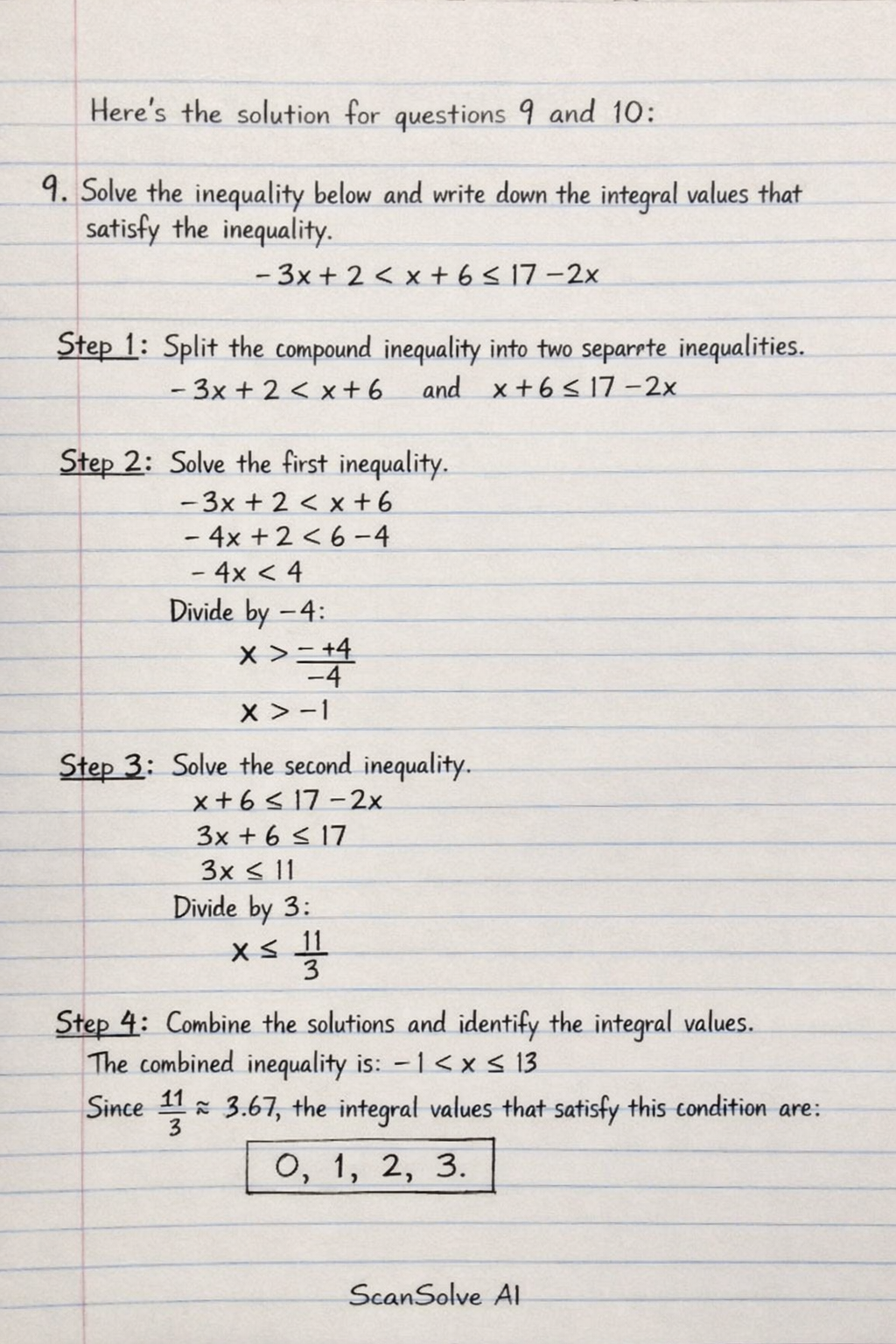
Here's the solution for questions 9 and 10:

9. Solve the inequality below and write down the integral values that satisfy the equality 3x+2<x+6172x-3x + 2 < x + 6 \le 17 - 2x

Step 1: Split the compound inequality into two separate inequalities. 3x+2<x+6andx+6172x-3x + 2 < x + 6 \quad and \quad x + 6 \le 17 - 2x

Step 2: Solve the first inequality. \begin{align*} -3x + 2 &< x + 6 \\ -3x - x &< 6 - 2 \\ -4x &< 4 \end{align*} Divide by 4-4 and reverse the inequality sign: x>44x>1x > \frac{4}{-4} \\ x > -1

Step 3: Solve the second inequality. \begin{align*} x + 6 &\le 17 - 2x \\ x + 2x &\le 17 - 6 \\ 3x &\le 11 \end{align*} Divide by 33: x113x \le \frac{11}{3}

Step 4: Combine the solutions and identify the integral values. The combined inequality is 1<x113-1 < x \le \frac{11}{3}. Since 1133.67\frac{11}{3} \approx 3.67, the integral values (integers) that satisfy this condition are those greater than 1-1 and less than or equal to 3.673.67. The integral values are 0,1,2,3\boxed{0, 1, 2, 3}.

10. Find the equation of a line which passes through the point (2,3)(2, 3) and is perpendicular to y3x+1=0y - 3x + 1 = 0, giving your answer in the form y=mx+cy = mx + c.

Step 1: Find the slope of the given line. The given equation is y3x+1=0y - 3x + 1 = 0. Rearrange it into the form y=mx+cy = mx + c: y=3x1y = 3x - 1 The slope of this line, m1m_1, is 33.

Step 2: Find the slope of the perpendicular line. For two lines to be perpendicular, the product of their slopes must be 1-1. Let m2m_2 be the slope of the required line. m1m2=13m2=1m2=13m_1 \cdot m_2 = -1 \\ 3 \cdot m_2 = -1 \\ m_2 = -\frac{1}{3}

Step 3: Use the point-slope form to find the equation of the required line. The line passes through (x1,y1)=(2,3)(x_1, y_1) = (2, 3) and has a slope m2=13m_2 = -\frac{1}{3}. The point-slope form is yy1=m(xx1)y - y_1 = m(x - x_1). y3=13(x2)y - 3 = -\frac{1}{3}(x - 2)

Step 4: Convert the equation to the y=mx+cy = mx + c form. y3=13x+23y=13x+23+3y=13x+23+93y=13x+113y - 3 = -\frac{1}{3}x + \frac{2}{3} \\ y = -\frac{1}{3}x + \frac{2}{3} + 3 \\ y = -\frac{1}{3}x + \frac{2}{3} + \frac{9}{3} \\ y = -\frac{1}{3}x + \frac{11}{3} The equation of the line is y=13x+113\boxed{y = -\frac{1}{3}x + \frac{11}{3}}.

Last free one today — make it count tomorrow, or type /upgrade for unlimited.

Was this helpful?

Need help with your own homework?

Get instant step-by-step solutions to any question. Free to start.

Ask Your Question
Handwritten step-by-step solution preview

Handwritten Step-by-Step Solution

Get this as a handwritten image on WhatsApp — like a tutor wrote it for you.

Try on WhatsApp

Still have questions?

Quick Answer

Here's the solution for questions 9 and 10: 9. Solve the inequality below and write down the integral values that satisfy the equality -3x + 2 < x + 6 17 - 2x Step 1: Split the compound inequality into two separate inequalities.

Solve the inequality below and write down the integral values that satisfy the equality
Mathematics

This mathematics problem involves applying core mathematical principles and formulas. Below you will find a complete step-by-step solution with detailed explanations for each step, helping you understand not just the answer but the method behind it.

ScanSolve AI Answer
Here's the solution for questions 9 and 10: 9. Solve the inequality below and write down the integral values that satisfy the equality -3x + 2 < x + 6 17 - 2x Step 1: Split the compound inequality into two separate inequalities. -3x + 2 < x + 6 and x + 6 17 - 2x Step 2: Solve the first inequality. -3x + 2 &< x + 6 \\ -3x - x &< 6 - 2 \\ -4x &< 4 Divide by -4 and reverse the inequality sign: x > (4)/(-4) \\ x > -1 Step 3: Solve the second inequality. x + 6 & 17 - 2x \\ x + 2x & 17 - 6 \\ 3x & 11 Divide by 3: x (11)/(3) Step 4: Combine the solutions and identify the integral values. The combined inequality is -1 < x (11)/(3). Since (11)/(3) ≈ 3.67, the integral values (integers) that satisfy this condition are those greater than -1 and less than or equal to 3.67. The integral values are 0, 1, 2, 3. 10. Find the equation of a line which passes through the point (2, 3) and is perpendicular to y - 3x + 1 = 0, giving your answer in the form y = mx + c. Step 1: Find the slope of the given line. The given equation is y - 3x + 1 = 0. Rearrange it into the form y = mx + c: y = 3x - 1 The slope of this line, m_1, is 3. Step 2: Find the slope of the perpendicular line. For two lines to be perpendicular, the product of their slopes must be -1. Let m_2 be the slope of the required line. m_1 · m_2 = -1 \\ 3 · m_2 = -1 \\ m_2 = -(1)/(3) Step 3: Use the point-slope form to find the equation of the required line. The line passes through (x_1, y_1) = (2, 3) and has a slope m_2 = -(1)/(3). The point-slope form is y - y_1 = m(x - x_1). y - 3 = -(1)/(3)(x - 2) Step 4: Convert the equation to the y = mx + c form. y - 3 = -(1)/(3)x + (2)/(3) \\ y = -(1)/(3)x + (2)/(3) + 3 \\ y = -(1)/(3)x + (2)/(3) + (9)/(3) \\ y = -(1)/(3)x + (11)/(3) The equation of the line is y = -(1)/(3)x + (11)/(3). Last free one today — make it count tomorrow, or type /upgrade for unlimited.