State three merits of operating two three-phase induction motors in cascade.

Physics
State three merits of operating two three-phase induction motors in cascade.

ScanSolve AI Answer

Answer

4.43 \Omega

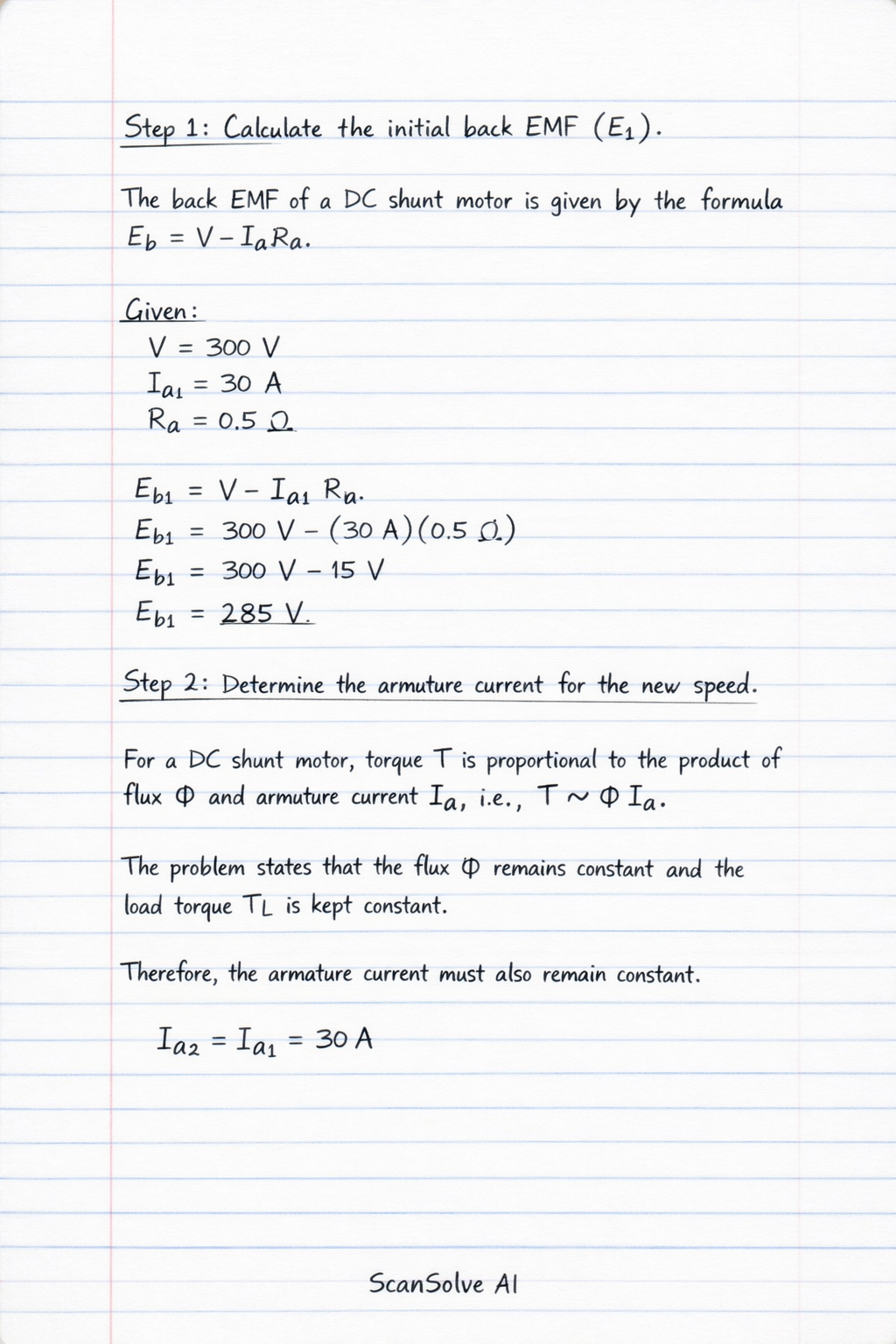
Step 1: Calculate the initial back EMF (Eb1E_{b1}). The back EMF of a DC shunt motor is given by the formula Eb=VIaRaE_b = V - I_a R_a. Given: V=300VV = 300\, \text{V} Ia1=30AI_{a1} = 30\, \text{A} Ra=0.5ΩR_a = 0.5\, \Omega

Eb1=VIa1RaE_{b1} = V - I_{a1} R_a Eb1=300V(30A)(0.5Ω)E_{b1} = 300\, V - (30\, A)(0.5\, \Omega) Eb1=300V15VE_{b1} = 300\, V - 15\, \text{V} Eb1=285VE_{b1} = 285\, \text{V}

Step 2: Determine the armature current for the new speed. For a DC shunt motor, torque TT is proportional to the product of flux Φ\Phi and armature current IaI_a, i.e., TΦIaT \propto \Phi I_a. The problem states that the flux Φ\Phi remains constant and the load torque TLT_L is kept constant. Therefore, the armature current must also remain constant. Ia2=Ia1=30AI_{a2} = I_{a1} = 30\, \text{A}

Step 3: Calculate the back EMF (Eb2E_{b2}) at the new speed. The back EMF is also proportional to the product of flux Φ\Phi and speed NN, i.e., EbΦNE_b \propto \Phi N. Since the flux Φ\Phi is constant, EbNE_b \propto N. We can write the ratio: Eb2Eb1=N2N1\frac{E_{b2}}{E_{b1}} = \frac{N_2}{N_1} Given: N1=1500r.p.mN_1 = 1500\, \text{r.p.m} N2=800r.p.mN_2 = 800\, \text{r.p.m}

Eb2=Eb1(N2N1)E_{b2} = E_{b1} \left(\frac{N_2}{N_1}\right) Eb2=285V(800r.p.m1500r.p.m)E_{b2} = 285\, V \left(\frac{800\, r.p.m}{1500\, r.p.m}\right) Eb2=285V(815)E_{b2} = 285\, V \left(\frac{8}{15}\right) Eb2=19V×8E_{b2} = 19\, V \times 8 Eb2=152VE_{b2} = 152\, \text{V}

Step 4: Determine the total armature resistance required. Let RextR_{ext} be the external resistance added in series with the armature. The total armature circuit resistance will be Ra+RextR_a + R_{ext}. Using the back EMF formula for the new condition: Eb2=VIa2(Ra+Rext)E_{b2} = V - I_{a2} (R_a + R_{ext}) 152V=300V30A(0.5Ω+Rext)152\, V = 300\, V - 30\, A (0.5\, \Omega + R_{ext})

Step 5: Solve for the external resistance RextR_{ext}. Rearrange the equation to solve for RextR_{ext}: 30A(0.5Ω+Rext)=300V152V30\, A (0.5\, \Omega + R_{ext}) = 300\, V - 152\, \text{V} 30A(0.5Ω+Rext)=148V30\, A (0.5\, \Omega + R_{ext}) = 148\, \text{V} 0.5Ω+Rext=148V30A0.5\, \Omega + R_{ext} = \frac{148\, V}{30\, A} 0.5Ω+Rext=4.9333...Ω0.5\, \Omega + R_{ext} = 4.9333... \, \Omega Rext=4.9333...Ω0.5ΩR_{ext} = 4.9333... \, \Omega - 0.5\, \Omega Rext=4.4333...ΩR_{ext} = 4.4333... \, \Omega

Rounding to two decimal places: Rext4.43ΩR_{ext} \approx 4.43\, \Omega

The value of resistance to be added in series with the armature is 4.43Ω\boxed{4.43 \Omega}.

Was this helpful?

Need help with your own homework?

Get instant step-by-step solutions to any question. Free to start.

Ask Your Question
Handwritten step-by-step solution preview

Handwritten Step-by-Step Solution

Get this as a handwritten image on WhatsApp — like a tutor wrote it for you.

Try on WhatsApp

Still have questions?

Quick Answer

Calculate the initial back EMF (E_b1). The back EMF of a DC shunt motor is given by the formula E_b = V - I_a R_a.

State three merits of operating two three-phase induction motors in cascade.
Physics

This physics problem tests your understanding of fundamental physical laws and their applications. The step-by-step solution below breaks down the problem using relevant equations and physical reasoning.

ScanSolve AI Answer
Step 1: Calculate the initial back EMF (E_b1). The back EMF of a DC shunt motor is given by the formula E_b = V - I_a R_a. Given: V = 300\, V I_a1 = 30\, A R_a = 0.5\, E_b1 = V - I_a1 R_a E_b1 = 300\, V - (30\, A)(0.5\, ) E_b1 = 300\, V - 15\, V E_b1 = 285\, V Step 2: Determine the armature current for the new speed. For a DC shunt motor, torque T is proportional to the product of flux and armature current I_a, i.e., T I_a. The problem states that the flux remains constant and the load torque T_L is kept constant. Therefore, the armature current must also remain constant. I_a2 = I_a1 = 30\, A Step 3: Calculate the back EMF (E_b2) at the new speed. The back EMF is also proportional to the product of flux and speed N, i.e., E_b N. Since the flux is constant, E_b N. We can write the ratio: E_b2E_b1 = (N_2)/(N_1) Given: N_1 = 1500\, r.p.m N_2 = 800\, r.p.m E_b2 = E_b1 ((N_2)/(N_1)) E_b2 = 285\, V (800\, r.p.m1500\, r.p.m) E_b2 = 285\, V ((8)/(15)) E_b2 = 19\, V × 8 E_b2 = 152\, V Step 4: Determine the total armature resistance required. Let R_ext be the external resistance added in series with the armature. The total armature circuit resistance will be R_a + R_ext. Using the back EMF formula for the new condition: E_b2 = V - I_a2 (R_a + R_ext) 152\, V = 300\, V - 30\, A (0.5\, + R_ext) Step 5: Solve for the external resistance R_ext. Rearrange the equation to solve for R_ext: 30\, A (0.5\, + R_ext) = 300\, V - 152\, V 30\, A (0.5\, + R_ext) = 148\, V 0.5\, + R_ext = 148\, V30\, A 0.5\, + R_ext = 4.9333... \, R_ext = 4.9333... \, - 0.5\, R_ext = 4.4333... \, Rounding to two decimal places: R_ext ≈ 4.43\, The value of resistance to be added in series with the armature is 4.43 .