We read your photo as:

Evaluate integral from -1 to 2 of (2+x-x²) dx. Find the equation of the normal to the curve y=x+4/x at the point where x=4.

Mathematics

ScanSolve AI Answer

Graph of y = x + 4/x

Use the left and right arrow keys to trace the curve, up and down to jump between key points, and plus and minus to zoom.

Key points of y = x + 4/x
Pointxy

Step-by-step solution

8 steps

Here are the solutions to the problems from the image.

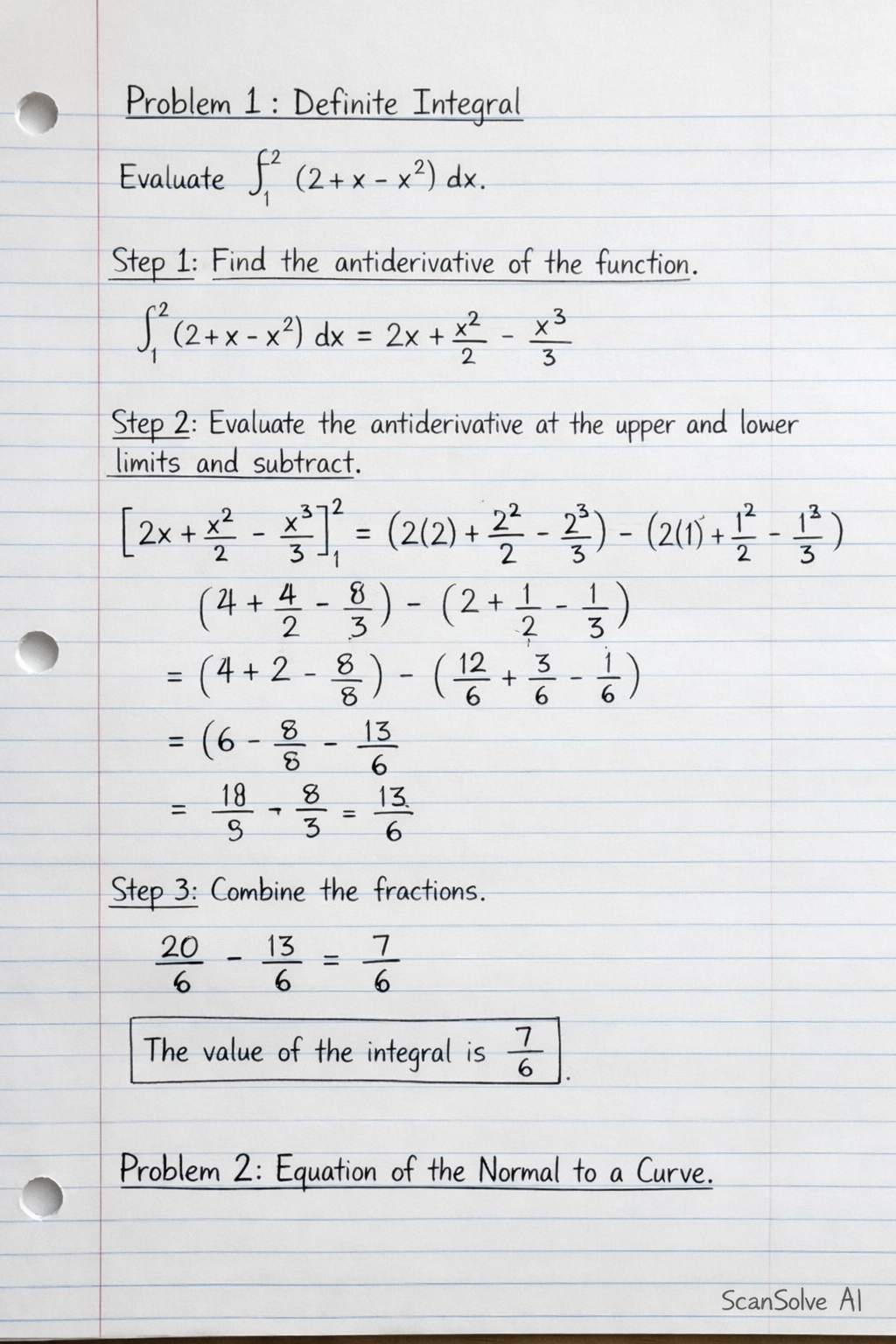
: Definite Integral

Evaluate ∫12(2+x−x2)dx\int_{1}^{2} (2+x-x^2) dx.

  1. Find the antiderivative of the function.

    ∫(2+x−x2)dx=2x+x22−x33\int (2+x-x^2) dx = 2x + \frac{x^2}{2} - \frac{x^3}{3}
  2. Evaluate the antiderivative at the upper and lower limits and subtract.

    [2x+x22−x33]12=(2(2)+222−233)−(2(1)+122−133)\left[ 2x + \frac{x^2}{2} - \frac{x^3}{3} \right]_{1}^{2} = \left( 2(2) + \frac{2^2}{2} - \frac{2^3}{3} \right) - \left( 2(1) + \frac{1^2}{2} - \frac{1^3}{3} \right) =(4+42−83)−(2+12−13)= \left( 4 + \frac{4}{2} - \frac{8}{3} \right) - \left( 2 + \frac{1}{2} - \frac{1}{3} \right) =(4+2−83)−(126+36−26)= \left( 4 + 2 - \frac{8}{3} \right) - \left( \frac{12}{6} + \frac{3}{6} - \frac{2}{6} \right) =(6−83)−(136)= \left( 6 - \frac{8}{3} \right) - \left( \frac{13}{6} \right) =(183−83)−136= \left( \frac{18}{3} - \frac{8}{3} \right) - \frac{13}{6} =103−136= \frac{10}{3} - \frac{13}{6}
  3. Combine the fractions.

    =206−136=76= \frac{20}{6} - \frac{13}{6} = \frac{7}{6}

    The value of the integral is 76\boxed{\frac{7}{6}}.

    : Equation of the Normal to a Curve

    Find the equation of the normal to the curve y=x+4xy = x + \frac{4}{x} at the point where x=4x=4.

  4. Find the y-coordinate of the point.

    Substitute x=4x=4 into the equation of the curve:

    y=4+44=4+1=5y = 4 + \frac{4}{4} = 4 + 1 = 5

    The point is (4,5)(4, 5).

  5. Find the derivative of the curve to get the gradient of the tangent.

    Rewrite y=x+4x−1y = x + 4x^{-1}.

    dydx=1−4x−2=1−4x2\frac{dy}{dx} = 1 - 4x^{-2} = 1 - \frac{4}{x^2}
  6. Calculate the gradient of the tangent at x=4x=4.

    mt=1−442=1−416=1−14=34m_t = 1 - \frac{4}{4^2} = 1 - \frac{4}{16} = 1 - \frac{1}{4} = \frac{3}{4}
  7. Calculate the gradient of the normal.

    The gradient of the normal (mnm_n) is the negative reciprocal of the gradient of the tangent.

    mn=−1mt=−13/4=−43m_n = -\frac{1}{m_t} = -\frac{1}{3/4} = -\frac{4}{3}
  8. Use the point-slope form y−y1=m(x−x1)y - y_1 = m(x - x_1) to find the equation of the normal.

    Using point (4,5)(4, 5) and mn=−43m_n = -\frac{4}{3}:

    y−5=−43(x−4)y - 5 = -\frac{4}{3}(x - 4)

    Multiply by 3:

    3(y−5)=−4(x−4)3(y - 5) = -4(x - 4) 3y−15=−4x+163y - 15 = -4x + 16

    Rearrange into the form Ax+By=CAx + By = C:

    4x+3y=16+154x + 3y = 16 + 15 4x+3y=314x + 3y = 31

    The equation of the normal is 4x+3y=31\boxed{4x + 3y = 31}.

Was this helpful?

Still stuck on this one?

Ask a follow-up, and the answer starts from this question.
Got a different question?Ask your own question
Handwritten step-by-step solution preview

Handwritten Step-by-Step Solution

Get this as a handwritten image on WhatsApp — like a tutor wrote it for you.

Try on WhatsApp