
We read your photo as:
Evaluate the integrals and combine the fractions.
Mathematics
ScanSolve AI Answer
Step-by-step solution
6 stepsHere are the solutions to your questions.
1) Evaluate
Find the indefinite integral of the function.
Apply the limits of integration using the Fundamental Theorem of Calculus, .
2) Express as a single fraction.
Find a common denominator for the two fractions, which is .
Rewrite each fraction with the common denominator.
Combine the numerators over the common denominator.
Expand and simplify the numerator.
Was this helpful?
Still stuck on this one?
Ask a follow-up, and the answer starts from this question.
Got a different question?Ask your own question
More Mathematics Questions
QEvaluate the definite integral.QCalculate the following integrals using partial fractions: 3.1 integral x³ + (5−5x)/(6x²+x−1) dx…QSimplify the integrand by factoring the numerator.QCombine the fractions using a common denominator.QDetermine the following integrals by means of partial fractions: 3.1 ∫(5x³ − x² + 8x − 4) / ((1-x)²…
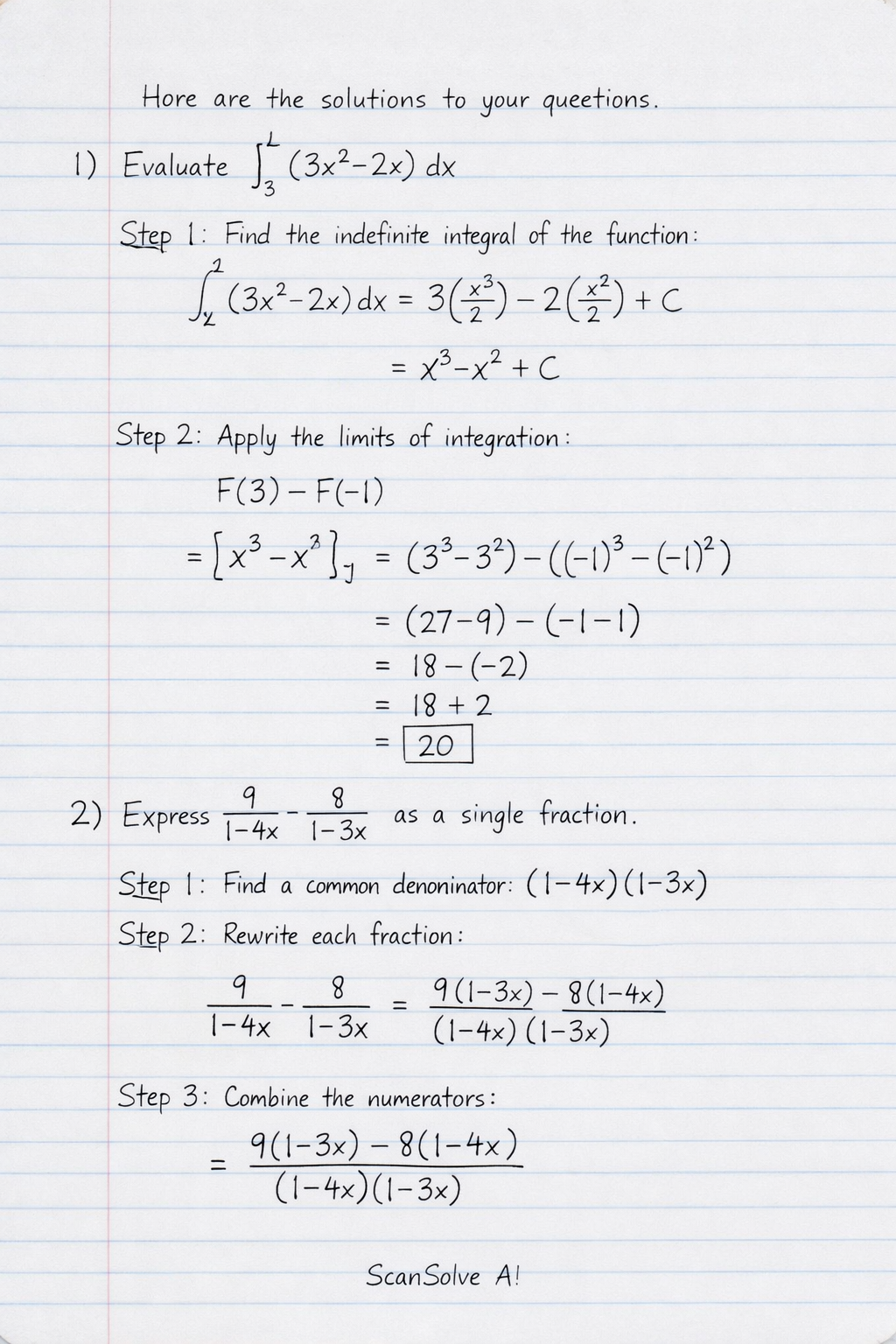
Handwritten Step-by-Step Solution
Get this as a handwritten image on WhatsApp — like a tutor wrote it for you.
Try on WhatsApp