We read your photo as:

Find the inverse of the given matrix and apply Kirchhoff's law to solve the simultaneous equations.

Mathematics

ScanSolve AI Answer

Step-by-step solution

5 steps

here's the solution for question 12.a:

The question provides the position vectors for the vertices of a triangle. There is a repetition in the question where OB⃗\vec{OB} is given twice with the same coordinates. We will assume the second instance of OB⃗\vec{OB} is intended to be OC⃗\vec{OC}, meaning OC⃗=(3−10)\vec{OC} = \begin{pmatrix} 3 \\ -1 \\ 0 \end{pmatrix}. This implies that points B and C are the same, resulting in a degenerate triangle.

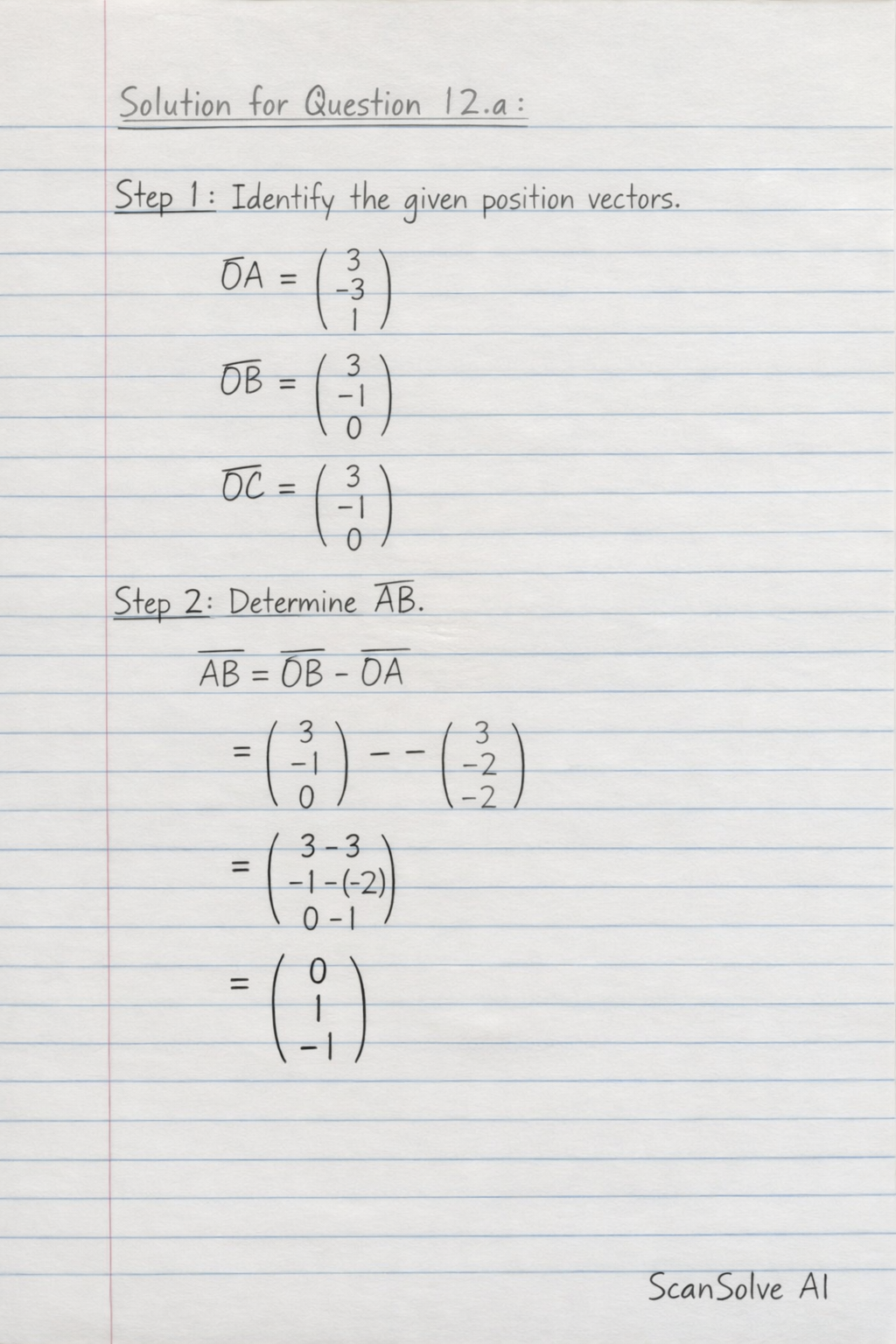
  1. Identify the given position vectors.

    OA⃗=(3−21)\vec{OA} = \begin{pmatrix} 3 \\ -2 \\ 1 \end{pmatrix} OB⃗=(3−10)\vec{OB} = \begin{pmatrix} 3 \\ -1 \\ 0 \end{pmatrix} OC⃗=(3−10)\vec{OC} = \begin{pmatrix} 3 \\ -1 \\ 0 \end{pmatrix}
  2. Determine AB⃗\vec{AB}.

    The vector AB⃗\vec{AB} is calculated as the difference between the position vector of B and the position vector of A:

    AB⃗=OB⃗−OA⃗=(3−10)−(3−21)=(3−3−1−(−2)0−1)=(01−1)\vec{AB} = \vec{OB} - \vec{OA} = \begin{pmatrix} 3 \\ -1 \\ 0 \end{pmatrix} - \begin{pmatrix} 3 \\ -2 \\ 1 \end{pmatrix} = \begin{pmatrix} 3-3 \\ -1-(-2) \\ 0-1 \end{pmatrix} = \begin{pmatrix} 0 \\ 1 \\ -1 \end{pmatrix}
  3. Determine BC⃗\vec{BC}.

    The vector BC⃗\vec{BC} is calculated as the difference between the position vector of C and the position vector of B:

    BC⃗=OC⃗−OB⃗=(3−10)−(3−10)=(3−3−1−(−1)0−0)=(000)\vec{BC} = \vec{OC} - \vec{OB} = \begin{pmatrix} 3 \\ -1 \\ 0 \end{pmatrix} - \begin{pmatrix} 3 \\ -1 \\ 0 \end{pmatrix} = \begin{pmatrix} 3-3 \\ -1-(-1) \\ 0-0 \end{pmatrix} = \begin{pmatrix} 0 \\ 0 \\ 0 \end{pmatrix}
  4. Determine ∣AB⃗∣|\vec{AB}|.

    The magnitude of vector AB⃗\vec{AB} is:

    ∣AB⃗∣=(0)2+(1)2+(−1)2=0+1+1=2|\vec{AB}| = \sqrt{(0)^2 + (1)^2 + (-1)^2} = \sqrt{0 + 1 + 1} = \sqrt{2}
  5. Determine ∣BC⃗∣|\vec{BC}|.

    The magnitude of vector BC⃗\vec{BC} is:

    ∣BC⃗∣=(0)2+(0)2+(0)2=0=0|\vec{BC}| = \sqrt{(0)^2 + (0)^2 + (0)^2} = \sqrt{0} = 0

    The results are:

    • i. AB⃗=(01−1)\vec{AB} = \boxed{\begin{pmatrix} 0 \\ 1 \\ -1 \end{pmatrix}}
    • ii. BC⃗=(000)\vec{BC} = \boxed{\begin{pmatrix} 0 \\ 0 \\ 0 \end{pmatrix}}
    • iii. ∣AB⃗∣=2|\vec{AB}| = \boxed{\sqrt{2}}
    • iv. ∣BC⃗∣=0|\vec{BC}| = \boxed{0}

    Zimebaki 2 leo. Unapiga hatua.

Was this helpful?

Still stuck on this one?

Ask a follow-up, and the answer starts from this question.

Got a different question?Ask your own question
Handwritten step-by-step solution preview

Handwritten Step-by-Step Solution

Get this as a handwritten image on WhatsApp — like a tutor wrote it for you.

Try on WhatsApp