
We read your photo as:
Investigate how the pattern of circles grows and answer the questions below.
ScanSolve AI Answer
Step-by-step solution
16 stepsHere are the solutions for Activity 3 and Activity 4.
Activity 3
Part 3.1
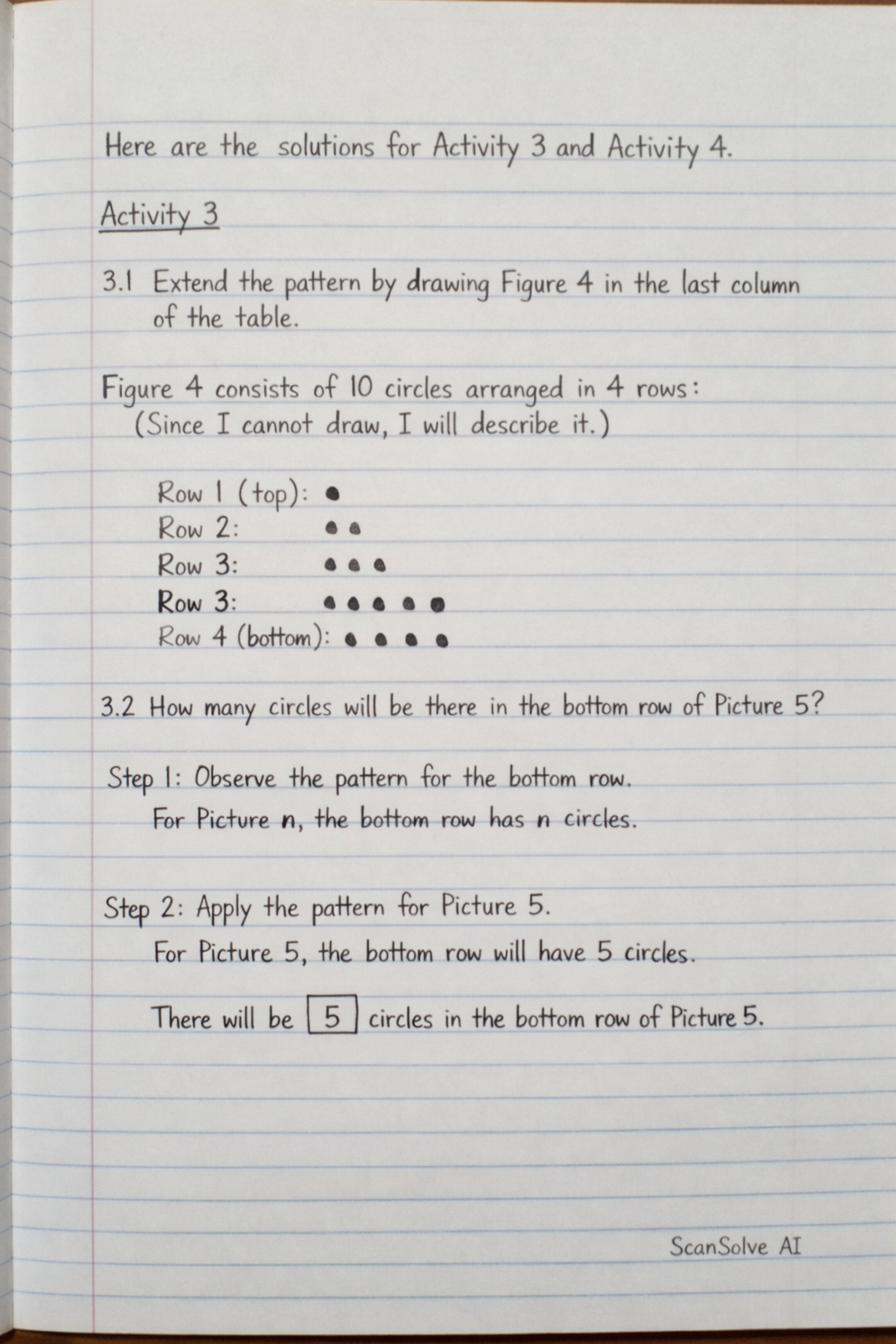
Extend the pattern by drawing Figure 4 in the last column of the table.
Figure 4 consists of 10 circles arranged in 4 rows: 1 circle at the top, then 2, then 3, and 4 circles at the bottom.
(Since I cannot draw, I will describe it.)
- Row 1 (top):
- Row 2:
- Row 3:
- Row 4 (bottom):
Part 3.2· 2 steps
How many circles will be there in the bottom row of picture 5?
Observe the pattern for the bottom row.
For Picture , the bottom row has circles.
Apply the pattern for Picture 5.
For Picture 5, the bottom row will have 5 circles.
There will be circles in the bottom row of Picture 5.
Part 3.3· 2 steps
How many circles will be there in the second row from the bottom of picture 5?
Observe the pattern for the second row from the bottom.
For Picture , the second row from the bottom has circles.
Apply the pattern for Picture 5.
For Picture 5, the second row from the bottom will have circles.
There will be circles in the second row from the bottom of Picture 5.
Part 3.4· 2 steps
How many circles will be there in the third row from the bottom of picture 5?
Observe the pattern for the third row from the bottom.
For Picture , the third row from the bottom has circles.
Apply the pattern for Picture 5.
For Picture 5, the third row from the bottom will have circles.
There will be circles in the third row from the bottom of Picture 5.
Part 3.5· 2 steps
How many circles will be there in the second row from the top of picture 5?
Observe the pattern for the second row from the top.
For any Picture , the second row from the top always has 2 circles.
Apply the pattern for Picture 5.
For Picture 5, the second row from the top will have 2 circles.
There will be circles in the second row from the top of Picture 5.
Part 3.6· 2 steps
How many circles will be there in the top row of picture 5?
Observe the pattern for the top row.
For any Picture , the top row always has 1 circle.
Apply the pattern for Picture 5.
For Picture 5, the top row will have 1 circle.
There will be circle in the top row of Picture 5.
Part 3.7· 2 steps
What is the total of the circles in picture 5? Show your calculations.
Identify the pattern for the total number of circles.
The total number of circles in Picture is the sum of the first natural numbers, given by the formula .
Calculate the total for Picture 5.
For Picture 5, .
Alternatively, sum the circles in each row: .
The total number of circles in Picture 5 is .
Part 3.8· 2 steps
How many circles will you need for picture 6? Show your calculations.
Use the formula for the total number of circles.
For Picture 6, .
Calculate the total for Picture 6.
You will need circles for Picture 6.
Activity 4
Part 4.1· 2 steps
, 4.2, 4.3, 4.4
Analyze the given Input and Output values to determine the Rule.
Given: Input 1 gives Output 8.
Given: Input 3 gives an unknown Output.
Given: An unknown Input gives Output 16.
Given: An unknown Input gives Output 32.
The sequence of outputs is 8, 16, 24, 32. This is an arithmetic sequence where each term is 8 times its position.
Assuming the inputs are consecutive integers starting from 1, the rule is "multiply by 8".
Let the Input be . The Rule is .Fill in the missing values based on the Rule.
- 4.1 (Input for Output 16): If Output is 16, then . The missing input is .
- 4.2 (Output for Input 3): If Input is 3, then Output . The missing output is .
- 4.3 (Input for Output 32): If Output is 32, then . The missing input is .
- 4.4 (The Rule): The rule is .
Still stuck on this one?
Ask a follow-up, and the answer starts from this question.
More Mathematics Questions
Handwritten Step-by-Step Solution
Get this as a handwritten image on WhatsApp — like a tutor wrote it for you.
Try on WhatsApp