
We read your photo as:
Is the angle formed by MH and MJ acute, obtuse, or straight?
ScanSolve AI Answer
Step-by-step solution
6 stepsHere are the answers based on the provided image:
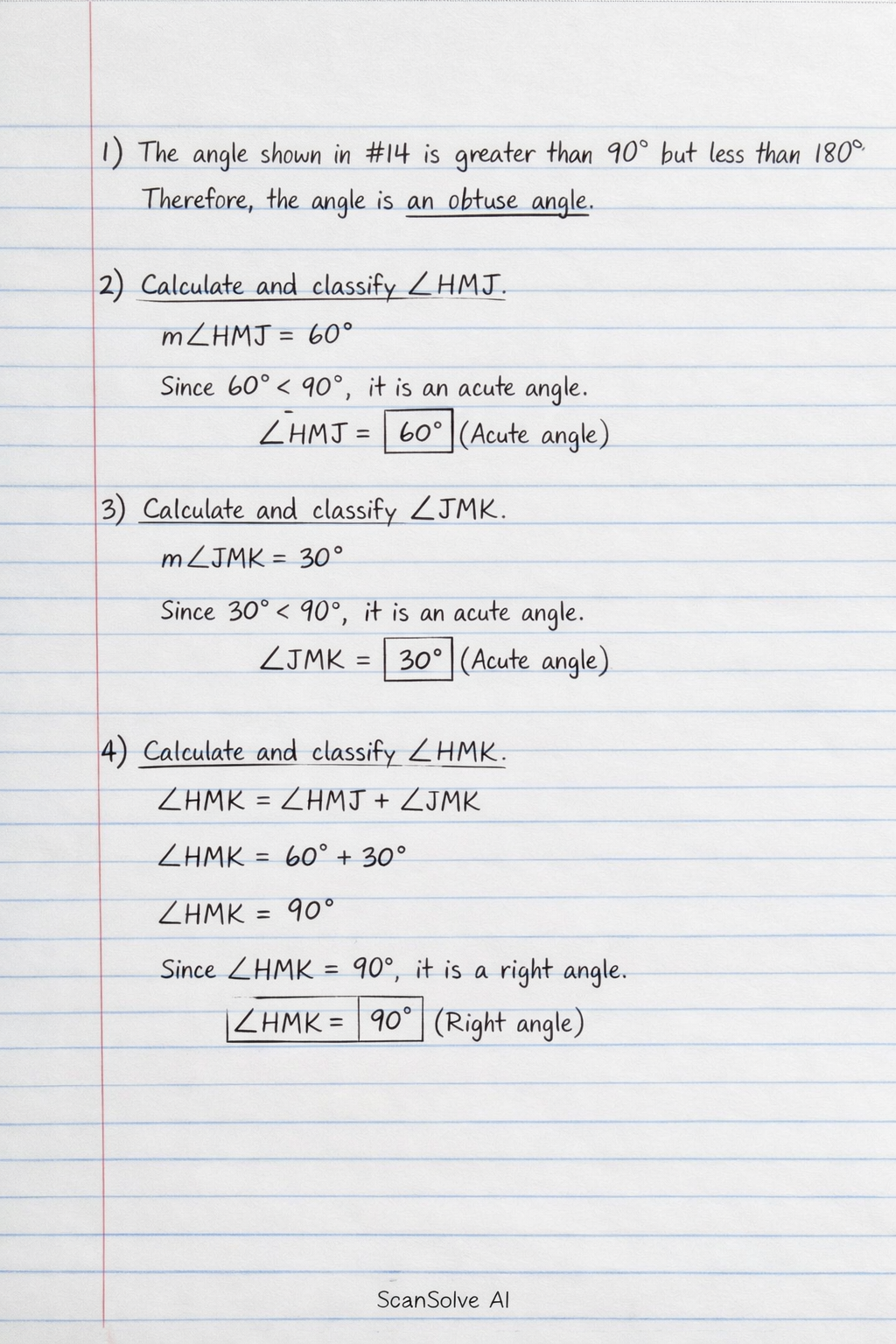
Classify the angle for question 14.
The angle shown next to "14." is visually larger than but less than . 14. The angle shown is an obtuse angle.
Calculate and classify .
From the diagram, the measure of is given as .
Since , it is an acute angle.
(Acute angle)Calculate and classify .
From the diagram, the measure of is given as .
Since , it is an acute angle.
(Acute angle)Calculate and classify .
is the sum of and .
Since , it is a right angle.
(Right angle)Calculate and classify .
Let L be the point on the leftmost ray. is the sum of and .
Since , it is an obtuse angle.
(Obtuse angle)Calculate and classify .
Let L be the point on the leftmost ray and N be the point on the rightmost ray. is the sum of all angles along the straight line.
Since , it is a straight angle.
(Straight angle)
Still stuck on this one?
Ask a follow-up, and the answer starts from this question.
More Mathematics Questions
Handwritten Step-by-Step Solution
Get this as a handwritten image on WhatsApp — like a tutor wrote it for you.
Try on WhatsApp